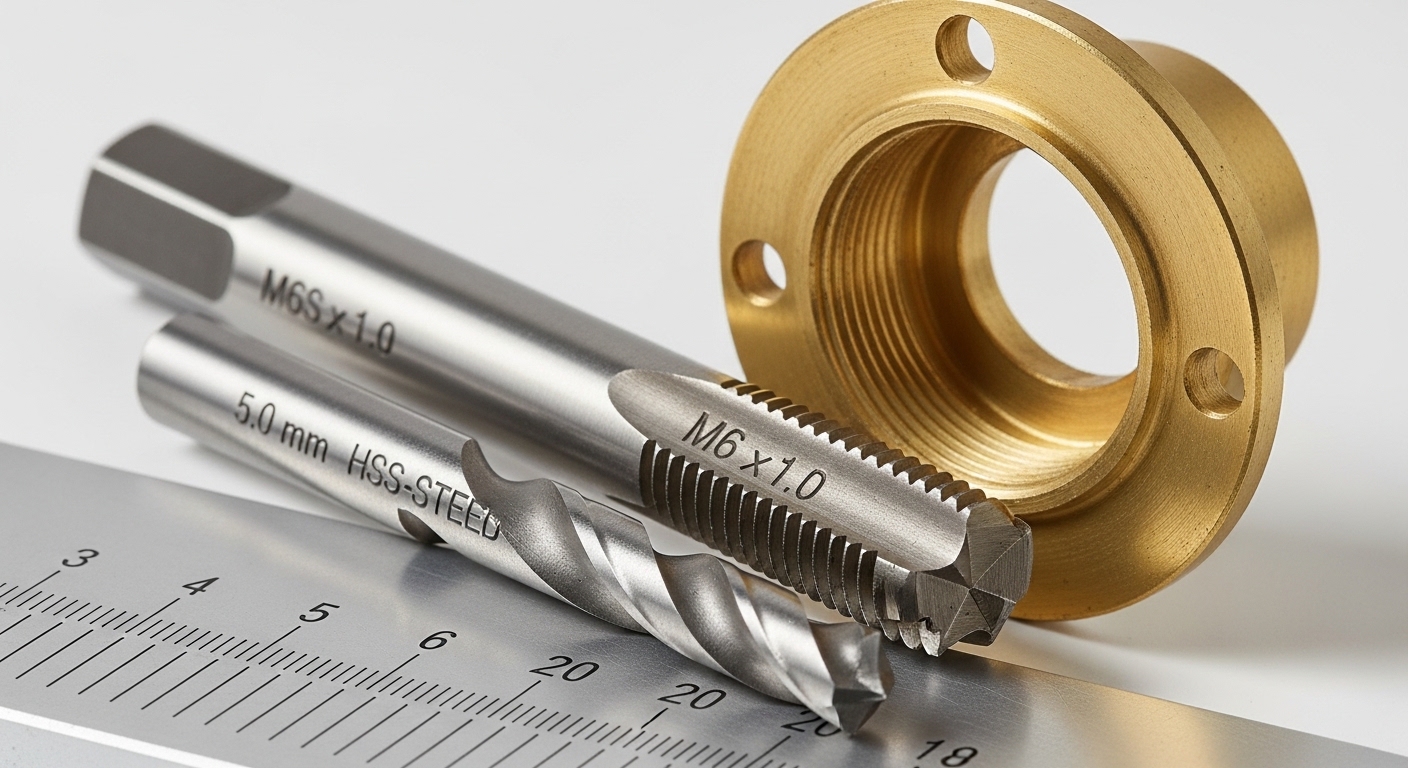
The short version: the m6 tap hole size in mm depends on the pitch you’re cutting. Most faucet mounting hardware, shower-arm clips, and bathroom-fixture brackets use the standard M6 × 1.0 coarse thread, which calls for a 5.0 mm tap drill. That single number — 5.0 mm — solves about 90% of the situations a homeowner or installer runs into when fitting a tap, a vanity-mounted accessory, or a brass mounting plate. The other 10% involves fine threads, repair inserts, or thin-wall brass castings where a slightly larger hole protects the part. Below is exactly how to pick the right size, the right drill, and the right technique so the thread bites cleanly the first time.
What size hole do I drill for an M6 tap in millimeters?
Drill a 5.0 mm hole for an M6 × 1.0 coarse tap. That is the answer for the thread you’ll meet on virtually every modern faucet base, shower-arm escutcheon screw, toilet-tank bolt, and bathroom-accessory bracket made to ISO metric standards. The math is simple: tap drill = nominal diameter − pitch, so 6 mm − 1 mm = 5 mm. Anything smaller than 5.0 mm forces the tap to cut too much material and snap; anything larger than 5.2 mm leaves a sloppy thread that strips under finger-tight torque.
If your fastener is a fine M6, the math shifts. M6 × 0.75 needs a 5.25 mm hole (round down to 5.2 mm with standard bit sets), and the rarer M6 × 0.5 wants 5.5 mm. Fine pitches are common on European-spec brass fittings, German-made shower valves, and replacement aerators where extra engagement is needed in a thin wall.
Why does M6 show up so often on faucets and bathroom fixtures?
M6 is the workhorse thread of the plumbing world because it hits the sweet spot between strength and footprint. A 6 mm bolt clamps a typical brass faucet body to a 1.5–2 mm stainless sink deck with about 8–10 N·m of torque — plenty for a watertight seal without crushing the gasket. Going smaller (M5) risks shearing the bolt during installation; going larger (M8) eats valuable real estate inside a slim faucet shank.
You will see M6 in these specific places on a modern bathroom or kitchen fixture:
- Faucet mounting studs and lock nuts — the threaded rods that pass through the sink deck and pull the faucet down onto the gasket.
- Widespread faucet tie bars — the cross-member that ties hot and cold valves together under the counter.
- Handle set screws on lever faucets — though many brands use M4, the heavier commercial-style levers step up to M6.
- Wall-mount shower arm escutcheons — the small grub screws that lock the trim ring against the wall.
- Towel bar, robe hook, and shelf anchors — brass-plated brackets almost always use M6 grub screws to lock onto the post.
- Toilet seat hinge bolts and bidet attachment plates — almost universally M6 × 1.0 in Asian and European market models.
If you’ve ever had a Pfister handle wobble loose on you, the culprit is usually a stripped M4 or M6 set screw — and the fix often involves chasing or re-cutting the thread. Our walkthrough on why a Pfister kitchen faucet handle goes loose and how to tighten it covers the exact set-screw geometry you’ll run into.
What’s the difference between M6 coarse, fine, and extra-fine for plumbing applications?
The difference is pitch — the distance between thread crests — and it changes both the drill size and how the bolt behaves in service. Coarse threads are forgiving and fast to install. Fine threads grip harder, resist vibration loosening, and are mandatory in thin-wall brass where coarse threads would simply tear out.
Here is the comparison you need at the bench:
| Thread Designation | Pitch (mm) | Tap Drill Size (mm) | Imperial Equivalent Drill | Typical Faucet/Fixture Use | Recommended Torque |
|---|---|---|---|---|---|
| M6 × 1.0 (coarse) | 1.00 | 5.0 mm | #9 (4.98 mm) or 13/64″ | Faucet mounting studs, deck nuts, towel bars | 8–10 N·m |
| M6 × 0.75 (fine) | 0.75 | 5.2 mm | #5 (5.22 mm) | European shower valves, thin-wall brass aerators | 9–11 N·m |
| M6 × 0.5 (extra-fine) | 0.50 | 5.5 mm | 7/32″ (5.56 mm) | Precision instrumentation, optical sensors (rare in plumbing) | 6–8 N·m |
| M6 × 1.0 with Helicoil insert | 1.00 | 6.3 mm (STI drill) | Letter F (6.35 mm) | Stripped-thread repair on faucet bodies | 8–10 N·m |
Most homeowners only ever need the first row of that table. Cabinet installers, restoration plumbers, and anyone repairing a vintage brass fitting will dip into the rest.
How do I drill and tap an M6 hole without cracking brass or stainless?
Use a sharp HSS or cobalt 5.0 mm bit, keep the speed under 800 RPM in brass and under 400 RPM in stainless, and apply cutting oil every couple of turns. Brass is soft but it will grab and shatter the drill if you push too hard; stainless work-hardens if you hesitate, so commit to steady pressure once you start.
The clean sequence looks like this:
- Center-punch first. A 5.0 mm bit will skate across polished brass if there’s no dimple to start in. Use a spring-loaded automatic punch — not a hammer punch — on a finished faucet body so you don’t dent the chrome.
- Pilot at 2.5 mm. A pilot hole keeps the 5.0 mm bit on axis and roughly halves the cutting load. Skip this only on parts thinner than 3 mm.
- Drill 5.0 mm straight through. Keep the drill perpendicular — a 2° tilt at the start becomes a noticeably off-axis hole by the time you exit the back side, and the tap will follow that crookedness.
- Deburr both sides. A countersink bit or even a larger drill spun by hand for one turn clears the lip that would otherwise catch the tap’s lead.
- Start the tap by hand. Use a T-handle, not a wrench. The first three turns determine whether the thread is square. Back off a half turn for every full turn forward to break the chip.
- Lubricate with the right cutting fluid. Brass: light machine oil or kerosene. Stainless: sulfurized tapping fluid. Never tap dry — chips weld to the cutting edges and you’ll snap the tap.
- Test with the actual bolt. The finished thread should accept the bolt finger-tight all the way through. If it stops short, run the tap in another quarter turn to clear the chips, then test again.
One more critical detail: avoid tapping into a blind hole on a thin-wall faucet body. A blind tap that bottoms out can split the casting from the inside, and that crack will weep water months later under line pressure. When in doubt, drill all the way through and use a longer bolt with a back nut, the same approach used on quality widespread vanity faucets. If you’re planning a new install on a non-standard sink, our buyer’s guide to making a widespread faucet work on a 4-inch sink shows exactly how the mounting hardware is sized around M6 threads.
Can I use a 5/32″ drill instead of a 5 mm bit for M6 in a pinch?
Yes, but reluctantly — 5/32″ measures 3.97 mm, which is a full millimeter undersized for M6 × 1.0 and will almost certainly snap your tap. What you actually want is a #9 (4.98 mm) or a 13/64″ (5.16 mm) bit if you’re stuck working in inch sizes. Of those two, the #9 is essentially perfect; the 13/64″ gives you a slightly looser thread that’s fine for non-structural fixture mounting.
Here’s the practical conversion most contractors keep on a sticker on their drill index:
- M6 × 1.0 ideal: 5.0 mm metric, #9 imperial, or 13/64″ as a tolerable substitute.
- M6 × 0.75 ideal: 5.2 mm metric, #5 imperial.
- Never substitute: 1/4″ (6.35 mm) is way too big and 3/16″ (4.76 mm) is way too small. Either size will ruin the work.
If your bit drawer is mixed metric and imperial — most American workshops are — buy a single 5.0 mm cobalt bit and dedicate it to plumbing tap work. It costs about $4 and lasts through hundreds of brass holes.
What’s the right way to repair a stripped M6 thread on a faucet base?
Drill the damaged hole out to 6.3 mm, tap it with an M6 STI (Screw Thread Insert) tap, and install a stainless Helicoil or Time-Sert insert. The repair restores the original M6 × 1.0 thread without changing the bolt you use, and the stainless insert is actually stronger than the original brass casting — so it won’t strip again.
The reason stripped M6 threads are so common on faucets comes down to material and torque. Most decorative brass castings are around 58–62% copper with the rest zinc and lead — soft, easy to machine, but unforgiving if you over-torque a mounting bolt. A homeowner with a regular adjustable wrench can easily push 20 N·m onto a fitting rated for 8 N·m, and the thread peels out of the brass long before the bolt yields.
The fix sequence:
- Confirm the stripped thread is actually M6 × 1.0 by trying a known-good M6 bolt — it will spin freely with no engagement.
- Drill out the damaged hole to 6.3 mm (the STI drill size for M6).
- Tap with an M6 STI tap — this cuts a larger thread sized specifically to accept the insert.
- Thread the Helicoil onto its installation mandrel, screw it into the new tapped hole until the top coil sits 1/4 to 1/2 turn below the surface.
- Break off the tang at the bottom of the insert with a punch.
- Reinstall the original M6 bolt at the correct torque (8–10 N·m for most faucet mounting hardware).
This same technique saves vintage tub fillers, antique widespread sets, and high-end imported shower valves from the scrap bin. If you’ve got a slow leak from a thread joint rather than from a fastener hole, the underlying cause is often a damaged cartridge — and our guide on diagnosing a leaking shower faucet valve and picking the right replacement walks through the difference between thread damage and cartridge wear.
Does the M6 hole size change with brass, stainless, or zinc-alloy fixtures?
The drill size stays at 5.0 mm for M6 × 1.0 regardless of material, but the technique changes. Brass cuts fast and clean; stainless cuts slow and needs aggressive lubrication; zinc die-cast (sometimes labeled “zamak”) is brittle and demands a slower feed to avoid chipping out the thread.
What does change with material is the maximum safe torque on the finished thread. A 5.0 mm hole tapped M6 × 1.0 will hold:
- 360 brass: up to 10 N·m before the thread strips.
- 304 stainless: up to 14 N·m — the strongest of the three.
- Zinc alloy / zamak: only 5–6 N·m before the thread crumbles.
That zinc number is why budget faucets feel “loose” within a year of installation — the M6 mounting threads simply can’t hold the bolts under cyclic vibration. Brand quality matters here: at Avamani we spec solid forged brass on all load-bearing thread points, tested to ASME A112.18.1 / CSA B125.1, and backed by a limited lifetime warranty on the body casting. You can see that material spec in action on a piece like our Elate widespread vanity faucet, where every mounting thread is cut directly into solid brass rather than into a zinc base plate.
How accurate does my 5.0 mm hole really need to be?
Aim for within ±0.05 mm of 5.0 mm. ISO 261 — the international standard for metric threads — defines a tap drill tolerance band of roughly 4.95 mm to 5.10 mm for M6 × 1.0. Inside that window, the bolt threads in cleanly and the joint holds its rated torque. Outside it, you either snap the tap (hole too small) or get a sloppy, leaky thread (hole too large).
If you don’t own a digital caliper, the practical check is simpler: drill the hole, try to push an M6 bolt through it. The bolt should drop in by gravity but not rattle side-to-side. If the bolt wedges, you’re undersized. If it tilts visibly, you’re oversized — go to a Helicoil repair before tapping. This same tolerance band applies to most brass fixture installation work and it’s the standard our QA team uses before any product ships from the Avamani factory.
FAQ
Is the M6 tap hole size always 5 mm?
For the standard coarse M6 × 1.0 thread, yes — 5.0 mm is correct. For fine M6 × 0.75 it changes to 5.2 mm, and for extra-fine M6 × 0.5 it goes to 5.5 mm. Always confirm the pitch stamped on the bolt or the fixture spec sheet before you drill, because using the wrong pitch tap in a 5.0 mm hole will either jam or strip.
What happens if I drill the hole at 5.1 mm or 4.9 mm instead?
At 5.1 mm the thread will still cut, but engagement drops to about 70% — fine for light-duty fixture brackets, not great for structural mounting. At 4.9 mm the tap has to remove an extra 0.1 mm of material per side, which doubles the cutting load and dramatically raises the risk of snapping the tap inside the hole. A broken tap in a finished brass faucet body is one of the hardest plumbing repairs there is, so err on the larger side if you’re guessing.
Can I tap an M6 thread by hand or do I need a machine?
Hand tapping is the right approach for any faucet or bathroom-fixture work. A T-handle tap wrench gives you the feel you need to back off when chips bind, which is impossible to detect with a power drill. Machine tapping is faster but it’s how most beginners snap taps. Hand tap, back off half a turn for every full turn forward, and use cutting fluid.
What’s the difference between M6 and 1/4-20?
M6 is metric — 6 mm nominal diameter, 1.0 mm pitch — while 1/4-20 is imperial at 6.35 mm diameter and 1.27 mm pitch. They look similar and you can sometimes force a 1/4-20 bolt into an M6 nut, but the threads will gall and the joint will fail under load. American-brand faucets often use 1/4-20; European, Asian, and most modern global brands use M6. Always match the spec — never mix.
Do I need a special tap for stainless steel sinks?
Use a cobalt or TiN-coated HSS tap rated for stainless. Standard carbon-steel taps will dull and seize in 304 or 316 stainless within a handful of holes. Combined with sulfurized cutting fluid and a feed rate of about a quarter turn per second, a cobalt tap will give you clean threads for hundreds of installations.
Can the same M6 size be used for outdoor or hose-connection fittings?
M6 is generally too small for hose-pressure plumbing — outdoor sillcocks and hose bibs use G1/2″ or 3/4-14 NPT threads on the supply side. M6 still shows up on the mounting flanges and bracket hardware of outdoor fixtures. For push-to-connect outdoor work where you might wonder about thread sizing on accessories, our commercial guide to SharkBite outdoor faucets and hose bibs covers the main pipe threads and the small M-series fasteners on the same fitting.
How deep does the M6 tapped hole need to be?
Plan on 1.5× the bolt diameter of full thread engagement — so about 9 mm of usable thread for an M6 bolt in brass, and 6 mm in stainless. Tap deeper than that if you can; the extra depth doesn’t add strength but it gives you margin if the lead threads ever wear. For blind holes, drill an additional 3 mm beyond your thread depth so chips have somewhere to collect.
What torque should I use on an M6 faucet mounting bolt?
8–10 N·m (about 6–7 ft-lb) for an M6 × 1.0 bolt in brass. That’s roughly the torque you can apply with a 4-inch hex key using two fingers. If you need a longer wrench or both hands, you’re overtightening, and you’re going to strip the thread or crack the casting. A small torque wrench in the 2–20 N·m range is one of the best $40 investments any DIY plumber can make.
About the Author and the Avamani Standard
This guide was written by the Avamani product engineering team, drawing on more than a decade of in-house faucet manufacturing experience and bench testing under ASME A112.18.1, CSA B125.1, and EN 200 standards. Every M6-threaded mounting feature on an Avamani faucet is cut from solid forged brass — never zinc alloy — verified by go/no-go thread gauges at three points during production, and backed by our limited lifetime warranty on the body casting. If you’re picking out fixtures for a renovation, the spec sheets at avamani.com list the exact thread sizes, mounting hardware, and recommended torque values for every product, so you’ll know before you order whether your sink deck, drill bits, and tap set are compatible.