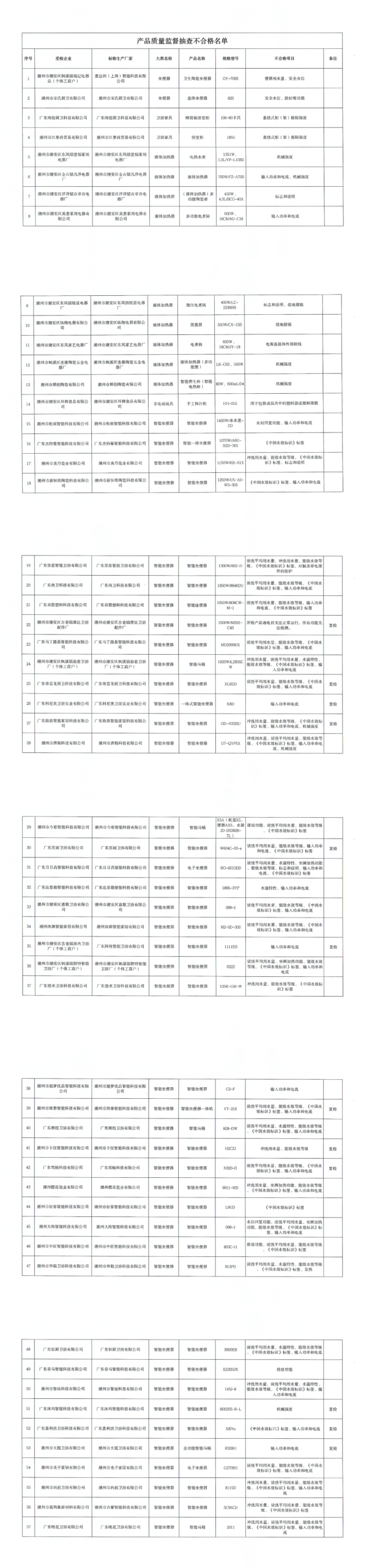
On June 22, the Chaozhou Municipal Market Supervision Administration released the results of its 2025 quality supervision spot checks on 11 types of products, including liquid heaters. A total of 57 batches of substandard products were found (see the end of this article), including 43 batches of smart toilets. The substandard items included “input power and current” and “protection against access to live parts,” which are all related to safety in use. In addition, several batches of smart toilets were also found to have substandard water efficiency labels.
43 batches of smart toilets fail inspection
According to the notice, this spot check found 43 batches of substandard smart toilets. The nominal manufacturers of the substandard products were mainly Chaozhou enterprises, including brands that are relatively well-known within the industry or locally. Products from several enterprises still failed after re-inspection.
The substandard items for smart toilets found in this spot check included: “China Water Efficiency Label” tag, energy and water efficiency ratings, input power and current, average water consumption for cleaning, flushing water consumption, water temperature characteristics, seat ring heating function, mechanical strength, discharge function, water seal restoration function, marking and instructions, heating, and protection against access to live parts.
In addition to smart toilets, this spot check also found 9 batches of liquid heaters, 2 batches of sanitary ceramics (toilets), 2 batches of bathroom furniture, and 1 batch of non-electric toys to be substandard. Among them, the substandard items for sanitary ceramics (toilets) were safe water level, anti-siphon function, and toilet water consumption, while the substandard item for bathroom furniture was the ultimate strength of wall-mounted cabinets (racks).
32 batches of substandard items involve electrical safety
Focusing on smart toilets, among the 43 batches of substandard products found in this spot check, 31 batches had substandard items involving “input power and current.”
It is understood that when the input power and current of a smart toilet exceed the rated values, the risk of electric leakage and electric shock increases dramatically. During use, high temperatures can damage the internal insulation, and once water vapor comes into contact with live parts, the leakage current surges; when flushing and spraying water, the water flow may become conductive, and there is a fatal risk of electric shock if the human body touches the metal casing of the toilet. In addition, power and current exceeding the rated values can also bring risks such as overheating of the toilet’s internal circuits, burnout of heating elements, failure of protective devices, and fire.
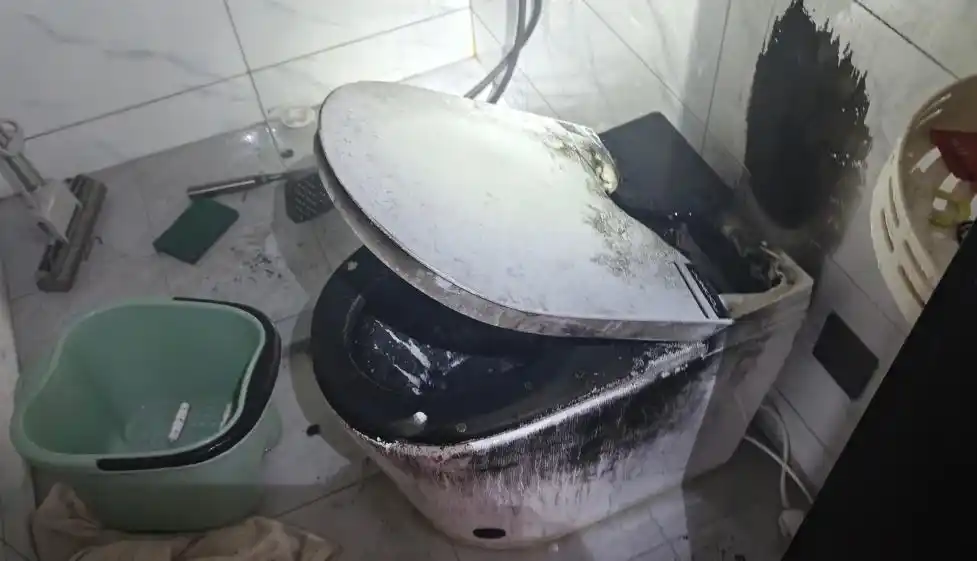
File photo
On the other hand, when the input power and current of a smart toilet are lower than the rated values, the user experience can be greatly reduced, including slow heating of the seat ring, cold water instead of warm water, and weak warm-air drying; insufficient water pressure from the flushing pump, greatly reduced cleaning effectiveness, and the inability to enable multiple functions simultaneously. In addition, insufficient current supply can also cause voltage fluctuations on the main board, malfunctioning chips and sensors, and faults such as automatic random flushing, heating without reason, and remote control failure.
In addition to “input power and current,” this inspection also detected 1 batch of smart toilets with substandard “protection against access to live parts.” This is also an important indicator of whether an electrical appliance is safe; users touching these parts during use can result in electric shock accidents.
33 batches of products have substandard water efficiency labels
In addition to electrical safety, this spot check also found 33 batches of smart toilets with substandard “China Water Efficiency Label” tags.
The “Measures for the Administration of Water Efficiency Labels” have been in effect since March 1, 2018. According to the “Catalogue of Products Subject to Water Efficiency Labels of the People’s Republic of China (2025 Edition)” issued on December 19, 2025, the products included are toilets, smart toilets, dishwashers, showers, water purifiers, and faucets.
Article 8 of the “Measures for the Administration of Water Efficiency Labels” stipulates that any product listed in the “Catalogue of Products Subject to Water Efficiency Labels of the People’s Republic of China” shall bear a water efficiency label in a conspicuous location on the product or the product’s minimum packaging, and this shall be explained in the product’s instruction manual. For online transactions, sellers shall display the corresponding water efficiency label in a prominent position on the main page displaying product information.
Regarding penalties, Article 27 of the “Measures for the Administration of Water Efficiency Labels” stipulates that, in violation of the provisions of these Measures, if a producer or importer fails to file the water efficiency label, or fails to complete the change procedures when they should be completed, a notice shall be issued; in any of the following circumstances, a notice shall be issued and a fine of not less than 10,000 yuan and not more than 30,000 yuan shall be imposed: (1) failing to bear a water efficiency label when one should be borne; (2) using a water efficiency label that does not comply with regulations; (3) forging or fraudulently using a water efficiency label.
Appendix: List of products that failed the product quality supervision spot check (click to enlarge)
Originally published in WeChat by Chu Wei Tou Tiao on 2026-07-03. Translated and edited for English-language readers.