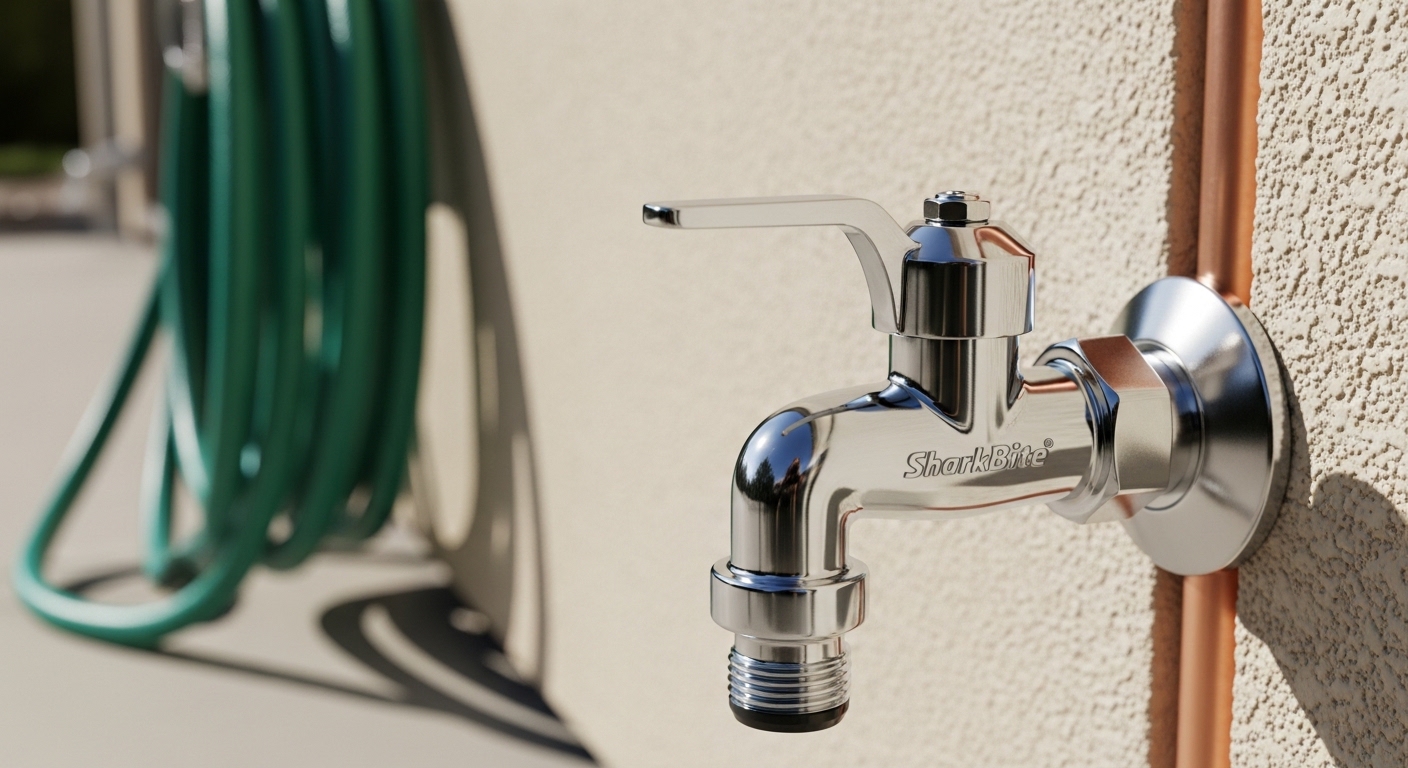
If you manage multifamily housing, light commercial properties, or a hospitality portfolio, the words “outdoor faucet SharkBite” probably show up in your maintenance work orders more than you’d like to admit. A burst hose bib in February or a leaking sillcock on a Saturday afternoon is exactly the kind of call where a push-to-connect repair earns its keep. At Avamani, we’ve spent years specifying fixtures for property teams that need durability, code-compliant performance, and fast turnaround, and SharkBite-compatible outdoor faucets sit at the intersection of all three. This commercial-focused buyer’s guide walks through what to look for, which configurations work for which buildings, and how to assemble a parts kit your techs will actually thank you for.
Why Outdoor Faucet SharkBite Fittings Have Become the Commercial Standard
Twenty years ago, replacing a frost-free sillcock meant cutting copper, sweating joints, and praying the pilot light didn’t catch a drip. SharkBite changed that calculus. The push-to-connect (PTC) fitting uses a stainless steel grab ring and an EPDM O-ring inside a brass body to create a watertight seal on copper, PEX, or CPVC — all without heat, glue, or crimping. For commercial buyers, that translates into three things: faster repair tickets, lower labor cost per unit, and dramatically reduced fire-watch overhead in occupied buildings.
Outdoor faucets — also called hose bibs, sillcocks, wall hydrants, or spigots depending on the region — are among the highest-failure fixtures in any building envelope. They freeze, they corrode, they get yanked sideways by lawn crews, and they’re often installed in tight rim-joist cavities where torch work is risky. A SharkBite-compatible outdoor faucet lets a single technician swap out a failed unit in under fifteen minutes, even inside a finished basement or behind drywall, without isolating large sections of the building’s water supply.
The Commercial Case for Push-to-Connect Outdoor Faucets
For a property manager spec’ing a hundred-unit refurbishment, the math is straightforward. A traditional soldered sillcock install runs roughly 45–60 minutes per unit when you account for torch setup, fire-watch protocol, and post-install pressure testing. A SharkBite-compatible outdoor faucet drops that to 15–20 minutes per unit, and the fitting itself is reusable if you ever need to rotate the spigot or service the valve. Across a portfolio, the labor savings dwarf the modest premium on the fitting body.
Anatomy of an Outdoor Faucet SharkBite Assembly
Before you order in volume, it helps to understand what’s actually inside a SharkBite-compatible outdoor faucet. There are typically three working sections: the inlet (where the push-to-connect joint meets the building supply line), the valve body (a compression or ceramic disc stem on most modern designs), and the outlet spout with a standard ¾-inch male hose thread. Frost-free models add a long stem that pushes the shut-off point back inside the heated building envelope, while anti-siphon versions integrate a vacuum breaker on the spout to prevent backflow contamination — a code requirement in most U.S. jurisdictions.
The push-to-connect inlet is usually offered in ½-inch or ¾-inch nominal sizing to match the building’s existing supply. SharkBite’s brass alloy is lead-free and certified to NSF/ANSI 61 and 372 for potable water, which matters for commercial buyers serving food service tenants, daycare operators, or any property covered by the Reduction of Lead in Drinking Water Act.
Frost-Free vs. Standard: Choosing for Your Climate Zone
If your buildings sit anywhere north of the Mason-Dixon line, frost-free is non-negotiable. A frost-free sillcock — sometimes called a freezeless hydrant — uses a long valve stem (typically 6, 8, 10, or 12 inches) that closes water flow inside the heated wall cavity. When the handle shuts off, water in the exposed portion of the spout drains out by gravity, leaving nothing to freeze and burst. Pair that with a SharkBite push-to-connect inlet, and you’ve got the fastest-to-install freeze-resistant outdoor faucet on the market.
The catch: the sillcock must be installed with a slight downward pitch toward the spout for proper drainage, and any garden hose left attached over the winter defeats the entire mechanism by trapping water in the stem. Include “disconnect hoses before first freeze” in your seasonal maintenance checklist — it’s the single cheapest insurance policy you’ll ever buy.
Comparison: Outdoor Faucet SharkBite Configurations for Commercial Use
Below is a side-by-side comparison of the four most common outdoor faucet configurations we spec for commercial accounts. Pricing reflects typical 2026 contractor-tier bulk costs; your jobber pricing may vary.
| Configuration | Best For | Inlet Size | Stem Length | Anti-Siphon | Approx. Bulk Cost |
|---|---|---|---|---|---|
| Standard Hose Bib w/ SharkBite Inlet | Warm climates, garages, mild-winter regions | ½” PTC | 2–3″ | Yes (integrated) | $22–28 |
| Frost-Free Sillcock w/ SharkBite Inlet (8″) | Northern multifamily, light commercial | ½” or ¾” PTC | 8″ | Yes | $38–48 |
| Frost-Free Sillcock w/ SharkBite Inlet (12″) | Insulated commercial walls, cold-climate hospitality | ¾” PTC | 12″ | Yes | $52–68 |
| Wall Hydrant w/ SharkBite Adapter | Industrial, parks, institutional grounds | ¾” PTC | 10–14″ | Yes (ASSE 1019-A) | $95–145 |
Reading the Spec Sheet: What Actually Matters
When evaluating any outdoor faucet SharkBite product for bulk procurement, focus on five spec lines: lead-free brass certification (NSF 61/372), backflow prevention rating (ASSE 1011 for hose bibs, ASSE 1019 for wall hydrants), maximum working pressure (look for 200 PSI minimum), temperature rating (typically 200°F for cold-water service), and the warranty. Avamani’s commercial-grade sillcocks ship with a lifetime warranty on the brass body and a five-year warranty on internal moving parts — terms that align with what facility managers actually need when they’re amortizing fixtures across a multi-building portfolio.
Installation Workflow: From Cut to Pressurized in 15 Minutes
The whole point of a SharkBite-compatible outdoor faucet is speed. Here’s the workflow our installer partners use on turnover days, condensed into a repeatable sequence that any trained maintenance tech can execute.
- Shut off and drain. Isolate the supply line at the nearest valve. Open the failed outdoor faucet to drain residual pressure and water from the line.
- Cut and deburr. Using a tubing cutter, square-cut the supply line. Deburr the inside and outside of the cut end with a deburring tool — a burr left in place will shred the O-ring and cause a slow weep.
- Mark insertion depth. SharkBite publishes a depth gauge tool, but you can also use a permanent marker. For ½-inch copper, insertion depth is approximately 15/16 inch. For ¾-inch, it’s about 1-1/16 inch.
- Push to connect. Push the supply line straight into the SharkBite inlet on the sillcock until it bottoms out at the marked depth. Twist slightly to confirm seating.
- Secure the sillcock body. Anchor the sillcock through its mounting flange into the rim joist or exterior sheathing using stainless steel screws. Apply exterior-rated sealant around the wall penetration.
- Pressurize and test. Restore supply, then run the faucet for 60 seconds at full open. Visually inspect every joint for weeping. Shut off and check again after the line equalizes.
Common Installation Mistakes to Avoid
The most frequent SharkBite failures we see in the field aren’t fitting failures — they’re prep failures. Pipe that wasn’t deburred is the number-one culprit, followed by pipe that wasn’t fully seated to depth. A close third is installers who try to push a SharkBite fitting onto out-of-round PEX without using the supplied stiffener insert. Build a small kit — tubing cutter, deburring tool, depth gauge, stiffeners, and a SharkBite disconnect clip — and standardize it across your maintenance vehicles. The cost is trivial relative to a single callback.
Code Compliance and Backflow Prevention
Every outdoor faucet sold in the United States for potable water service is required by the Uniform Plumbing Code and the International Plumbing Code to include backflow prevention. That’s typically accomplished with an integrated atmospheric vacuum breaker (AVB) on the spout, certified to ASSE 1011 for hose bibs or ASSE 1019 for wall hydrants. When you’re sourcing outdoor faucet SharkBite assemblies, confirm the backflow certification appears on both the product label and the cut sheet — your AHJ will ask.
For properties serving sensitive populations (medical, daycare, food service), some jurisdictions now require a dual-check backflow preventer with intermediate atmospheric vent (ASSE 1052) on outdoor faucets. These cost slightly more but eliminate any question during inspection. The Reduction of Lead in Drinking Water Act also requires that any fitting in contact with potable water — including the SharkBite inlet itself — be certified lead-free (≤0.25% lead content on wetted surfaces). All current-production SharkBite fittings meet this threshold; legacy stock from before 2014 may not, so verify date codes on any old inventory.
Finish Options for Outdoor Faucet SharkBite Sillcocks
Outdoor faucets aren’t usually a finish-driven purchase, but for boutique hospitality, historic properties, or premium multifamily where the spigot is visible from a guest courtyard, the finish matters. Here’s how the common options stack up for exterior service.
- Rough Brass: The default for utility installations. Develops a natural patina, doesn’t show water spots, and costs the least.
- Polished Chrome: Bright and recognizable but shows hard-water etching quickly in exposed installations. Best for protected locations.
- Oil-Rubbed Bronze: A favorite for craftsman and Mediterranean architecture. The living finish deepens with weather exposure. Pairs naturally with matching interior fixtures — if you’re coordinating across the property, our guide to oil-rubbed bronze bathtub faucets covers the full spec ecosystem.
- Brushed Nickel: A middle-ground finish that hides water spots better than chrome and ages more gracefully.
- Matte Black: Increasingly common on premium specs. Requires a quality PVD coating to survive UV exposure without fading.
For brand coherence across an entire renovation project, we recommend matching the outdoor faucet finish to your primary bathroom spec. If you’re building a vanity package around a widespread lavatory faucet, our Elate Widespread Faucet buyer’s guide walks through finish coordination across multiple fixtures.
Sizing and Specification for Bulk Orders
When you’re placing a 100+ unit order, the small decisions compound. Here’s our standard intake checklist for commercial accounts.
Supply Line Material and Diameter
Inventory the existing supply runs in your portfolio. Copper Type L is the most common in commercial new construction; CPVC dominates Sun Belt multifamily; PEX-A is increasingly the default in cold-climate refurbishments. SharkBite fittings work on all three, but only if you specify the correct inlet. ¾-inch PTC is overkill for a typical single-spigot hose bib fed by ½-inch supply — and conversely, a ½-inch inlet on a ¾-inch supply forces you to use a reducer, which adds a failure point. Match the inlet to the supply.
Wall Thickness and Stem Length
Measure the exterior wall assembly at a representative installation point. A typical 2×4 frame with brick veneer is about 8 inches; 2×6 with stone veneer can hit 12 inches or more. The stem must be long enough to place the shut-off valve inside the heated envelope but short enough that the handle doesn’t protrude awkwardly. When in doubt, go one size longer — you can always shim the flange outward.
Handle Style and Vandalism Resistance
For ground-floor commercial and parks-and-recreation installations, consider a loose-key sillcock. The handle is removable so unauthorized users can’t open the spigot. For staff-only utility installations, a standard round wheel handle is fine. For ADA-adjacent or assisted-living applications, a lever handle reduces required hand strength.
Maintenance and Lifecycle Planning
An outdoor faucet SharkBite assembly is engineered for a 25-year service life under typical residential and light commercial use, but real-world conditions shorten that. Hard water deposits on the stem and vacuum breaker are the biggest culprit — both should be inspected annually and descaled with a mild vinegar soak if you see scale buildup. The SharkBite fitting itself is essentially maintenance-free; the EPDM O-ring inside is rated for 25 years of continuous service.
Schedule a fall maintenance pass on every outdoor faucet in your portfolio: disconnect hoses, confirm the frost-free drain pitch, and replace any stem washers that show signs of failure. A well-maintained sillcock will give you decades of service; one neglected through a single freeze cycle can flood a finished space. For broader fixture maintenance protocols across your buildings, our resource on diagnosing and fixing leaking shower faucet valves uses the same diagnostic approach that applies to outdoor stem failures.
Sourcing Outdoor Faucet SharkBite Assemblies from Avamani
Avamani has been supplying faucets and bathroom fixtures to commercial accounts since 2009, and our outdoor faucet program is built around the realities of multi-unit procurement: predictable lead times, lifetime warranties on brass bodies, and pre-assembled SharkBite-compatible inlets that ship ready for installation. We carry stock in ½-inch and ¾-inch inlets, stem lengths from 4 to 14 inches, and five finish options. For bulk orders over 50 units, we offer custom-stamped property identification on the flange — useful for warranty tracking across a portfolio.
Every unit ships with NSF/ANSI 61 and 372 certification documentation, ASSE 1011 or 1019 backflow certification (depending on configuration), and our standard installation guide. Our commercial accounts team can help you build a parts kit tailored to your maintenance fleet — including the right deburring tools, depth gauges, and disconnect clips to make field swaps fast and repeatable.
FAQ
Can SharkBite outdoor faucets be used on PEX, copper, and CPVC?
Yes. The push-to-connect fitting on a SharkBite-compatible outdoor faucet works on copper (Types K, L, and M), PEX-A, PEX-B, and CPVC. For PEX, you must use the supplied stiffener insert to keep the tubing round under the grab ring. Always cut square and deburr before insertion.
Are outdoor faucet SharkBite fittings code-approved for commercial buildings?
SharkBite push-to-connect fittings are listed under ASSE 1061, IAPMO, and NSF/ANSI 61. They’re approved for commercial potable water service in all 50 U.S. states, though some jurisdictions require a licensed plumber to perform the installation. Confirm with your local AHJ before ordering at scale.
How long do SharkBite outdoor faucets last?
The fitting itself is rated for 25 years of continuous service. The sillcock body, when manufactured from lead-free brass and properly installed, typically lasts 20–30 years in residential use and 15–20 years under heavier commercial cycling. Stem washers and O-rings on the valve itself may need replacement every 5–7 years.
What’s the difference between a hose bib, a sillcock, and a wall hydrant?
A hose bib is a basic outdoor spigot, typically with a short stem. A sillcock is a frost-free hose bib with a long stem that shuts off water inside the heated wall cavity. A wall hydrant is a heavy-duty commercial-grade sillcock, usually with a recessed box and integrated key operation, designed for high-traffic institutional use.
Can I remove a SharkBite outdoor faucet and reuse the fitting?
Yes — that’s one of the major advantages over soldered or crimped connections. Use a SharkBite disconnect clip to compress the grab ring and slide the fitting off the pipe. Inspect the O-ring before reinstallation; if it shows any nick or compression set, replace it with a SharkBite O-ring kit. The brass body itself can be reused indefinitely.
Do I need a permit to replace an outdoor faucet with a SharkBite assembly?
For like-for-like replacement of an existing sillcock, most jurisdictions don’t require a permit. New installations that involve cutting into the building supply or adding a new outdoor faucet generally do require a plumbing permit. Check with your local building department; commercial accounts are almost always subject to stricter permitting than single-family residential.
Author Note & Brand Credibility
This guide was written by the Avamani commercial specification team, drawing on more than fifteen years of supplying outdoor faucets, sillcocks, and SharkBite-compatible fixtures to property managers, hospitality groups, and licensed plumbing contractors across North America. All products referenced ship with NSF/ANSI 61 and 372 lead-free certification, ASSE backflow prevention certification appropriate to their configuration, and Avamani’s lifetime warranty on brass bodies. Specifications and pricing reflect 2026 catalog data and are subject to change.