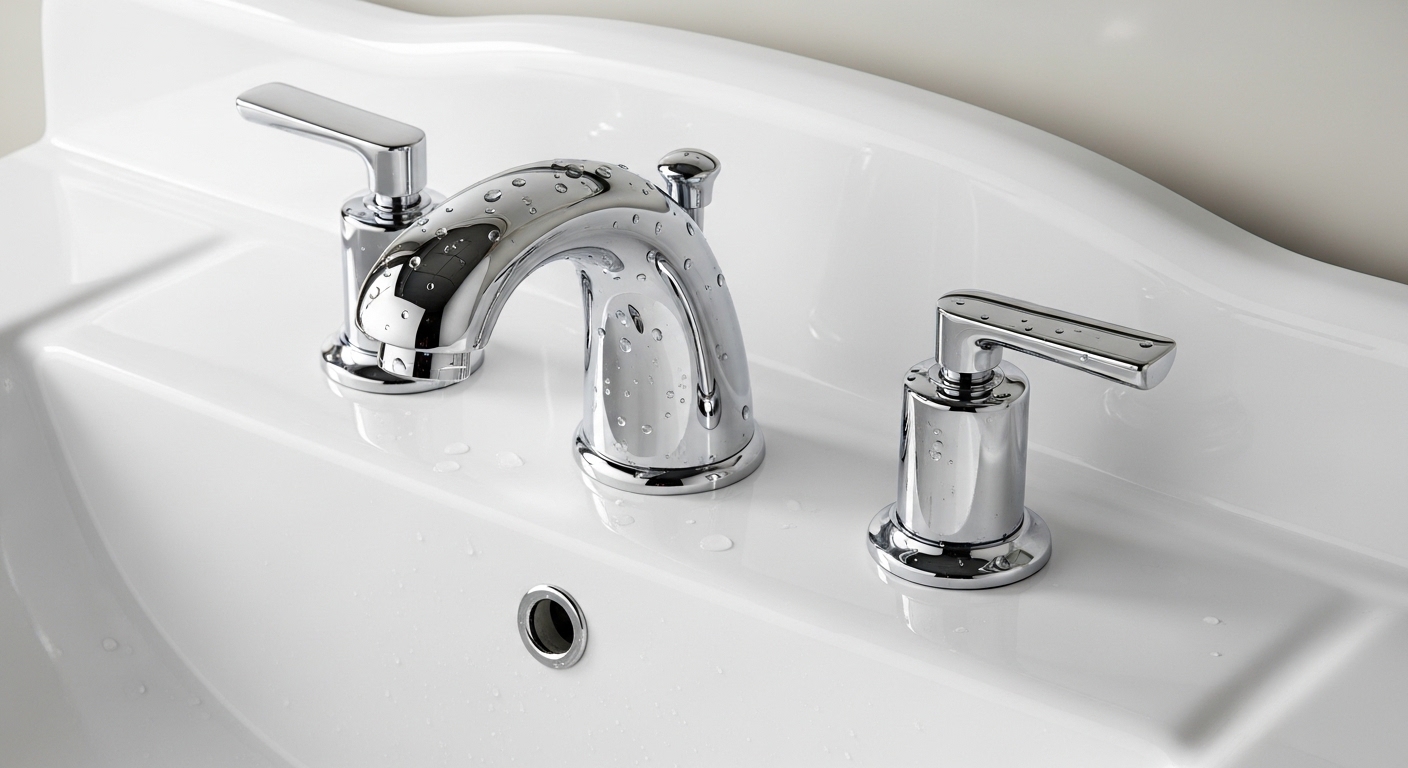
If you have ever tried to install a widespread faucet on 4 inch hole spacing, you have probably discovered the awkward truth: standard widespread bodies expect 6 to 16 inches between the hot and cold valves, while a 4-inch deck is technically centerset territory. The good news is that the modern bathroom market has answered the demand for that elegant, three-piece silhouette on a smaller sink. With the right product class — mini-widespread (also called 4-inch widespread) — you can keep the look you want without re-drilling your countertop or replacing the sink. This guide breaks down exactly what fits, what does not, and what to buy when you want a split-handle aesthetic on a tight 4-inch deck.
What “Widespread Faucet on 4 Inch” Actually Means
Bathroom faucets are categorized by the distance between the outer mounting holes on the sink or countertop. That distance is measured from center-to-center of the outermost holes. Three configurations dominate the market: single-hole, centerset (4 inches), and widespread (8 to 16 inches). When shoppers search for a widespread faucet on 4 inch deck, they are almost always looking for one of two things — either confirming whether a true widespread will fit a 4-inch sink (it will not), or hunting for a mini-widespread model that delivers the split-handle look on a centerset footprint.
A true widespread is plumbed with three separate components: a spout body and two individual valve bodies, connected underneath the deck with flexible supply hoses or copper risers. Because each piece is independent, the installer can position the handles anywhere within the manufacturer’s allowable range — typically 6 to 16 inches apart. A mini-widespread, by contrast, is engineered to look like a three-piece faucet but uses a rigid 4-inch spread, matching the centerset standard adopted by virtually every major U.S. sink manufacturer.
How to Measure Your Sink Before You Buy
Before you order anything, flip a tape measure across your existing sink. Place the hook on the center of one outer mounting hole and read the distance to the center of the opposite outer hole. If you get 4 inches, you have a centerset configuration and need either a centerset faucet, a single-hole faucet with an escutcheon plate, or a mini-widespread. If you read 6 inches or more, you are in widespread territory and can shop the larger category freely.
- 4 inches center-to-center — Centerset sinks. Choose a mini-widespread or centerset faucet.
- 6 to 16 inches center-to-center — True widespread sinks. Choose a standard widespread faucet.
- Single hole only — Modern minimalist sinks. Choose a single-hole faucet, optionally with a 3-hole escutcheon if you need to convert later.
- No holes (wall-mount) — Vessel sinks with wall plumbing. Choose a wall-mounted faucet.
Mini-Widespread vs. True Widespread vs. Centerset: The Real Differences
The terms get tossed around interchangeably online, but the engineering is meaningfully different under the deck. A centerset faucet is a single unibody casting where the spout and handles share one base — even though there are visually three pieces, the plumbing is integrated. A mini-widespread looks like three separate pieces because it is three separate pieces, but the handles are anchored at a fixed 4-inch spread. A true widespread is fully modular, which is why it offers that custom 6-to-16-inch range.
When to Choose Each Type
If you are replacing a faucet on an existing 4-inch sink and want a higher-end look without retrofitting the countertop, mini-widespread is the right call. If you are renovating and pre-drilling a new vanity top — especially a stone slab — go with a true widespread for the more flexible, designer-grade installation. If budget is the constraint and you simply need water flowing tomorrow, a centerset will get you there fastest with the fewest connections to leak.
| Spec | Centerset | Mini-Widespread | True Widespread |
|---|---|---|---|
| Hole Spacing | 4 inches | 4 inches | 6 to 16 inches |
| Number of Pieces | 1 (unibody) | 3 (joined under deck) | 3 (fully separate) |
| Visual Style | Compact, traditional | Three-piece look, compact | Elegant, custom spread |
| Installation Difficulty | Easy (1 hour) | Moderate (1.5 hours) | Moderate to Hard (2+ hours) |
| Typical Price Range | $60 – $180 | $120 – $320 | $180 – $700+ |
| Best For | Powder rooms, rentals | Existing 4-inch sinks | New builds, master baths |
| Spout Reach | 4 to 5 inches | 4.5 to 5.5 inches | 5 to 7 inches |
The Anatomy of a Mini-Widespread Faucet
Understanding the internal layout helps you avoid the most common installation mistakes. A mini-widespread for a 4-inch deck includes a center spout body with an integrated horizontal manifold underneath. The two handle valve cartridges thread into the ends of that manifold, exactly 4 inches apart. Hot and cold supply lines connect to the underside of each valve, and the assembly is anchored to the sink with mounting nuts and rubber gaskets.
The cartridges inside the valves are usually ceramic disc cartridges, which is the standard the industry has settled on for durability. Ceramic disc cartridges are rated for hundreds of thousands of on-off cycles and resist mineral buildup far better than the old compression washers. When you are evaluating a faucet for a 4-inch sink, ceramic disc cartridges, a brass body, and a CALGreen or WaterSense-listed flow rate (1.2 GPM or 1.5 GPM) are the non-negotiables.
Finishes That Hold Up on a Bathroom Vanity
Finish matters more than buyers realize, especially in humid bathrooms where chrome can spot and brushed nickel can dull without proper PVD protection. The most durable finishes use a physical vapor deposition (PVD) process that bonds the color to the brass at the molecular level — these will outlast electroplated finishes by a decade or more. If you love a warm metallic look, our deep dive on the oil rubbed bronze bathtub faucet walks through how that finish performs over years of use, and the same principles apply to your vanity faucet.
- Polished Chrome — Most affordable, universally compatible, shows water spots quickly.
- Brushed Nickel — Warm neutral, hides fingerprints well, the safest choice for resale.
- Matte Black — Bold modern statement; insist on PVD or it will fade in 2-3 years.
- Brushed Gold / Champagne Bronze — Current design favorite, pairs with both warm and cool palettes.
- Oil Rubbed Bronze — Living finish, develops a patina, beautiful with traditional vanities.
- Polished Nickel — Vintage-luxury feel, slightly warmer than chrome.
Installation Walkthrough: Putting a Mini-Widespread on a 4-Inch Sink
Even if you plan to hire a plumber, knowing the install sequence helps you spot a sloppy job. Most homeowners can DIY this in about 90 minutes with basic tools — an adjustable wrench, a basin wrench, a flashlight, and plumber’s tape are all you really need. Always shut off the angle stops under the sink and open the existing faucet to release pressure before you begin.
Step-by-Step Process
First, remove the old faucet by disconnecting the supply lines and loosening the mounting nuts. Clean the sink deck with a non-abrasive pad to remove any old plumber’s putty or silicone residue. Test-fit the new mini-widespread by placing the spout body in the center hole and threading the two valve bodies through the outer 4-inch holes. They should align cleanly without forcing — if you have to torque the manifold, your sink is not actually 4-inch centerset and you have a measurement issue to resolve before continuing.
Once aligned, secure the mounting nuts hand-tight, then add a quarter-turn with a basin wrench. Connect the flexible supply hoses to the valve undersides with plumber’s tape on the threads. Restore water at the angle stops, run the faucet for 60 seconds to flush debris, and check every connection with a dry paper towel. Any moisture means you need to tighten that fitting one more eighth-turn.
Common Mistakes to Avoid
The biggest mistake we see in returns is overtightening — installers crank down on the brass nuts thinking they are stopping a leak, when in reality they are crushing the rubber gasket and causing the leak. Hand-tight plus a quarter-turn is the rule. Another frequent issue is using thread sealant on compression fittings where the rubber washer does the sealing — only use plumber’s tape on threaded NPT connections. If you do encounter a leak from the handle base later on, our guide on diagnosing a leaking faucet valve walks through the cartridge replacement process, which is the same principle for both shower and lavatory faucets.
What to Look For in Build Quality
Cheap mini-widespreads use zinc or plastic internal components that corrode within 18 months. Premium models use forged brass throughout — body, manifold, valve housing, and handle stems. The weight difference is noticeable; a brass mini-widespread weighs three to four pounds out of the box, while a zinc-bodied imitation feels suspiciously light at around 1.5 pounds. When you lift the box at the showroom or unbox a delivery, trust the heft.
Look for these certifications on the packaging or product listing:
- NSF/ANSI 61 — Confirms the faucet is safe for drinking water contact.
- NSF/ANSI 372 — Lead-free compliance under the federal Safe Drinking Water Act.
- WaterSense — EPA certification that the flow rate is 1.5 GPM or less.
- ASME A112.18.1 / CSA B125.1 — Plumbing fixture performance standard.
- ADA Compliance — Lever handles operable with a closed fist, meeting accessibility code.
Matching a Mini-Widespread to Your Vanity Style
The 4-inch widespread sits in a sweet spot for design flexibility. Because it visually reads as a three-piece faucet, it elevates a modest vanity into something that feels custom. The deck plate is omitted — that is the whole point — so your countertop is on display between the handles, which means stone or quartz vanities especially benefit from this style. For a deeper dive into how a true widespread anchors a master-bath vanity, our walkthrough of the Elate widespread faucet covers spout heights, handle ergonomics, and the design rationale behind the wider 8-inch spread.
Spout Height and Reach Considerations
Mini-widespreads typically offer a 5 to 6.5-inch spout height. Anything taller than 7 inches and you risk splashing in a shallow vessel-style sink. Spout reach (the horizontal distance from the spout base to the water exit point) should put the aerator over the center of the drain or just slightly past it — for most 16 to 20-inch sinks, a 4.5 to 5.5-inch reach is ideal.
Why Buy Avamani Faucets
Avamani designs and tests every faucet against the ASME A112.18.1 standard, with each model rated for a minimum of 500,000 valve cycles before the cartridge requires service. Our mini-widespread line is forged from lead-free brass, finished with multi-stage PVD coating, and backed by a limited lifetime warranty on the body and finish, plus a 10-year warranty on the ceramic disc cartridges. Every unit ships with WaterSense-compliant aerators and NSF 61/372 documentation in the box.
Beyond the lavatory category, we make a full family of complementary fixtures — from kitchen pull-downs to push-to-connect outdoor faucets — so you can match finishes across the entire home from a single supplier. That consistency matters more than buyers expect: the moment a brushed nickel bath faucet sits next to a slightly different brushed nickel cabinet pull, the eye notices.
Budget Planning: What You Should Actually Spend
For a 4-inch mini-widespread, the sweet spot for residential quality is the $150 to $280 range. Below $120, you are almost certainly getting zinc components and electroplated finishes that will dull or pit. Above $400, you are paying for designer branding or specialty finishes (true brass-grade unlacquered, hand-rubbed bronze) rather than meaningfully better engineering. Add $80 to $150 for installation if you hire a licensed plumber, plus $25 to $40 for new angle stops and braided supply lines if yours are more than a decade old.
About the Author
This guide was authored by the Avamani product team, drawing on more than 15 years of combined experience in plumbing fixture design, ASME testing oversight, and bathroom remodeling consultation. Our specifications are reviewed by a licensed master plumber before publication, and our faucets are independently tested by IAPMO R&T to confirm certification compliance before any unit ships to a customer.
FAQ
Can I install a true widespread faucet on a 4-inch sink?
No. A true widespread requires 6 to 16 inches between the outer holes, and a 4-inch sink is too narrow to accommodate the separate valve bodies. You need a mini-widespread (also called a 4-inch widespread) that is purpose-built for centerset hole spacing.
Is a mini-widespread faucet just a centerset with extra steps?
Not exactly. A centerset is a single unibody casting where the handles and spout share one base plate. A mini-widespread uses three visually separate pieces joined by a manifold beneath the deck — it gives you the look of a widespread on a 4-inch sink, which is a meaningful aesthetic upgrade even if the hole spacing is identical.
What flow rate should I look for on a 4-inch widespread?
The EPA WaterSense standard is 1.5 GPM (gallons per minute) at 60 psi. California, Colorado, and Georgia mandate 1.2 GPM. A quality mini-widespread will hit either spec without feeling weak — engineering the aerator correctly is more important than raw flow.
How long should a quality mini-widespread last?
A forged brass mini-widespread with ceramic disc cartridges should last 15 to 25 years with normal use. The cartridges themselves are rated for 500,000+ cycles, and quality PVD finishes are warranted against fading or corrosion for the life of the faucet. Avamani backs its bodies and finishes with a limited lifetime warranty.
Do I need a plumber to install one, or can I DIY?
Most homeowners with basic tools can install a mini-widespread in 60 to 90 minutes. The work happens entirely under the sink — disconnect the old supply lines, swap the faucet, reconnect. The two skills you need are using a basin wrench in tight quarters and recognizing when a connection is hand-tight plus a quarter-turn (not cranked down).
What if my sink has separate holes but they are not exactly 4 inches apart?
Measure carefully — center-to-center between the outer holes. If the gap is between 4 and 6 inches, you have an unusual sink and may need to drill a wider spread, install a deck plate to bridge the gap, or swap the sink. Anything between 6 and 16 inches accepts a standard widespread without modification.
Can I use a 3-hole escutcheon plate to install a single-hole faucet on my 4-inch sink?
Yes. Many single-hole faucets ship with an optional 4-inch (3-hole) escutcheon plate that covers the outer holes. This is a valid path if you fall in love with a single-hole design but already own a centerset sink.