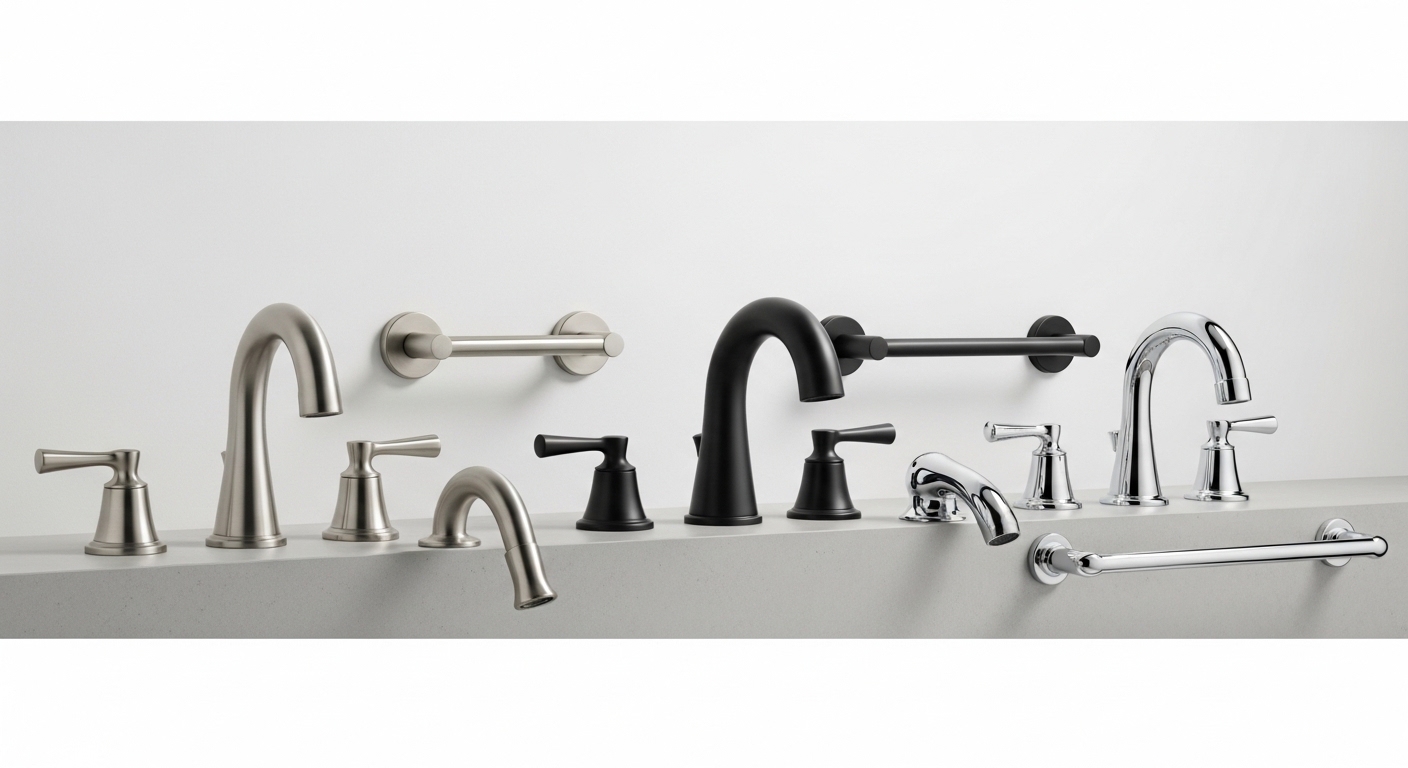
If you’re shopping for the best bathroom faucet collections, here’s the short version: a “collection” is a family of fixtures — lavatory faucet, tub filler, shower trim, towel bars, and robe hooks — engineered to share one finish, one handle shape, and one design vocabulary. Buying the collection instead of hunting down individual parts is the single easiest way to make a bathroom look intentional instead of pieced together. Below, we’ll compare the main collection styles, walk through what actually matters when you choose one, and answer the real questions people ask before they buy.
What exactly is a “bathroom faucet collection” — and why not just buy parts separately?
A bathroom faucet collection is a coordinated product family where every piece is designed to match — same finish batch, same handle geometry, same spout curve. You buy parts separately and you risk three mismatches: finish (one brand’s “brushed nickel” is warmer or cooler than another’s), handle style (a lever here, a cross handle there), and scale (a chunky spout next to a delicate one).
The practical payoff of a collection is finish consistency. Finishes are applied in production runs, and even within “chrome” or “matte black” there’s drift between manufacturers. When your faucet, your tub filler, and your shower trim all come from the same collection, they’re spec’d to the same finish standard, so they read as one set across the room. That’s the whole point — and it’s why designers spec collections rather than chasing individual SKUs.
- Finish match: identical plating/coating spec across every piece.
- Style match: handles, escutcheons, and spouts share one design language.
- Valve compatibility: the shower trim is built for the collection’s rough-in valve, so you’re not guessing about parts.
- Easier reordering: need a matching robe hook two years later? It’s still in the line.
Which bathroom faucet collection style is right for my bathroom?
Match the collection style to your sink configuration and your room’s overall look. Your sink’s drilling — single-hole, centerset (4″), or widespread (8″) — narrows the field before aesthetics even come into play. After that, pick the design family that fits your space: modern, transitional, or classic.
Here’s how the main collection types compare on the things that actually drive the decision:
| Collection style | Best for sink type | Look | Typical price (faucet) | Maintenance |
|---|---|---|---|---|
| Single-hole modern (e.g. Lumora) | Single-hole or 1-hole vessel | Clean, minimal, sculptural | $120–$260 | Low — one handle, fewer crevices |
| Widespread transitional (e.g. Elate) | 8″ widespread (3-hole) | Balanced classic-meets-modern | $180–$380 | Medium — two handles, more parts |
| Centerset classic (e.g. Heritage) | 4″ centerset (3-hole) | Traditional, often cross handles | $110–$240 | Medium — compact two-handle |
| Wall-mount designer | Wall-drilled (no deck holes) | Spa / high-end statement | $260–$500+ | Higher — in-wall valve service |
If you already have a sink, count the holes and measure the spread (center-to-center of the outer holes) before you fall in love with a look. A widespread collection won’t fit a 4″ sink without an adapter — and that’s a real compatibility gotcha we cover in our guide on putting a widespread faucet on 4-inch sinks. If you’re drawn to the widespread look specifically, the Elate widespread faucet buyer’s guide breaks down specs and finishes piece by piece.
What’s the best bathroom faucet finish for hard water and daily cleaning?
For hard water and easy cleaning, brushed nickel and matte black hide water spots and fingerprints best, while polished chrome shows every droplet but wipes clean fastest. The “right” finish is the one that matches your cleaning tolerance, not just your tile.
Finish is where a collection earns its keep, because you’re committing the whole room to one. Here’s the honest breakdown:
- Brushed/satin nickel: warm, forgiving, hides spots and fingerprints. The default “you can’t go wrong” pick for family bathrooms.
- Matte black: dramatic and on-trend; hides water spots but can show limescale (white residue) in very hard water — wipe weekly.
- Polished chrome: brightest, most durable, cheapest to produce, shows spots but cleans in seconds. The workhorse.
- Oil-rubbed bronze: rich, traditional, living finish that develops character. Great for classic baths — see our deep dive on oil-rubbed bronze bathtub faucets for how the finish ages.
- Brushed gold / champagne bronze: warm luxury look; pairs beautifully in transitional collections.
One hard-water tip that applies to every finish: it’s the water, not the faucet, leaving spots. If your home runs above ~7 grains per gallon of hardness, expect more visible mineral buildup on any finish, and clean with a soft cloth and mild vinegar solution — never abrasive pads, which scratch the protective coating and void most finish warranties.
How much should I budget for a full bathroom faucet collection?
Plan on roughly $350–$900 to outfit one bathroom with a coordinated collection (lav faucet, tub or shower trim, plus accessories), with the sweet spot for quality mid-range collections around $450–$650. The faucet itself is usually the cheapest piece; shower and tub trim drive the total.
Here’s a realistic per-piece budget for a single full bathroom in a mid-range collection:
- Lavatory faucet: $130–$300
- Tub filler or tub/shower trim: $150–$400 (plus the rough-in valve, $40–$120)
- Shower head + arm: $50–$150
- Accessories (towel bar, ring, robe hook, paper holder): $80–$180 for the set
Where people overspend: buying premium designer collections for a guest bath used twice a month. Where people underspend: cheap shower valves. The valve is the one part buried in the wall — if it fails, you’re opening drywall. Spend on the valve, save on accessories. If a valve does start dripping down the line, our guide on a leaking shower faucet valve walks through diagnosis and the right replacement.
What should I look for in faucet quality and valve internals?
Look for a solid brass body and a ceramic disc cartridge — those two things separate a faucet that lasts 15+ years from one that drips in 18 months. Finish and style get all the attention, but the guts decide longevity.
Quick spec checklist for any collection you’re considering:
- Brass body (not zinc alloy or plastic) — corrosion resistance and durability.
- Ceramic disc cartridge — smooth handle feel, drip-resistant, rated for hundreds of thousands of cycles.
- WaterSense label — bathroom faucets capped at 1.5 GPM or below; EPA-certified for efficiency without weak flow.
- NSF/ANSI 61 & 372 compliance — confirms the faucet is safe for drinking water (low-lead).
- Lifetime finish & function warranty — the strongest signal a brand stands behind its build.
A loose handle is usually a maintenance issue, not a death sentence — most are a quick set-screw tighten, similar to the fix in our loose kitchen faucet handle walkthrough, which applies to bathroom levers too. But persistent drips almost always trace back to a worn cartridge, and a cheap cartridge in a cheap body is hard to source later. Buy quality internals once.
Can I mix finishes within one collection, or across collections?
Yes — you can mix finishes deliberately, and many modern collections are sold in two-tone (e.g., matte black with brushed gold accents) precisely for this. The rule of thumb: pick one dominant metal for the room and one accent, and don’t exceed two finishes total in a single bathroom.
Staying within one collection makes mixing safe because the brand pre-coordinates the pairings. Mixing across collections — say a faucet from one line and a shower from another — works only if you carefully match both the finish and the design language, which is exactly what a single collection saves you from doing by hand. If you do mix, keep your “wet” pieces (faucet, tub, shower) in one finish and let accessories carry the accent.
How do I install a coordinated faucet collection without surprises?
The number-one install surprise is hole spacing and tap-hole size, so confirm both before anything ships. A deck-mount collection needs your sink’s drilling to match the faucet’s footprint, and your supply lines need to match the faucet’s threading.
- Count and measure your holes — single, 4″ centerset, or 8″ widespread.
- Check the tap-hole diameter — fixtures are spec’d to standard hole sizes; our explainer on the M6 tap hole size in mm shows why a few millimeters matter for fit.
- Shut off supply and clear the cabinet before you start.
- Dry-fit the faucet and trim before final tightening — confirm the spout reaches the basin and handles clear the backsplash.
- Use plumber’s tape on threaded connections and hand-tighten plus a quarter turn — over-torquing cracks fittings.
For shower and tub trim, the valve must be installed in the wall first; trim kits are just the visible parts. Buy the valve and trim from the same collection so the trim seats correctly.
FAQ
What is the most popular bathroom faucet collection finish in 2026?
Brushed/satin nickel remains the best-selling finish because it hides water spots and fingerprints and pairs with nearly every tile and cabinet color. Matte black is the fastest-growing finish, especially in modern single-hole collections, but it shows limescale in hard water and needs a weekly wipe.
Are matched faucet collections worth the extra cost?
For most bathrooms, yes. The price difference between assembling individual parts and buying a collection is usually small, and a collection guarantees the finish and style actually match — eliminating the most common and most visible bathroom-remodel mistake. The only time it’s not worth it is a quick rental refresh where appearance cohesion doesn’t matter.
Can I buy just the faucet now and add the tub and shower trim later?
Yes, and that’s a major advantage of buying within an established collection — the matching pieces stay in production, so you can add the tub filler, shower trim, or accessories months later in the exact same finish. Just confirm the line isn’t being discontinued before you commit to phasing your purchase.
What’s the difference between a centerset and a widespread collection?
A centerset collection mounts on a 4-inch three-hole sink with the handles and spout on one connected base, while a widespread collection spreads across an 8-inch three-hole sink with the spout and two handles as separate pieces. Widespread looks more upscale and gives more handle room; centerset is more compact and budget-friendly.
Do bathroom faucet collections come with a warranty?
Quality collections, including Avamani’s, carry a limited lifetime warranty on both finish and function for residential use. Always register your purchase and keep your receipt — warranties typically cover manufacturing and finish defects but exclude damage from abrasive cleaners or hard-water neglect.
How many GPM should a bathroom faucet in a collection use?
Look for 1.2–1.5 GPM (gallons per minute) — the WaterSense standard caps efficient bathroom faucets at 1.5 GPM at 60 psi. Reputable collections are engineered to feel full at that flow using aerators, so you save water without a weak stream.
The bottom line
The best bathroom faucet collections aren’t about one perfect faucet — they’re about coordination. Match the collection to your sink’s drilling, pick a finish you’ll actually enjoy cleaning, insist on a brass body with a ceramic cartridge, and spend where it counts (the valve) instead of where it doesn’t (accessories). Do that, and your bathroom will read as one deliberate, finished room.
Author note: This guide was written by Avamani’s fixtures team, drawing on hands-on testing of lavatory faucets, tub fillers, and shower trim across finishes and water-hardness conditions. Avamani designs coordinated bathroom faucet collections built with solid-brass bodies and ceramic disc cartridges, certified to NSF/ANSI 61 and WaterSense standards and backed by a limited lifetime warranty. We test finishes for spot resistance and durability before any collection ships.