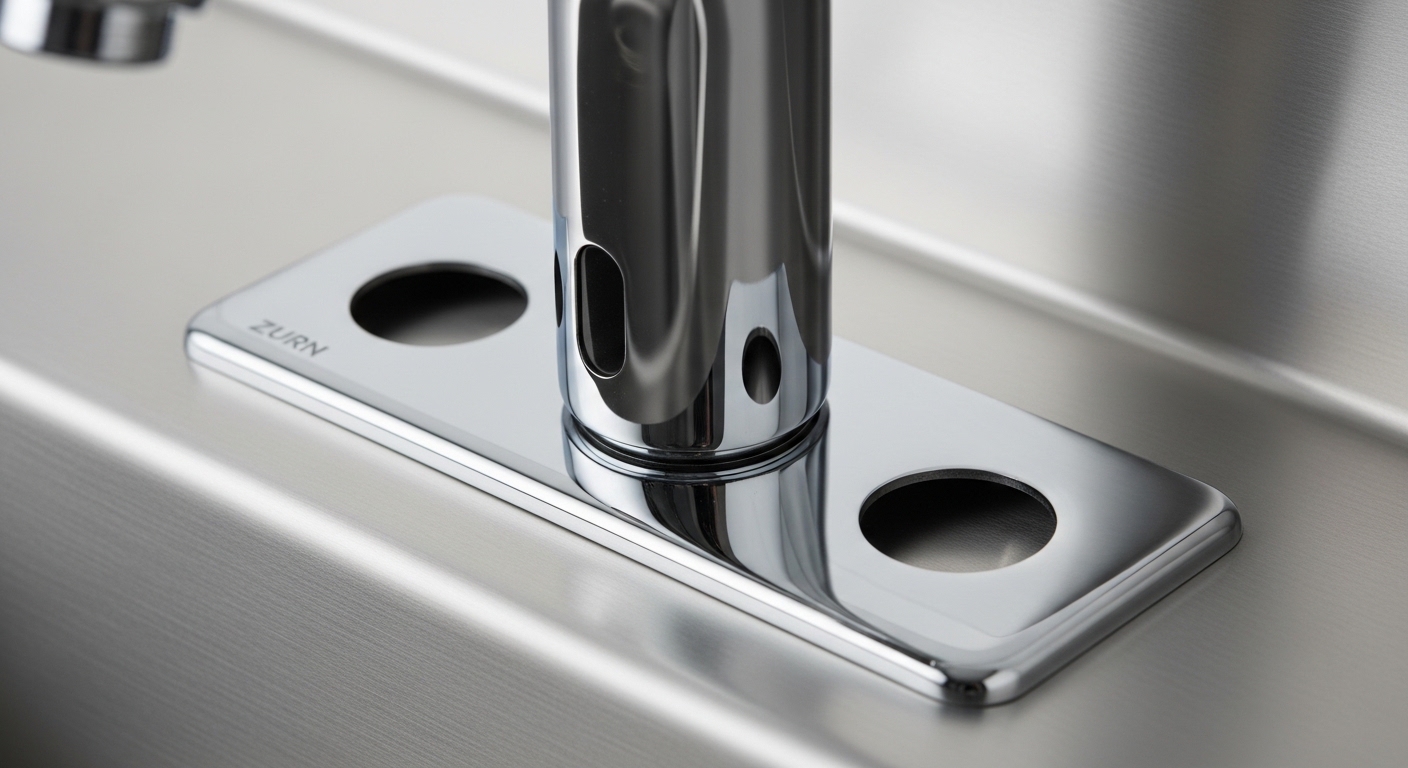
If you manage a restroom, a commercial kitchen, or a multi-unit building, sooner or later you’ll go looking for a zurn faucet escutcheon — usually because the old plate is corroded, spinning loose, or missing entirely after a valve swap. The frustrating part is that “escutcheon” isn’t one part; it’s a whole family of trim plates sized to specific Zurn faucets, sensor fixtures, and valve bodies. Grab the wrong diameter or the wrong thread pattern and it won’t cover the hole or won’t seat flush. This guide walks you through exactly what the part does, how to identify the right one for your fixture, what it should cost, and how to install it without calling a plumber. Everything here is written for people buying real replacement hardware, not browsing for décor.
What does a faucet escutcheon actually do, and why does Zurn make so many?
An escutcheon is a cover plate that hides the hole where a faucet, spout, or valve stem passes through a wall, deck, or sink — and it also helps seal that penetration against splash and cleaning water. Without it you’d stare at a rough cutout, exposed threads, or a gap around the pipe. Zurn makes dozens of variants because their fixtures span everything from sensor-operated lavatory faucets to gooseneck kitchen faucets, flush valves, and shower/tub trim, and each fixture family has its own mounting geometry.
On a Zurn commercial lavatory faucet, the escutcheon is typically a deck plate that covers unused mounting holes on a 4″ centerset or 8″ widespread sink and gives the base a finished look. On a Zurn wall-mounted or metering faucet, it’s the flange that dresses the wall penetration. On tub-and-shower trim, the escutcheon is the large plate behind the handle that covers the valve access hole. Same word, very different parts — which is exactly why matching the model number matters more than eyeballing a photo.
Escutcheon vs. deck plate vs. flange — are they the same thing?
Mostly yes, with nuance. All three are trim covers, but the trade uses them slightly differently. A “deck plate” (or base plate) sits horizontally on a sink deck and typically converts a 3-hole sink to a single-hole faucet look. A “flange” usually refers to a thinner slip-on ring around a pipe or valve stem, common on wall and shower penetrations. “Escutcheon” is the umbrella term that covers both. When you shop Zurn parts, you’ll see all three words used — read the dimensions and mounting style, not the label.
| Trim type | Where it mounts | Typical Zurn use | Common size |
|---|---|---|---|
| Deck plate escutcheon | Horizontal sink deck | Sensor & manual lav faucets | 4″ or 8″ spread |
| Round wall flange | Vertical wall | Wall-mount & metering faucets | 2″–3″ diameter |
| Shower/tub escutcheon | Wall behind handle | Pressure-balance valve trim | 3-1/2″–5″ diameter |
| Slip-on flange | Around exposed pipe | Supply/stop coverage | Sized to pipe OD |
How do I find the right Zurn escutcheon for my exact faucet?
Start with the model number stamped on the fixture — it’s the single fastest way to get the correct escutcheon on the first try. Zurn model numbers usually begin with a “Z” (for example, a Z6950 sensor faucet or a Z7440 series), and every faucet has a matching parts diagram that lists the escutcheon by part number. If you can find that number, buy that part and you’re done.
If the fixture is unlabeled or the tag is worn off, identify the escutcheon by five measurements and details:
- Outside diameter (or length × width) — measure the plate itself, or the hole it must cover plus overlap. Most Zurn lav plates run 2″ to 8″; shower plates run 3-1/2″ to 5″.
- Center hole diameter — the opening the spout, stem, or pipe passes through.
- Mounting style — does it thread on, snap on, use a hidden set screw, or seat under the faucet base?
- Finish — polished chrome is standard on commercial Zurn; brushed nickel, matte black, and PVD finishes also exist. The finish must match your faucet, not just “look close.”
- Gasket/seal — many Zurn escutcheons ship with a foam or rubber gasket that must sit between plate and deck. Confirm it’s included.
When you’re stuck on the mounting hole itself, it helps to understand standard tap-hole sizing before you buy — our breakdown of the M6 tap hole size in mm and why it matters for faucet installation explains how deck cutouts and fastener threads are specified, which is the same logic Zurn escutcheons follow.
What if my sink has three holes but my Zurn faucet only needs one?
Use a deck-plate escutcheon sized to your sink’s spread — that’s exactly what it’s for. A 4″ centerset sink has holes 4 inches apart; an 8″ widespread has them 8 inches apart. A matching Zurn deck plate spans those holes so a single-hole sensor or metering faucet looks intentional instead of leaving two open cutouts. Measure center-to-center between the outer holes before ordering. If you’re weighing single-hole versus spread layouts more broadly, our guide to what a single-hole lav faucet is and whether it’s right for your bathroom sink covers the trade-offs in plain language.
How do I replace a Zurn faucet escutcheon myself?
You can swap most Zurn escutcheons in 10–20 minutes with basic hand tools — no plumber needed, because on many fixtures you don’t even shut off water to change the plate itself. Here’s the general process; always confirm against your model’s parts sheet.
- Shut off supplies if the plate is captured under the faucet. If the escutcheon slips over the stem or pipe freely, you can often skip this. If it’s trapped beneath the faucet base, close the angle stops first.
- Loosen the retainer. Depending on model, that’s a hidden set screw (usually a 5/64″ or 3/32″ hex/Allen), a threaded collar, or the faucet mounting nut underneath.
- Remove the old plate and clean the surface. Scrape off old plumber’s putty, silicone, or mineral scale so the new gasket seats flat.
- Seat the new gasket, then the escutcheon. Foam gaskets go dry; some installs call for a thin bead of clear silicone on the underside for a water-tight seal on splash-prone decks.
- Re-tighten and check for wobble. Snug the set screw or collar — hand-tight plus a nudge. Don’t over-torque a chrome plate or you’ll crack the finish.
- Restore water and wipe down. Run the faucet and check that no water tracks under the plate.
If your plate keeps spinning loose no matter how you tighten it, the problem is usually a stripped set screw or a missing gasket creating a gap — the same failure pattern behind a wobbling handle. The diagnostic logic in why a faucet handle goes loose and how to tighten it transfers directly to escutcheon retainers.
Genuine Zurn part vs. universal escutcheon — which should I buy?
Buy the genuine Zurn escutcheon when the plate is captured by the faucet’s mounting system or must match a specific finish; a universal flange is fine only for simple slip-on pipe coverage where fit tolerances are loose. The reason is fit and finish. Genuine Zurn plates match the exact center-hole diameter, gasket profile, and finish coating of the fixture, so they seat flush and don’t create galvanic corrosion between mismatched metals. Universal plates from a hardware bin can work for covering an exposed supply pipe, but on a sensor faucet base or a valve trim they often leave a visible gap or the wrong finish tone.
| Factor | Genuine Zurn escutcheon | Universal / aftermarket flange |
|---|---|---|
| Fit to fixture | Exact — matched to model | Approximate; may gap |
| Finish match | Identical PVD/chrome | Often slightly off-tone |
| Gasket included | Usually yes | Sometimes |
| Price range | ~$12–$45 | ~$4–$15 |
| Best for | Faucet base, valve trim | Plain pipe coverage |
| Warranty impact | Preserves it | May void trim warranty |
There’s a genuine-parts lesson here that repeats across brands: a $10 mismatched trim piece can undermine a $300 faucet. We made the same case for sourcing OEM components in our look at where to find genuine Kohler faucet soap dispenser parts and which ones actually fail — the principle applies just as much to Zurn escutcheons.
How much should a Zurn faucet escutcheon cost?
Expect $8 to $45 for a genuine replacement, depending on size and finish. A small round chrome flange sits at the low end; a large brushed-nickel or matte-black deck plate for a widespread sensor faucet lands at the top. If you’re being quoted much more, you may be buying a full trim kit (plate + handle + sleeve) rather than the plate alone. If you’re being quoted much less, verify it’s genuine and includes the gasket — a bare stamped ring without a seal will let water track under it.
Why does my escutcheon keep corroding or leaking, and how do I prevent it?
Corrosion and under-plate leaks almost always trace to a failed or missing gasket, harsh cleaning chemicals, or standing splash water — not the metal itself failing. Commercial restrooms get aggressive daily cleaning, and acidic or bleach-based cleaners can etch chrome and eat foam gaskets over time. Once the seal breaks, water wicks under the plate, sits against the deck, and starts corroding both the escutcheon and the fixture base.
Three concrete prevention steps:
- Replace the gasket every time you pull the plate. A $2 gasket is cheaper than a corroded faucet base.
- Switch to a neutral-pH cleaner on chrome and PVD finishes; skip abrasive pads that scratch the coating and expose base metal.
- Add a thin silicone seal on splash-heavy decks so water can’t migrate under the plate near high-use sinks.
If you’re chasing water that appears around a valve rather than a faucet base, the escutcheon is often just the messenger — the real leak may be at the valve behind it. Our guide to a shower faucet valve that’s leaking, its causes, and the right replacement valve to buy helps you tell a cosmetic trim gap apart from an actual valve failure.
Do Zurn escutcheons meet commercial plumbing standards and warranty terms?
Yes — genuine Zurn trim components are designed to pair with fixtures built to ASME A112.18.1/CSA B125.1 faucet standards, and using OEM parts keeps the fixture’s warranty intact. Zurn commercial faucets typically carry multi-year limited warranties (often 1–5 years on commercial-duty finishes and mechanisms), but that coverage generally assumes genuine replacement parts. Swapping in a random aftermarket plate that damages the finish or causes corrosion can give a manufacturer grounds to deny a claim. For any specced or code-sensitive installation, always cross-check the current model’s cut sheet and warranty language before ordering.
Because escutcheons live in the wettest, most-cleaned zone of a commercial fixture, choosing corrosion-resistant, standards-matched trim isn’t cosmetic — it’s part of keeping the whole faucet compliant and serviceable. That’s the same durability-first mindset we bring to commercial-grade hardware guides like our commercial buyer’s guide to SharkBite outdoor faucets and push-to-connect hose bibs.
FAQ
What size is a standard Zurn faucet escutcheon?
There’s no single size — it depends on the fixture. Round wall and pipe flanges run about 2″ to 3″ in diameter, lavatory deck plates match 4″ centerset or 8″ widespread sink spreads, and shower/tub valve escutcheons run roughly 3-1/2″ to 5″. Always measure your plate or the hole it must cover before ordering.
Can I use a non-Zurn escutcheon on a Zurn faucet?
For simple pipe coverage, a universal slip-on flange can work if the diameter matches. For a faucet base or valve trim, use the genuine Zurn escutcheon — it matches the exact center-hole size, gasket profile, and finish, so it seats flush and won’t cause finish mismatch or galvanic corrosion.
How do I remove a stuck Zurn escutcheon?
Look for a hidden set screw first (usually on the underside or bottom edge, needing a small hex key). If it’s threaded, twist counterclockwise; a strap wrench protects the finish. If mineral scale has cemented it, apply a vinegar-soaked cloth for 15–20 minutes to loosen deposits, then work it free gently rather than prying.
Why does my escutcheon spin freely and not tighten?
Almost always a stripped set screw, a missing retainer, or a compressed/absent gasket leaving a gap. Replace the gasket and the set screw first — those two cheap parts fix the majority of loose escutcheons without replacing the whole plate.
Does an escutcheon need caulk or plumber’s putty?
Not always. Many Zurn escutcheons rely on an included foam or rubber gasket and need no sealant. On splash-heavy commercial decks, a thin bead of clear silicone under the plate adds cheap insurance against water tracking underneath. Avoid over-applying — you still want to be able to remove the plate later.
Where can I find my Zurn faucet’s model number?
Check the underside of the spout or base, the original spec/cut sheet, or the box the faucet came in. It usually starts with “Z” followed by digits (e.g., Z6950). That number maps to a parts diagram listing the exact escutcheon part number — the surest way to order the right one.
Author note: This guide was written by the Avamani fixtures team, which specifies, sources, and tests commercial and residential faucet trim across dozens of brands. We handle Zurn parts identification and replacement questions from facility managers and contractors regularly, and our recommendations reflect real fit, finish, and durability outcomes rather than catalog copy. Avamani is an independent faucet and bathroom-fixtures retailer; we reference ASME/CSA faucet standards and manufacturer warranty terms so you can buy parts that stay compliant and last.