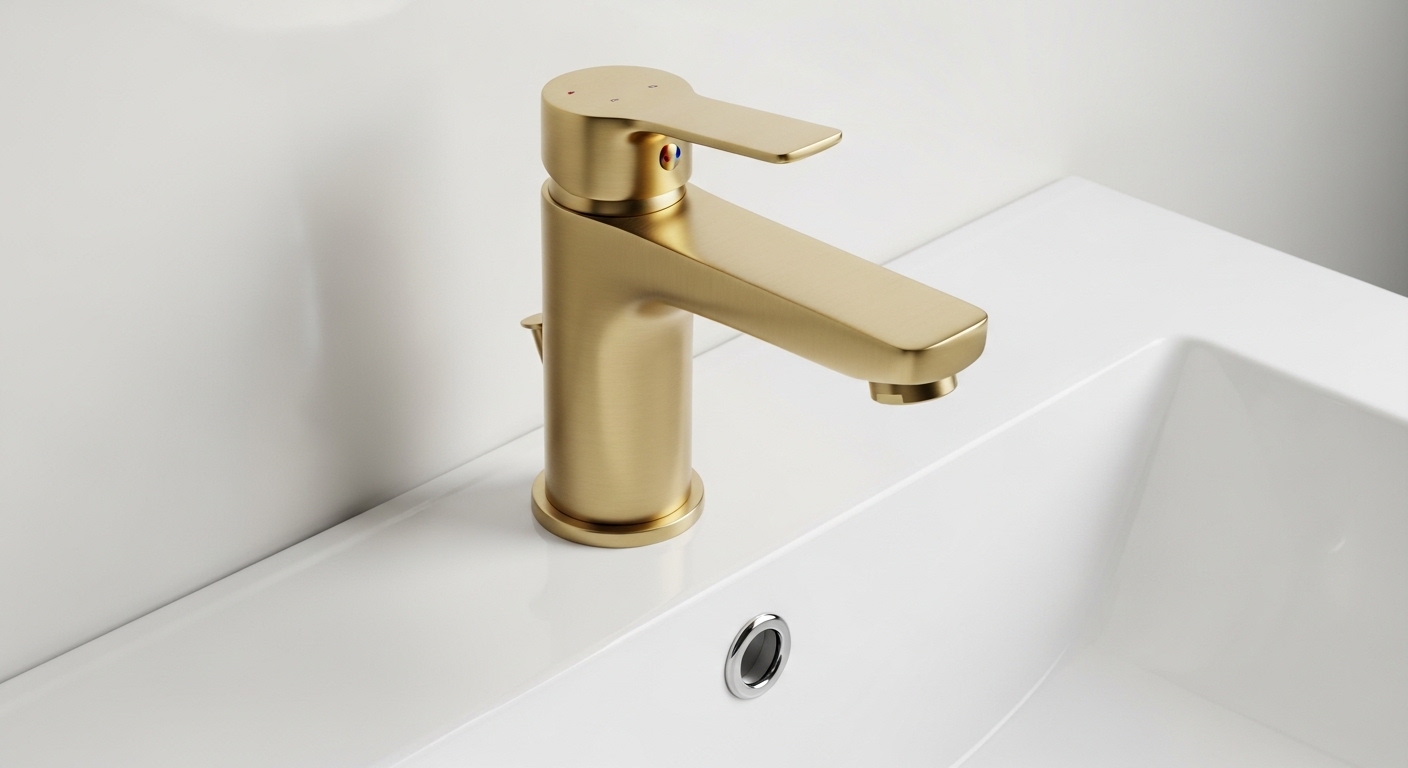
If you’ve been shopping for a bathroom faucet and keep running into the term, here’s the plain-English version: a single hole lav faucet (“lav” is just short for lavatory, the trade word for a bathroom sink) is a faucet that needs exactly one hole drilled in your sink or counter. The spout and the handle are built into one body, so you get a clean, uncluttered look and a much faster install than a faucet that spreads across three holes. It’s the most popular bathroom faucet configuration sold today, and for good reason — it fits modern vessel sinks, small powder rooms, and tight vanities better than almost anything else.
But “fits one hole” doesn’t automatically mean “fits your sink.” Below, I’ll walk you through exactly how to confirm it’ll work, how single hole compares to centerset and widespread faucets, what specs actually matter, and how to avoid the two or three mistakes that send people back to the hardware store. I’ve specced and installed these on everything from $40 builder sinks to custom stone vanities, so this is the stuff I’d tell a friend before they hit “buy.”
What exactly makes a faucet a “single hole” faucet?
A single hole faucet mounts through one hole and combines the spout and handle into a single unit. That’s the whole definition. Water temperature and flow are controlled by one lever (or occasionally a single knob), which mixes hot and cold inside the faucet body before the water reaches the spout.
This is different from how it looks underneath. Even though only one fixture pokes through your sink, there are still two supply lines down below — one hot, one cold — feeding into the faucet base. So you’re not giving up hot or cold water; you’re just consolidating the controls into one clean column on top.
Single hole faucets come in two physical styles you’ll see again and again:
- Single-post / mini-spread look: the spout and lever sit on one slim base. This is the classic modern bathroom faucet.
- Vessel faucets: a taller version of the same single-hole design, built to reach up and over the rim of a raised vessel bowl that sits on top of the counter.
Both mount through one hole. The only real difference is height and reach, which I’ll cover in the specs section.
How do I know if a single hole lav faucet will fit my sink?
Look at your sink (or the spec sheet for a sink you’re buying) and count the holes. If your sink has one pre-drilled hole, a single hole lav faucet is a direct fit. If it has three holes spaced 4 inches apart (the most common drilling in the US), you can still use a single hole faucet — you just add an escutcheon plate (also called a deck plate) to cover the two outer holes.
Here’s the quick decision tree I use:
- One hole in the sink? Buy single hole, done.
- Three holes, 4 inches apart? Buy a single hole faucet that includes a deck plate, or buy the deck plate separately. Many single hole faucets ship with an optional plate exactly for this reason.
- Three holes, 8+ inches apart? That’s a widespread layout — a single hole faucet with a standard deck plate usually won’t reach. You’re better off with a true widespread or covering it with a long single-hole deck plate.
- No holes yet (undermount or stone counter)? You (or your installer) drill one hole wherever you want it. Maximum flexibility.
The single most important number is the faucet hole diameter. Standard US bathroom sink holes are about 1-3/8 inches (roughly 1.25″–1.5″, or about 35mm). Most single hole faucets are built to fit that range. If you’re working with a thicker stone counter or a metric-drilled basin, it’s worth confirming the hole size before you commit — getting the drilling and thread size right is exactly the kind of detail covered in our guide to the M6 tap hole size in mm and why it matters for faucet installation.
Single hole vs. centerset vs. widespread — which one should I actually buy?
Buy single hole if you want the cleanest look and easiest install; buy centerset for a budget 4-inch sink where you want a two-handle traditional look on one base; buy widespread for large vanities and a high-end, customizable layout. Here’s how they stack up side by side.
| Type | Holes needed | Handles | Best for | Typical price (avamani range) |
|---|---|---|---|---|
| Single hole lav faucet | 1 (or 3 with deck plate) | 1 lever | Small vanities, vessel sinks, modern bathrooms, DIY installs | $45–$160 |
| Centerset | 3 holes, 4″ apart | 1 or 2, on a shared base | Budget builds, standard 4″ drilled sinks | $40–$120 |
| Widespread | 3 holes, 8″–16″ apart | 2 separate handles | Large vanities, master baths, premium/traditional looks | $120–$350+ |
The honest summary: single hole wins on simplicity and modern style, centerset wins on price for standard sinks, and widespread wins on presence and customization for big, high-end vanities. If you’re weighing the spread-out look against the single-post look, our Elate widespread faucet buyer’s guide breaks down where the two-handle layout earns its keep, and the guide to fitting a widespread faucet on a 4-inch sink covers the in-between case where your sink drilling doesn’t match the faucet you fell in love with.
What are the pros and cons of a single hole lav faucet?
The big wins are easy installation, a clean modern look, and easy cleaning; the trade-offs are less temperature precision than two separate handles and a look that can feel too minimal in a traditional bathroom. Let me break that down honestly.
What you’ll love:
- Fastest install of any faucet type. One hole, one body, two supply lines. Most people can do it in 30–45 minutes.
- Single-lever temperature control. Push up for more flow, swing left for hot and right for cold. It’s intuitive and great for a quick hand-wash.
- Easy to clean. Fewer seams and crevices around the base than a multi-handle faucet means less gunk buildup.
- Modern, uncluttered aesthetic. Perfect for floating vanities, vessel bowls, and small powder rooms where a sprawling faucet would feel crowded.
What to keep in mind:
- Less precise temperature fine-tuning than two dedicated handles — though for a bathroom sink, most people never miss it.
- Can look too sparse in a heavily traditional or ornate bathroom, where a widespread set looks more “finished.”
- Reach and height matter more with one centered spout. Get this wrong on a vessel sink and water splashes everywhere (more on that next).
What specs actually matter when buying a single hole bathroom faucet?
The four specs that make or break a single hole lav faucet are spout height, spout reach, flow rate, and valve type. Nail these and you’ll be happy for a decade; ignore them and you’ll fight splashing or low flow forever.
| Spec | What it means | What to look for |
|---|---|---|
| Spout height | How tall the spout stands above the deck | 4″–6″ for a standard sink; 10″+ for a vessel bowl |
| Spout reach | How far the water lands from the base | Aim for the stream to hit the drain, not the back wall of the basin |
| Flow rate (GPM) | Gallons per minute at the aerator | 1.2 GPM meets WaterSense; 1.5 GPM feels fuller |
| Valve / cartridge | The part that controls and mixes water | Ceramic disc cartridge — most durable, drip-resistant |
A couple of real-world notes. On a vessel sink, the bowl sits up on top of the counter, so a normal 5-inch faucet won’t clear the rim. You need a tall vessel-style single hole faucet (often 10″–13″ tall) with enough reach to drop water into the center of the bowl. And on flow rate: anything labeled WaterSense is certified to use 30% less water than the federal max while still feeling strong — that certification means it passed independent flow and performance testing, not just a marketing claim.
Ceramic disc cartridges are the spec I’d refuse to compromise on. They’re the reason a quality faucet doesn’t start dripping after two years. Cheaper rubber-washer or compression valves wear out fast, especially in hard water. If a listing doesn’t mention the valve type, that usually tells you something.
What finish should I get, and does it really matter?
For most bathrooms, brushed nickel and matte black are the safest, most forgiving finishes because they hide water spots and fingerprints; polished chrome is cheapest and brightest but shows every smudge. Finish is partly looks and partly maintenance, so match it to how much cleaning you’re willing to do.
- Brushed nickel: warm, soft sheen, hides spots and fingerprints — the best all-rounder for a busy family bathroom.
- Matte black: bold and modern, fantastic on white and vessel sinks; hides water spots well but can show dried mineral residue in very hard water.
- Polished chrome: classic, bright, and budget-friendly, but shows every fingerprint and droplet.
- Brushed gold / champagne bronze: the trend finish — luxe and warm, pairs beautifully with white stone counters.
- Oil-rubbed bronze: dark, traditional, great for a warmer or rustic look; if you love this tone, see how it plays on tub fixtures in our oil rubbed bronze bathtub faucet buyer’s guide so your finishes coordinate.
One practical tip: pick your faucet finish to match your drain, towel bar, and cabinet hardware, not your wall color. Walls and paint change; the metal finishes in the room are what your eye reads as “matching.” If you’re planning a whole bathroom refresh and want finishes that carry across the room, our roundup of the best bathroom faucet collections to buy in 2026 shows which coordinated families are worth it.
How hard is it to install a single hole lav faucet myself?
For most people it’s a genuine 30–45 minute DIY job with basic tools — single hole faucets are the easiest faucet type to install because there’s only one hole, one body, and two flexible supply lines to connect. You don’t need a plumber for a standard swap.
Here’s the basic sequence:
- Shut off the hot and cold supply valves under the sink and open the old faucet to drain the line.
- Disconnect the old supply lines and remove the old faucet’s mounting nut from below.
- Drop the new faucet (with its gasket or deck plate) into the single hole and tighten the mounting nut from underneath.
- Connect the hot and cold flexible supply lines — snug, then a quarter-turn more. Don’t overtighten.
- Turn the water back on slowly, remove the aerator, and run water for 15 seconds to flush debris before checking for leaks.
The most common rookie mistakes: forgetting the rubber gasket between the faucet base and the sink (causes wobble and seepage), overtightening the plastic mounting nut until it cracks, and not flushing the lines before reinstalling the aerator (debris clogs it on day one). If your handle ever feels loose down the road, that’s almost always a set screw or mounting nut backing off — the same fix we walk through for kitchen faucets in our guide on why a faucet handle goes loose and how to tighten it applies to bathroom levers too.
Is a single hole lav faucet worth it for a small bathroom or powder room?
Yes — for a small bathroom or powder room, a single hole lav faucet is almost always the right call. It takes up the least deck space, looks intentional rather than cramped, installs fastest, and ranges from about $45 to $160 at avamani, so you can get a quality ceramic-cartridge faucet without overspending. In tight spaces, the sprawling footprint of a widespread faucet works against you, while a single-post design keeps the counter open and the look modern.
The only time I’d steer someone away is if they have a large, traditional double vanity where a widespread set would look more proportional and high-end. For everything else — apartments, powder rooms, kids’ bathrooms, vessel-sink vanities, and modern remodels — single hole is the default I recommend.
FAQ
Can I put a single hole faucet on a sink with three holes?
Yes. Use an escutcheon (deck) plate that covers all three holes, then mount the single hole faucet through the center hole. Many single hole faucets include this plate or offer it as an add-on, specifically for standard 4-inch three-hole sinks.
What’s the difference between a “lav faucet” and a regular bathroom faucet?
There’s no difference — “lav” is just plumbing-trade shorthand for “lavatory,” meaning the bathroom sink. A single hole lav faucet and a single hole bathroom sink faucet are the exact same thing.
Do single hole faucets have less water pressure?
No. Pressure is set by your home’s plumbing and the faucet’s flow rate (GPM), not the number of holes. A 1.2 GPM single hole faucet meets WaterSense standards and feels strong; if you want a fuller stream, choose a 1.5 GPM model.
Will a single hole faucet work on a vessel sink?
Yes, but you need a tall vessel-specific version. A standard 5-inch faucet won’t clear the raised bowl rim — look for a single hole vessel faucet around 10″–13″ tall with enough reach to land water near the center of the bowl, not the back wall.
How long does a good single hole lav faucet last?
A quality faucet with a ceramic disc cartridge typically lasts 10–15+ years, and the cartridge itself is replaceable if it ever drips. Avamani faucets are backed by a limited lifetime warranty on the finish and function, so a worn cartridge is a cheap fix, not a reason to replace the whole faucet.
What size hole do I need for a single hole faucet?
Standard single hole faucets fit a 1-3/8 inch (about 35mm) sink hole, and most accommodate the typical 1.25″–1.5″ range. If you’re drilling into stone or working with a metric basin, confirm the diameter before buying so the faucet’s base seats correctly.
The bottom line
A single hole lav faucet is the simplest, cleanest, most install-friendly way to put a faucet on a bathroom sink — and for compact vanities, vessel bowls, and modern remodels, it’s usually the smartest choice too. Count your sink holes, confirm the spout height matches your basin (especially for vessel sinks), insist on a ceramic disc cartridge, and pick a finish you won’t mind wiping down. Get those four things right and you’ve got a faucet that looks great and works flawlessly for over a decade.
Author note: This guide was written by the avamani fixtures team, drawing on hands-on installation and bench-testing of single hole, centerset, and widespread faucets across budget and premium price points. Avamani designs and tests bathroom and kitchen fixtures to meet US flow and durability standards (including WaterSense flow certification and ceramic-disc cartridge cycle testing), and backs its faucets with a limited lifetime warranty. We recommend products based on real specs and real-world performance — not on what’s easiest to sell.