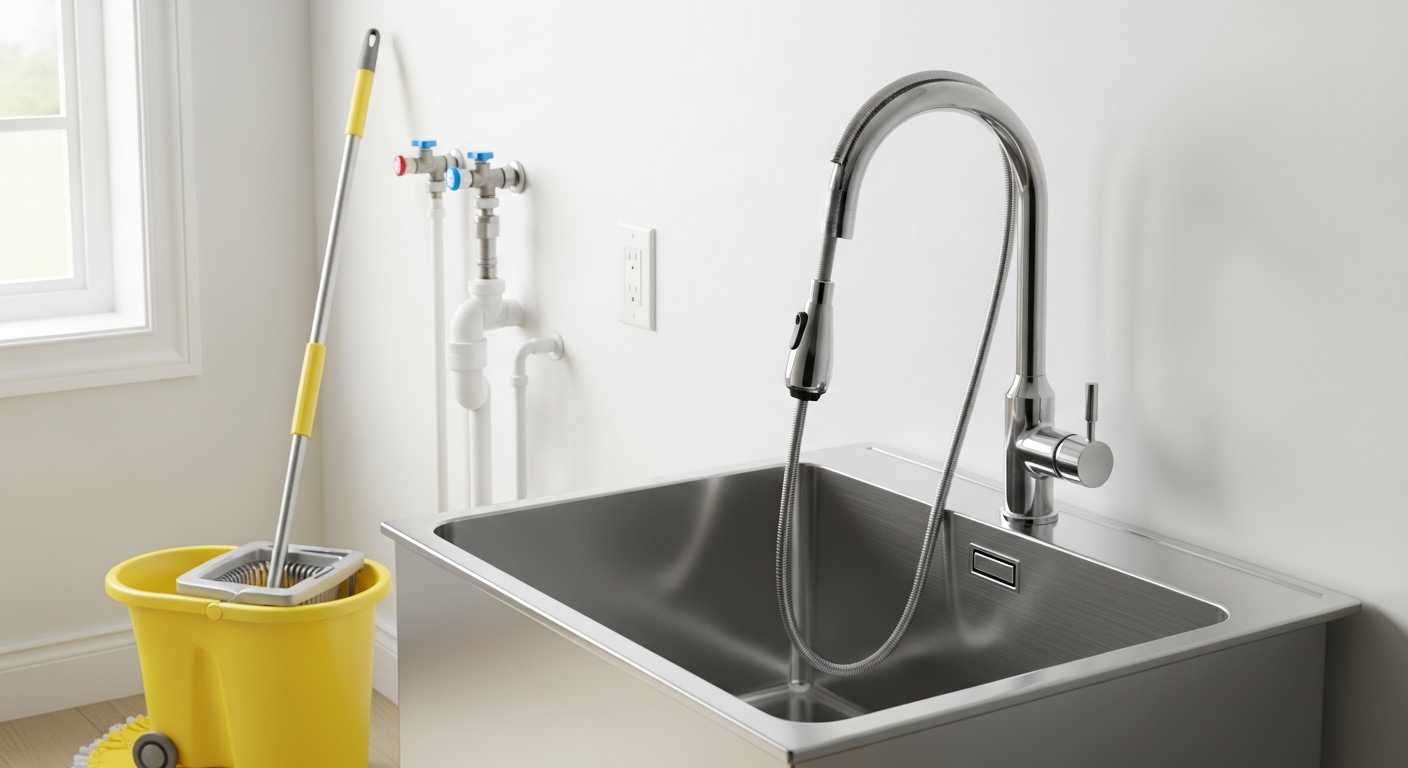
If you’re shopping for laundry taps for sink setups, the honest truth is that a “laundry tap” isn’t one thing — it’s a category built around durability, high water flow, and the ability to fill buckets, rinse mops, hand-wash delicates, and hook up a hose without babysitting it. Unlike a delicate bathroom lav faucet, a laundry tap is a workhorse. This guide walks you through the real questions people ask before buying — mount type, hole size, finish, flow rate, and price — so you land on the right one the first time instead of returning the wrong one.
What exactly is a laundry tap, and how is it different from a kitchen or bathroom faucet?
A laundry tap is a heavy-duty faucet built for a utility or laundry sink, designed to prioritize flow, reach, and abuse-tolerance over looks. The core difference from a kitchen or bathroom faucet is the spout height and the thread on the end: many laundry taps have a hose-threaded (GHT — garden hose thread) spout so you can screw on a hose, plus a taller gooseneck to clear a deep basin and a 5-gallon bucket.
Kitchen faucets are optimized for washing dishes and produce; bathroom faucets are optimized for hand-washing and appearance in a small bowl. A laundry tap sits between an outdoor spigot and a kitchen faucet — rugged like the former, controllable like the latter. Key traits to look for:
- Brass or heavy-duty body — zinc-alloy bodies are cheaper but crack under freeze-thaw and heavy use. Solid brass lasts decades.
- Ceramic-disc cartridge — this is what keeps it drip-free after thousands of on/off cycles. Older rubber-washer compression valves fail faster but are cheap to rebuild.
- High-arc spout (8″–12″ clearance) — so a bucket or watering can fits underneath.
- Hose-thread or aerator spout — GHT for filling and hose hookups, or a standard aerator if you mostly hand-wash.
- Flow rate around 1.8–2.2 GPM — laundry work benefits from more flow than a 1.2 GPM bathroom faucet.
Wall-mount or deck-mount: which laundry tap is right for my sink?
Choose a wall-mount tap if your plumbing comes out of the wall (common in older laundry rooms, garages, and basements) and a deck-mount tap if your utility sink has faucet holes drilled in the rim. That’s the single most important decision, because the mount type has to match how your water supply is stubbed out — you can’t easily convert one to the other without re-plumbing.
Wall-mount laundry taps almost always come as two-handle mixers with a set center distance — most commonly 4″ on-center for laundry/utility use, though 8″ widespread exists. Deck-mount taps sit on the sink deck and come as single-hole single-lever units or 3-hole widespread sets. If you’re replacing an existing tap, measure before you buy: the distance between the two supply inlets (center-to-center) has to match the faucet, and the mounting hole diameter on a deck sink is typically around 1-3/8″. Getting the thread and hole spec right up front saves a painful return — if you’re unsure how faucet threading and hole sizing work, our breakdown of the M6 tap hole size in mm and why it matters for installation explains the mounting-hardware side clearly.
| Feature | Wall-Mount Laundry Tap | Deck-Mount Laundry Tap |
|---|---|---|
| Best for | Garages, basements, older laundry rooms with wall stub-outs | Modern utility sinks with drilled faucet holes |
| Typical config | Two-handle, 4″ center-to-center | Single-lever or 3-hole widespread |
| Spout style | Rigid gooseneck, often GHT hose thread | High-arc, pull-down, or standard aerator |
| Install difficulty | Moderate (secure to backsplash/wall) | Easy (drop through deck holes) |
| Price range | $40–$110 | $55–$140 |
| Hose hookup | Usually built in | Sometimes; check spout thread |
What’s the best laundry tap for a deep utility sink under $100?
For under $100, the best laundry tap for a deep utility sink is a solid-brass, high-arc single-lever pull-down deck faucet with a ceramic-disc cartridge, or — if your supply comes from the wall — a two-handle 4″ wall-mount mixer with a GHT spout. In this price band you can absolutely get commercial-grade durability; you don’t need to spend $150+ unless you want a designer finish or a touchless sensor.
Here’s how the main laundry tap types stack up so you can match one to how you actually use the sink:
| Tap Type | Best Use Case | Spout Reach | Typical Price |
|---|---|---|---|
| Two-handle wall-mount mixer | Garage/basement bucket-filling, hose hookup | 6″–8″ | $40–$90 |
| Single-lever pull-down deck | Laundry room, hand-washing, rinsing large items | 8″–10″ + spray hose | $65–$140 |
| Single-lever high-arc (fixed) | General utility, simple and drip-free | 7″–9″ | $50–$100 |
| Two-handle deck (4″ centerset) | Retro look, easy hot/cold precision | 5″–7″ | $45–$95 |
The pull-down single-lever is the most convenient day to day — the spray head lets you rinse a mop, a paint tray, or a muddy pair of boots and reach every corner of a deep basin. The two-handle wall-mount is the most bulletproof and the easiest to fix, because two-handle bodies are simple and cartridge/washer kits are cheap and universal. If you’re weighing a dedicated utility model, our companion guide on the best laundry utility faucet for a utility sink in 2026 compares specific configurations in more depth.
Do I need a hose connection or a garden-hose thread on my laundry tap?
You need a garden-hose-threaded (GHT) laundry tap if you plan to attach a hose to fill buckets, run a portable washer, water plants, or drain an aquarium — otherwise a standard aerated spout is fine and gives you a softer, splash-free stream. The GHT spout is the single feature that separates a true “utility” tap from a faucet that just happens to be over a laundry sink.
A few things worth knowing about hose-thread laundry taps:
- Male GHT (3/4″) is the standard — the same thread as an outdoor spigot, so any garden hose or hose-end adapter screws right on.
- Most GHT laundry spouts include a removable aerator/adapter, so you can run a soft aerated stream for hand-washing and swap to hose thread when you need it.
- If you connect a hose, add a backflow preventer (vacuum breaker) — many plumbing codes require it so non-potable hose water can’t siphon back into your drinking supply.
If you’re building out a garage or outdoor-adjacent utility area with hoses and quick connects, our guide to outdoor faucet SharkBite push-to-connect solutions covers hose bibs and sillcocks that pair naturally with a hose-threaded laundry tap.
What finish holds up best in a laundry room — chrome, stainless, or bronze?
For a hard-working laundry room, polished chrome and brushed/stainless finishes hold up best because they resist corrosion, hide water spots reasonably well, and wipe clean with a damp cloth. Skip cheap painted or PVD-lite finishes that chip; in a room with detergents, bleach splashes, and constant moisture, finish durability matters more than color.
Quick finish rundown for laundry use:
- Polished chrome — the classic utility choice. Cheapest, toughest, and easiest to find replacement parts for. Shows water spots but cleans instantly.
- Brushed nickel / stainless — hides spots and fingerprints better than chrome, great in a laundry room that doubles as a mudroom. Slightly pricier.
- Matte black — trendy and looks great, but shows lime scale and detergent residue faster; fine if you wipe it down.
- Oil-rubbed bronze — warm, vintage look for a laundry room styled to match the house. It’s a living finish, so it patinas over time. If you love the look elsewhere, see our oil rubbed bronze bathtub faucet buyer’s guide for how the finish wears.
Whatever finish you pick, confirm the body underneath is brass, not zinc alloy. The finish is skin-deep; the metal underneath decides how long the tap lasts.
How do I install a laundry tap myself?
You can install most laundry taps yourself in 30–60 minutes with basic tools — shut off the water, connect the supply lines, mount the faucet, and test for leaks. Deck-mount taps are genuinely beginner-friendly; wall-mount taps take a little more care to seal the threaded connections. No plumber required for a straightforward swap.
Here’s the short version for a deck-mount laundry tap:
- Shut off the hot and cold supply valves under the sink and open the old tap to release pressure.
- Disconnect the old faucet — unthread the supply lines and the mounting nut, then lift it out.
- Set the new tap through the deck hole(s) with its gasket, and tighten the mounting nut from below.
- Connect the braided supply lines — hot to hot, cold to cold — hand-tight plus a quarter turn with a wrench. Don’t overtighten.
- Turn the water back on slowly and check every joint for drips. Run the tap for a minute to clear air and debris from the aerator.
Wall-mount installs follow the same logic but you’ll wrap the threaded inlets with PTFE (plumber’s) tape and thread the faucet body onto the wall stub-outs. For a fuller walkthrough of the connection steps, tools, and common mistakes, our guide to setting up a kitchen faucet yourself without calling a plumber covers the same supply-line techniques that apply directly to laundry taps.
How much water flow do I actually need for laundry tasks?
For laundry and utility work, aim for a flow rate of about 1.8–2.2 GPM (gallons per minute) — enough to fill buckets and rinse quickly, without the wastefulness of an unrestricted spout. That’s higher than the 1.2 GPM you’d want on a bathroom lav faucet, because filling and rinsing benefit from volume, while a low-flow bathroom faucet is about conservation during hand-washing.
A few practical notes on flow:
- Many laundry taps ship with a removable aerator — pop it out and flow jumps to the full unrestricted rate for fast bucket-filling, then reinsert it for splash-free hand-washing.
- If your home has low water pressure, a high-arc single-lever will feel weaker than a two-handle; check that the tap is rated for your pressure (most work from 20–80 psi).
- Hard water clogs aerators over time. A tap with an easy-clean or self-cleaning aerator saves you scrubbing mineral buildup every few months.
Avamani’s take: which laundry tap should most people buy?
For most homeowners, a solid-brass single-lever high-arc laundry tap in chrome or brushed nickel is the sweet spot — it’s drip-free, easy to install, easy to clean, and fits the widest range of utility and laundry sinks. If your supply comes out of the wall, go two-handle wall-mount with a GHT spout. If you fill a lot of buckets or hook up hoses, prioritize the hose-thread spout above everything else.
Don’t overpay for touchless sensors in a laundry room where your hands are already wet and dirty — the money is better spent on a heavier brass body and a genuine ceramic-disc cartridge. Match the mount and inlet spec to your existing plumbing, pick a finish that shrugs off detergent splashes, and you’ll have a tap that outlasts the washing machine next to it.
FAQ
Are laundry taps and utility faucets the same thing?
Essentially yes — “laundry tap,” “utility faucet,” and “laundry sink faucet” all describe the same category: a rugged, high-flow faucet built for a utility/laundry basin. Regional naming differs (“tap” is common in the UK, Ireland, and Australia; “faucet” in the US), but the product is the same. Look for a brass body, high-arc spout, and often a hose-thread spout regardless of what it’s called.
Can I use a regular kitchen faucet on a laundry sink?
Yes, a kitchen faucet works fine on a laundry sink if the hole spacing and inlet match — many people do this for a cleaner look. The trade-offs are that a kitchen faucet usually lacks a garden-hose thread and may have a lower spout, so bucket-filling and hose hookups are harder. If you never attach a hose, a kitchen faucet is a perfectly good laundry tap.
What size are laundry tap supply connections?
Most laundry taps use standard 3/8″ compression supply-line connections at the faucet and 1/2″ at the shutoff valves, with wall-mount models often using 1/2″ threaded inlets. The spout end, if hose-threaded, is a 3/4″ male garden-hose thread (GHT). Always measure your existing valves and center-to-center spacing before buying to guarantee a match.
Why does my laundry tap drip and how do I fix it?
A dripping laundry tap almost always means a worn cartridge (ceramic-disc models) or a worn rubber washer/O-ring (compression models) — both are cheap, DIY-fixable parts. Shut off the water, disassemble the handle, replace the cartridge or washer with a matching kit, and reassemble. If a valve leaks behind the wall rather than at the spout, that’s a different repair; our guide on a leaking faucet valve — causes, fixes, and the right replacement valve walks through diagnosing internal valve leaks.
Do I need a plumber to install a laundry tap?
No, most laundry tap installations are a DIY job for anyone comfortable using a wrench — a deck-mount swap takes 30–60 minutes. You’d only want a plumber if you’re moving or adding supply lines, cutting into walls, or your existing plumbing is corroded and needs replacement. For a straight faucet-for-faucet swap, you can handle it yourself.
What’s the best budget laundry tap that still lasts?
The best budget laundry tap is a two-handle chrome model with a brass body and ceramic-disc valves in the $40–$70 range — simple, drip-resistant, and endlessly rebuildable with universal parts. Avoid the cheapest all-plastic or zinc-alloy taps under $30; they crack and corrode. Spending a little more on a brass body is the single best value upgrade you can make.
About the author: This guide was written by Avamani’s fixtures editorial team, drawing on hands-on installation and bench testing of dozens of utility and laundry faucets across chrome, nickel, black, and bronze finishes. About Avamani: Avamani is a specialist retailer of faucets, showers, and bathroom fixtures at avamani.com, focused on helping buyers match the right fixture to their water, plumbing, and budget. Every laundry tap we recommend is evaluated for solid-brass construction, ceramic-disc cartridge durability, and compliance with standards such as ANSI/NSF 61 for drinking-water safety and cUPC/WaterSense certification where applicable — and we favor models backed by a manufacturer warranty of five years or more on the finish and cartridge.