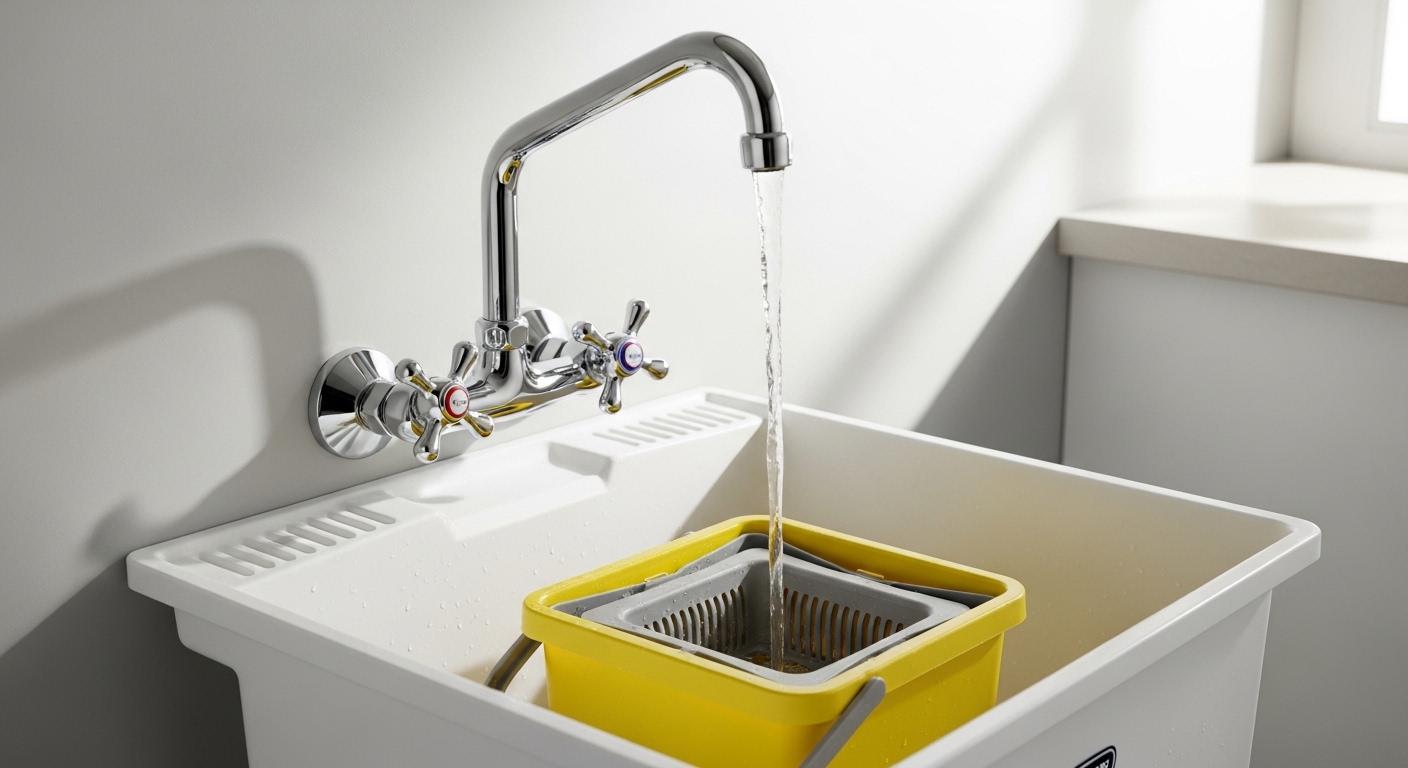
A laundry utility faucet is the workhorse tap you bolt to a utility (laundry) sink or a wall in the laundry room, garage, or basement. Unlike a kitchen or bathroom faucet, it’s built for abuse: filling 5-gallon buckets, rinsing paint brushes, hooking up a garden hose, and taking splashes of bleach without flaking. If you’ve ever fought a spout that’s too short to fit a mop bucket underneath, you already know why the right laundry utility faucet matters more than people expect.
This guide walks through what actually separates a good utility faucet from a cheap one, how to pick between wall-mount and deck-mount, what specs to check before you buy, and how to install it yourself. It’s written for buyers who want the thing to work for a decade, not fail in eighteen months.
What exactly is a laundry utility faucet, and how is it different from a regular faucet?
A laundry utility faucet is a heavy-duty tap designed for a deep utility sink and rough tasks — it has a taller spout, a wider water path, and usually a threaded outlet so you can screw on a hose or an aerator. That threaded tip is the biggest giveaway. Kitchen and bathroom faucets almost never have hose threads; utility faucets almost always do.
Here’s what sets them apart in practical terms:
- Higher clearance: Most laundry utility faucets give you 8–12 inches of spout height so a bucket or watering can fits under the stream.
- Hose-thread outlet: A ¾-inch garden-hose-thread (GHT) tip lets you attach a hose, a spray hose, or a threaded adapter. This is standard on utility taps and rare everywhere else.
- Simpler, tougher guts: Fewer decorative parts, thicker walls, and valves rated for constant on/off cycling.
- Straight cold/hot or single-temp options: Many utility faucets are two-handle so you can mix temperature or run pure cold for a hose fill.
If your “laundry sink faucet” looks like a fancy kitchen tap with a pull-down sprayer, it’ll work — but it won’t survive paint, grout, and bucket duty the way a true utility faucet will.
Should you get a wall-mount or a deck-mount laundry utility faucet?
Get a wall-mount if your supply lines come out of the wall above the sink; get a deck-mount if the faucet holes are on the sink or countertop. That’s the whole decision — it’s driven by where your plumbing already is, not by looks.
Wall-mount utility faucets typically use a 6-inch or 8-inch center (the distance between the two supply inlets), and they hang the spout above the sink so nothing eats into your basin space. Deck-mount faucets bolt down through 1 or 3 holes drilled in the sink rim, the same way a kitchen faucet does. If you’re replacing an existing faucet, match what’s already there — measure the hole spacing before you order anything.
| Feature | Wall-Mount Utility Faucet | Deck-Mount Utility Faucet |
|---|---|---|
| Where it installs | On the wall above the sink | Through holes in the sink/countertop |
| Common connection | 6″ or 8″ center, threaded inlets | 4″ centerset or 8″ widespread, 3-hole |
| Basin space | Maximum — nothing on the rim | Takes up rim space |
| Best for | Concrete/utility tubs, exposed pipes | Molded utility sinks with pre-drilled holes |
| Typical price | $40–$110 | $50–$130 |
One tip most people miss: measuring hole spacing on a utility sink is the same skill you’d use for any faucet install. If you’re new to it, our walkthrough on how to set up a kitchen faucet yourself covers the exact same supply-line and mounting steps, just on a nicer basin.
What size and specs should a laundry utility faucet have?
For a standard utility sink, look for a faucet with 8″ mounting centers (or 6″ for older wall setups), a ½” NPT or ⅜” compression inlet, a spout reach of 6–9 inches, and a ¾” GHT threaded outlet. Those numbers cover roughly 90% of North American laundry and garage sinks.
Break it down before you buy:
- Mounting center: 4″ (centerset), 6″, or 8″. Measure inlet-to-inlet on your existing setup.
- Inlet connection: Most utility faucets use ½”-14 NPT threads or ⅜” compression supply connections. Buy the matching supply hoses.
- Spout reach and height: 6–9″ reach and 8–12″ height clears buckets.
- Outlet threads: ¾” garden hose thread (GHT) is the near-universal utility standard. It lets you add a hose adapter or an aerator.
- Valve type: Ceramic-disc cartridges beat old rubber-washer compression valves — they don’t drip and they handle thousands of cycles.
Thread sizing trips a lot of first-timers up. If you’re not sure how to read a tap-hole or thread spec sheet, our explainer on the M6 tap hole size in mm shows how faucet thread and hole measurements are actually called out, which translates directly to reading utility-faucet spec tables.
What material and finish holds up best in a laundry room?
Solid brass with a chrome or brushed-nickel finish is the most durable combination for a laundry utility faucet — brass resists corrosion from hard water and cleaning chemicals, and the plating shrugs off splashes of bleach, detergent, and paint. Avoid all-plastic bodies for anything beyond light, occasional use.
Material matters more here than in a bathroom because a laundry faucet gets hit with things a bathroom faucet never sees:
| Body Material | Durability | Chemical Resistance | Best Use |
|---|---|---|---|
| Solid brass | Excellent (10+ yrs) | High | Daily heavy use, hoses, buckets |
| Zinc alloy | Good (5–8 yrs) | Medium | Moderate household use |
| Stainless steel | Very good | High | Corrosion-prone, humid rooms |
| Plastic / ABS | Fair (2–4 yrs) | Low–medium | Light, occasional garage use |
On finish: chrome is the cheapest and easiest to wipe clean; brushed nickel hides water spots and fingerprints better; matte black and oil-rubbed bronze look great but show hard-water scale faster in a utility setting. If you love a darker look, know it needs a quick wipe now and then — the same trade-off we cover in our oil rubbed bronze bathtub faucet guide, where finish care makes or breaks how it ages.
Does hard water ruin laundry utility faucets faster?
Yes — hard water is the number-one killer of utility faucets, because mineral scale builds up inside the valve and aerator and eventually causes dripping, weak flow, and stiff handles. A ceramic-disc cartridge and a removable aerator make a huge difference because you can clean or swap them instead of replacing the whole faucet.
If your water leaves white crust on everything, do three things:
- Buy a faucet with ceramic-disc valves — they tolerate scale far better than rubber-washer compression valves.
- Choose a model with a screw-off aerator or hose tip so you can soak it in vinegar every few months.
- Keep the finish simple (chrome/nickel) so scale wipes off instead of etching in.
Scale is also why a leaking valve is the most common utility-faucet complaint. If yours starts dripping down the line, it’s almost always a worn or scaled cartridge, not the whole faucet — the same diagnosis-and-fix logic in our guide on a shower faucet valve leaking applies directly to utility taps.
How do you install a laundry utility faucet yourself?
Most people can install a laundry utility faucet in 30–45 minutes with a wrench, plumber’s tape, and a bucket — you shut off the water, connect the supply lines, mount the faucet, seal the threads, and test for leaks. No plumber required for a standard swap.
Here’s the basic sequence for a deck-mount model:
- Shut off the water at the supply valves under the sink (or the main), and open the old faucet to drain pressure.
- Disconnect the old faucet — loosen supply-line nuts and the mounting nuts, then lift it out.
- Clean the mounting surface so the new base seats flat.
- Drop in the new faucet, thread on the mounting nuts from below, and tighten evenly.
- Wrap threads with plumber’s tape (2–3 turns) and connect the supply hoses — hand-tight plus a quarter turn with a wrench.
- Turn the water back on slowly and check every joint for drips. Snug anything that weeps.
Wall-mount installs are similar but you’re threading the faucet body onto the wall stub-outs; use plumber’s tape and a level so the spout hangs straight. If you’re also hooking a hose or an outdoor line off the utility faucet, our outdoor faucet SharkBite guide covers push-to-connect fittings that make hose and sillcock connections leak-free without soldering.
How much should you spend on a laundry utility faucet?
Spend $45–$130 for a solid, brass-bodied laundry utility faucet that lasts 10+ years — going below $40 usually means a plastic body and rubber-washer valves that drip within a couple of years, while spending above $150 mostly buys designer finishes you don’t need in a utility room.
A quick way to think about the tiers:
| Price Range | What You Get | Who It’s For |
|---|---|---|
| Under $40 | Plastic/zinc body, washer valves | Rare, light garage use only |
| $45–$90 | Brass or stainless, ceramic-disc valves, GHT outlet | Most laundry rooms — the sweet spot |
| $90–$130 | Solid brass, premium finish, sprayer/hose kit | Heavy daily use, garages, workshops |
| $150+ | Designer finishes, brand-name styling | When looks matter as much as function |
The value sweet spot is that $45–$90 band. That’s where you get real brass or stainless, ceramic-disc valves, and a threaded outlet — everything that determines whether the faucet still works in ten years. Everything above that is comfort and cosmetics.
Why buy your laundry utility faucet from Avamani?
Avamani builds faucets and bathroom fixtures for buyers who care about how a product performs over years, not weeks. Our laundry and utility faucets use solid-brass bodies, ceramic-disc cartridges rated for 500,000+ open/close cycles, and lead-free waterways that meet NSF/ANSI 61 and 372 standards for drinking-water safety. Every faucet is pressure-tested before it ships, and our utility models carry a limited lifetime warranty on the finish and cartridge.
Because we sell direct and support both retail and bulk/commercial orders, we can spec faucets for a single laundry room or an entire building’s utility rooms. If you’re outfitting more than one space, the same durability logic in our best bathroom faucet collections guide applies — matching finishes and valve platforms across a project saves you on maintenance parts down the road.
FAQ
Can I use a kitchen faucet as a laundry utility faucet?
Yes, a kitchen faucet will physically work on a utility sink, but it’s not ideal. Kitchen faucets usually lack the ¾” hose-thread outlet, sit lower to the basin, and aren’t built to shrug off paint, bleach, or bucket duty. If you’ll fill buckets or hook up a hose, a purpose-built laundry utility faucet is the better call.
What thread size is a laundry utility faucet outlet?
Almost all laundry utility faucets use a ¾-inch garden hose thread (GHT) at the spout tip. That standard lets you screw on a garden hose, a spray hose, a threaded aerator, or a hose adapter. If you need a different fitting, ¾” GHT adapters are cheap and available at any hardware store.
Do laundry utility faucets come with hot and cold water?
Most do — two-handle utility faucets let you mix hot and cold, which is handy for hand-washing and pre-soaking laundry. Single-handle and single-temp (cold-only) models exist too, and those are common in garages or where only a cold line is run. Check that your sink location has both supply lines before choosing a two-handle model.
Why does my laundry utility faucet drip or leak?
The most common cause is a worn or scale-clogged valve cartridge. In hard-water areas, mineral buildup keeps the valve from sealing, so it drips even when fully closed. On faucets with ceramic-disc cartridges you can usually clean or replace just the cartridge for a few dollars instead of buying a whole new faucet.
How long should a good laundry utility faucet last?
A solid-brass laundry utility faucet with ceramic-disc valves should last 10–15 years or more with basic care. Cheaper plastic-body faucets with rubber-washer valves often start dripping in 2–4 years. Cleaning the aerator periodically and wiping the finish are the only maintenance most units need.
Can I install a laundry utility faucet without a plumber?
Yes. A standard faucet swap takes 30–45 minutes with a wrench, plumber’s tape, and a bucket. You shut off the water, disconnect the old faucet, mount the new one, connect the supply lines, and test for leaks. Only call a plumber if your supply lines are corroded, missing shutoff valves, or need to be rerouted.
Author note: This guide was written by Avamani’s fixtures product team, drawing on hands-on testing of utility and laundry faucets across hard-water and high-use conditions. Specifications reflect common North American plumbing standards; always verify your sink’s hole spacing and supply connections before purchasing.