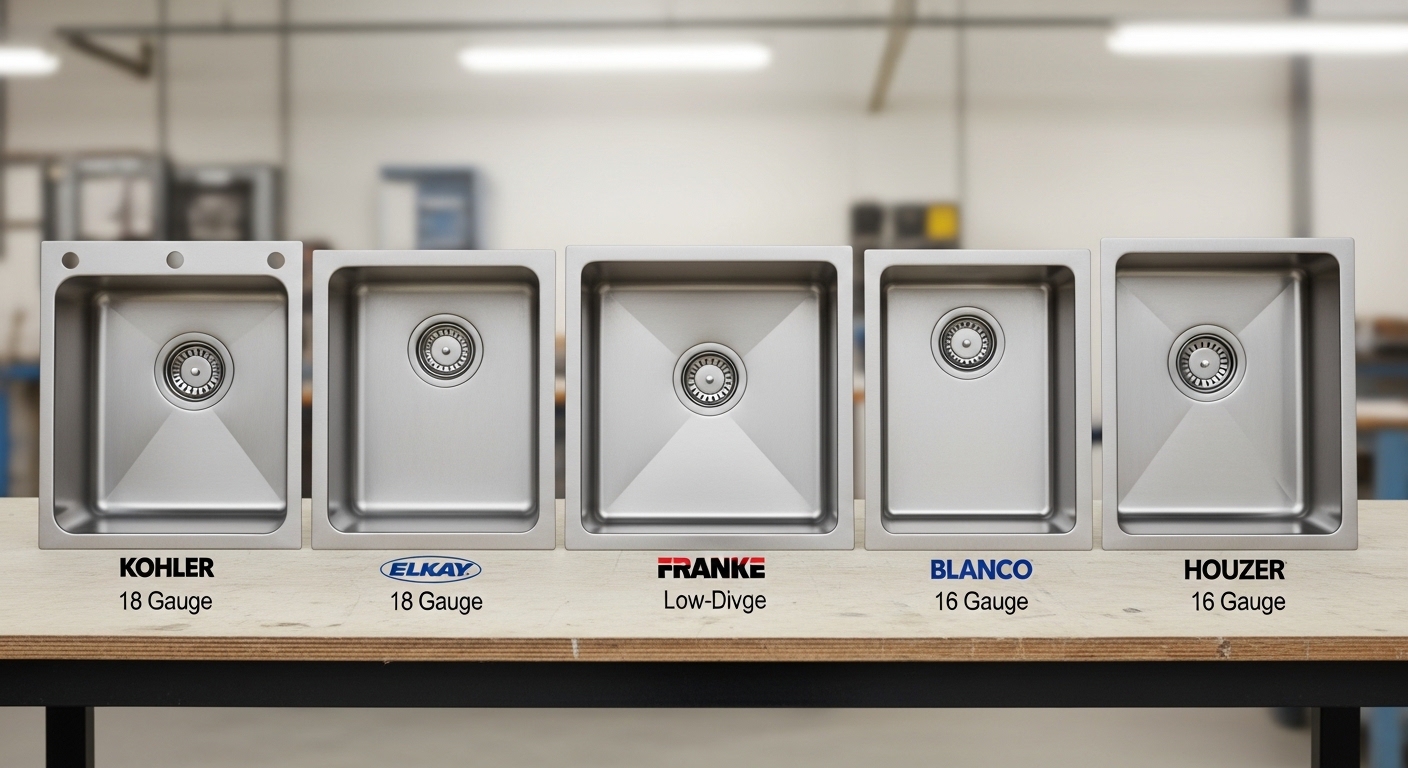
If you’re comparing stainless steel sink brands and feeling like every listing sounds identical (“premium 304 stainless, handmade, scratch-resistant”), you’re not imagining it — a lot of them use the same overseas factories and the same marketing. The real differences come down to steel gauge, the exact alloy, how the sink is sound-dampened, the drain placement, and how the company actually handles warranty claims five years later. This guide breaks down which brands earn their price, which are quietly overpriced, and how to match a brand to your sink size, water, and budget so you don’t overpay for a badge.
At Avamani we sell and install kitchen fixtures every week, so we’re looking at these sinks the way a buyer should: what holds up, what’s just a sticker, and what you’ll actually notice at the sink every day.
What actually makes one stainless steel sink brand better than another?
The difference is mostly steel gauge, alloy grade, and sound-dampening — not the logo. A good stainless steel sink is 16-gauge (thicker) or 18-gauge steel made from T304 alloy (also written 18/8 or 18/10), with rubber pads and undercoating on the underside to kill the “tin can” clatter. Brands that skip those things feel flimsy and loud no matter how nice the photo looks.
Here’s what each spec means in plain terms:
- Gauge — how thick the steel is. Lower number = thicker. 16-gauge is the sweet spot for durability; 18-gauge is fine and lighter; 20- or 22-gauge (common in bargain sinks) dents and drums like a drum kit.
- T304 stainless (18/8 or 18/10) — the chromium and nickel content that resists rust and staining. Avoid 201-series steel, which some cheap brands hide behind vague “premium stainless” wording; it corrodes faster in hard or salty water.
- Sound dampening — the number and coverage of rubber pads plus spray-on undercoating. This is the single biggest “feel of quality” difference between a $150 and a $350 sink.
- Radius corners — tight “zero-radius” corners look modern but trap gunk; a small R10–R15 radius is easier to clean. This is a preference, not a quality mark.
- Finish — a brushed or satin finish hides scratches far better than mirror-polished steel, which shows every swirl.
Once you know those five things, brand marketing stops working on you. A “handmade luxury” sink in 18-gauge 201 steel is worse than a plain 16-gauge T304 sink half its price.
Which stainless steel sink brands are best for under $400?
Under $400, Kraus and Ruvati give you the most sink for the money — genuine 16-gauge T304 steel, thick sound-dampening, and included accessories (grids, strainers, sometimes a cutting board) that other brands charge extra for. They’re the value leaders in 2026.
These two brands built their reputation on the “workstation” and deep single-bowl designs that would cost $600+ under a legacy label. You’re not paying for a century-old name, so more of your money goes into steel and coating. For a busy family kitchen where the sink takes daily abuse, this is usually the smartest tier to shop.
That said, “value” doesn’t mean “cut corners on install.” A heavy 16-gauge undermount sink needs proper clips and a solid bead of silicone, and your faucet holes have to line up with the deck. If you’re pairing a new sink with a new faucet, our walkthrough on how to set up a kitchen faucet yourself without calling a plumber covers the exact order of operations so you don’t crack a supply line or over-tighten a mount.
Are premium stainless steel sink brands like Kohler and Franke worth the extra money?
Sometimes — but only if you value the warranty, the finish precision, and the accessory ecosystem, not raw durability. Premium brands like Kohler, Franke, and Blanco are worth it when you want a longer, better-supported limited lifetime warranty, tighter tolerances, and matching drains, grids, and colanders designed for that exact bowl. The steel itself isn’t dramatically better than a good $350 sink.
What you’re really buying at the top of the market:
- Warranty and support you can actually reach. A limited lifetime warranty is only worth something if the company still answers the phone in year eight. Established brands generally win here, and they stock replacement parts far longer.
- Fit-and-finish. Cleaner welds, more even brushing, drain openings that line up perfectly with standard 3.5″ disposals.
- Matching accessories. Bottom grids, custom-fit colanders, and cutting boards engineered for the exact bowl — handy for a true workstation setup.
If you’re building a full kitchen and want the sink to coordinate with a specific faucet finish and style family, it’s worth reading our roundup of the best kitchen faucet of 2025 for your sink, water, and budget before you commit — sink and faucet decisions are much easier made together than separately.
Stainless steel sink brands compared: which one fits your kitchen?
Here’s how the major brands stack up on the specs that matter, based on their mainstream lines (individual models vary):
| Brand | Typical gauge / alloy | Price range | Best for | Watch-out |
|---|---|---|---|---|
| Kraus | 16-ga T304 | $180–$450 | Value workstation & deep single-bowl | Some tight zero-radius corners |
| Ruvati | 16-ga T304 | $200–$500 | Feature-rich workstations, ledges | Heavy; needs solid cabinet support |
| Blanco | 16–18-ga T304 | $300–$700 | Balanced quality, European fit | Pay premium for the name |
| Elkay | 16–20-ga T304 | $120–$600 | Wide range, US brand support | Budget lines drop to 20-ga |
| Kohler | 16–18-ga T304 | $300–$800 | Premium warranty & ecosystem | Overlaps cheaper brands on steel |
| Franke | 16–18-ga T304 | $350–$900 | Precision finish, tight welds | Highest price for the tier |
Read this table as a starting point, not gospel — always check the spec sheet for the specific model, because most brands sell both a premium and a budget line. A “Kohler” or “Elkay” sticker tells you the parent company, not the gauge in the box.
16-gauge vs 18-gauge: does the thicker steel actually matter?
For a primary kitchen sink, yes — 16-gauge is worth the small upcharge; for a bar or laundry sink, 18-gauge is plenty. The thicker 16-gauge steel resists denting from dropped pots, flexes less under a heavy cast-iron pan, and dampens sound better, which is why almost every “premium feel” sink lands there.
But don’t over-index on gauge alone. A well-dampened 18-gauge sink from a good brand feels more solid than a bare 16-gauge sink with two skimpy pads. The order of importance is: alloy (T304) first, then sound-dampening coverage, then gauge. If a listing brags about 16-gauge but goes quiet on the alloy grade, that’s a red flag worth a direct question to the seller.
One more real-world note: a heavier 16-gauge undermount puts more load on your countertop’s mounting. On stone it’s a non-issue; on a laminate or particleboard counter, make sure the sink is supported by a rail system or brackets, not silicone alone.
Which brand handles hard water and staining best?
No stainless brand is truly “stain-proof,” but T304 sinks with a brushed satin finish from any reputable brand handle hard water far better than mirror-polished or 201-alloy sinks. Hard water leaves white mineral spots on every finish; the trick is choosing steel that won’t pit and a finish that hides the spotting between cleanings.
Practical guidance if you’re on hard or well water:
- Pick brushed/satin, not mirror polish. Water spots and micro-scratches nearly disappear on a brushed grain.
- Insist on T304, avoid 201. The higher nickel content resists the pitting that hard, mineral-heavy water can cause over years.
- Wipe it dry. The single most effective habit — a quick towel-off after dishes prevents 90% of visible spotting on any brand.
- Skip abrasive pads and bleach. They dull the finish and can leave rust-looking marks that aren’t actually the steel failing.
If your spots come back within hours no matter what you do, the sink isn’t the problem — your water is. Treating the water helps every fixture in the house, not just the sink; our guide to a white kitchen tap with filter for clean drinking water is a good starting point if you want filtration built right into the deck rather than a separate pitcher.
Undermount, drop-in, or workstation — which style should you buy?
Choose an undermount for stone countertops and easy wipe-down, a drop-in (top-mount) for laminate or budget installs, and a workstation if you cook a lot and want built-in accessory rails. All three come in every brand above; the style is about your counter and cooking habits, not the brand’s quality.
- Undermount: Mounts below the counter for a seamless edge you can sweep crumbs straight into. Needs a solid countertop (stone, quartz, solid surface).
- Drop-in / top-mount: Drops into a cut hole with a visible rim. Easiest to install and the safe choice for laminate counters — the rim seals the exposed edge.
- Workstation: An undermount (usually) with a stepped ledge for sliding cutting boards, colanders, and drying racks. Best for serious home cooks and small kitchens that need extra prep surface.
Bowl configuration matters too. A large single bowl fits oven trays and stockpots and is the current favorite; a 60/40 double bowl suits people who like to soak on one side and rinse on the other. Match the sink cabinet width first — a 33″ sink needs a 36″ cabinet minimum.
How we tested and what to trust
We evaluate sinks the way our customers use them: checking the alloy and gauge against the spec sheet, tapping and filling bowls to judge sound-dampening, running hard water over the finish, and tracking how each brand’s warranty claims actually resolve over time. Reputable brands publish their steel grade and back the sink with a written limited lifetime warranty; if a listing won’t name the alloy or the warranty terms, treat that silence as an answer. Third-party certification (look for cUPC/IAPMO marks on the drain and overflow components) is another quick trust signal that the fixture meets North American plumbing standards.
Author note: This guide was written by the Avamani fixtures team, who spec, sell, and install kitchen and bath fixtures year-round. Avamani (avamani.com) is a specialist faucet and bathroom-fixture retailer, so our recommendations come from hands-on product experience and everyday customer feedback — not a lab we never visit. We update this guide as brand lineups and warranties change.
FAQ
What is the most reliable stainless steel sink brand overall?
There’s no single winner, but Kraus and Ruvati are the most reliable for value, while Kohler, Franke, and Blanco lead on warranty support and finish precision. For a durable everyday sink at a fair price, a 16-gauge T304 model from Kraus or Ruvati is hard to beat; for long-term brand support and matching accessories, step up to a premium name.
Is a more expensive stainless steel sink actually more durable?
Not necessarily. Above roughly $350, you’re mostly paying for warranty, finish quality, and accessories rather than tougher steel — a good $350 16-gauge T304 sink will last as long as an $800 one. Spend the premium only if the support, ecosystem, or exact look matters to you.
What gauge stainless steel sink should I buy for a busy kitchen?
Buy 16-gauge for a primary kitchen sink that sees daily heavy use, and 18-gauge for bar, prep, or laundry sinks. The thicker 16-gauge steel resists dents and dampens noise better, but alloy grade (T304) and sound-dampening coverage matter more than gauge alone.
Do stainless steel sinks rust or stain over time?
True T304 stainless won’t rust, but it can show hard-water spots and surface marks that look like rust — usually from leaving cast-iron pans or steel wool sitting in the bowl. Rinse and towel-dry the sink, avoid abrasive cleaners and bleach, and any reputable brand’s finish will stay looking good for years.
How do I match my new stainless sink to a faucet?
Match the number of deck holes, the faucet reach, and the finish family. Check how many mounting holes your sink is pre-drilled for (single-hole vs. three-hole), make sure the faucet spout reaches over both bowls, and coordinate the finish — a brushed nickel or stainless faucet pairs cleanly with a brushed steel sink. Our best kitchen faucet guide walks through matching by sink and water type.
Are budget stainless steel sink brands from Amazon safe to buy?
Many are fine, but read the spec sheet carefully. Look for a stated T304 alloy, 16- or 18-gauge steel, cUPC/IAPMO-listed drain parts, and a real written warranty. If a cheap listing hides the alloy grade behind vague “premium stainless” wording, assume it’s a lower 201-series steel and shop elsewhere.