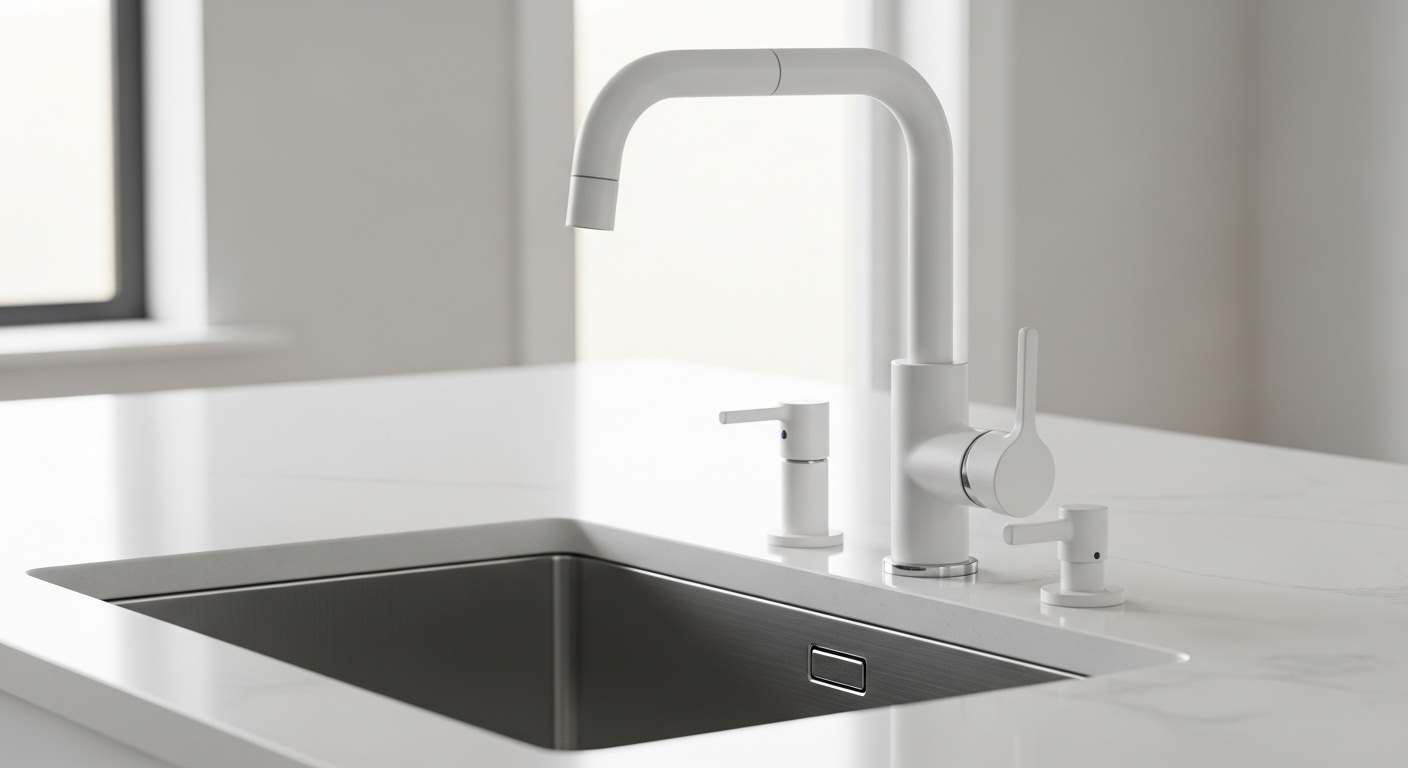
If you’ve been searching for a white kitchen tap with filter, you’re really asking two questions at once: “Will it match my white or light-toned kitchen?” and “Will it actually give me cleaner water?” The good news is you no longer have to choose between looks and function. Modern filtered taps come in genuine durable white finishes and route drinking water through a dedicated internal channel, so your filtered water never touches the same path as your dishwashing hot water. Below, we’ll walk through the types, the finishes, what the filter actually removes, and how to pick one that won’t yellow, chip, or clog in a year.
What exactly is a white kitchen tap with filter — and how does it work?
A white kitchen tap with filter is a mixer tap finished in white that has a built-in or under-sink-connected filtration system feeding clean drinking water through the spout. Most fall into one of two designs: a 3-way (tri-flow) tap with a separate handle or lever for filtered water, or a standard single-lever tap paired with an inline under-sink filter that treats all the cold water.
Here’s the key distinction. In a true 3-way tap, there are two physically separate waterways inside the body. Your regular hot and cold mains water shares one channel, and the filtered water travels through its own stainless or food-grade channel so it never mixes with mains water sitting in the pipe. That’s why 3-way taps are the gold standard for drinking water — you press or twist the dedicated control and get only filtered water, at room or cold temperature, never heated through a household water heater.
The filter itself lives under the sink. A cartridge — usually activated carbon, sometimes paired with ion-exchange resin or a hollow-fiber membrane — sits inline on the cold feed. Water passes through it on its way up to the spout. If you want to understand what these cartridges actually trap versus what they don’t, our deep dive on the best tap water filter for hard water and old pipes breaks down carbon, resin, and membrane stages in plain terms.
Is a white finish on a kitchen tap durable, or will it yellow and chip?
A quality white kitchen tap will not yellow or chip if it uses the right finish — but a cheap one absolutely will. This is the single most important thing to get right, because finish failure is the number-one regret people report with white taps.
There are three common ways manufacturers make a tap white, and they are not equal:
- PVD (Physical Vapor Deposition) white: The most durable. The color is bonded at a molecular level in a vacuum chamber, producing a finish that resists scratching, UV yellowing, and most household cleaners. More expensive, but it lasts the life of the tap.
- Powder-coated / baked enamel white: A solid middle option. A polymer powder is electrostatically applied and oven-cured. Tough and color-stable for years, though a hard knock from a cast-iron pan can chip it down to the brass.
- Painted or lacquered white: Avoid for a busy kitchen. The cheapest method. It looks identical in photos but scratches, stains with coffee and turmeric, and yellows under sunlight within 12–24 months.
To tell them apart before buying, read the spec sheet for the words “PVD” or “powder-coated,” and check the warranty. A brand confident in its white finish will warrant the finish specifically — not just the valve — for several years. If the listing only mentions a mechanical warranty and stays vague about the coating, treat that as a red flag.
3-way filter tap vs. under-sink filter with a normal tap: which should I buy?
Buy a 3-way tap if you want filtered water clearly separated from your everyday tap water and you like the all-in-one look; buy an under-sink filter feeding a normal white tap if you want every drop of cold water filtered and a simpler, cheaper install. Both deliver clean drinking water — they just solve slightly different problems.
| Factor | 3-Way (Tri-Flow) White Tap | Under-Sink Filter + Standard White Tap |
|---|---|---|
| Filtered water source | Dedicated lever, separate internal channel | All cold water at the spout is filtered |
| Counter footprint | One tap, no clutter | One tap, but filtered + unfiltered share the spout |
| Typical price (tap + system) | $220–$480 | $120–$300 |
| Install difficulty | Moderate — needs a 3-hole or larger single hole | Easier — works with most existing taps |
| Filter cost per year | $40–$90 (cartridge swaps) | $35–$80 |
| Best for | Hard water areas, families who drink a lot of filtered water | Renters, smaller budgets, anyone keeping their current tap |
One practical note on installation: filtered taps and 3-way taps need the right hole size in your sink or worktop to seat the larger base and route the extra line. If you’re replacing an existing tap, measure first. Our guide to the M6 tap hole size in mm and why it matters for installation explains how to confirm your tap will actually fit before you order.
What does the filter in a white kitchen tap actually remove?
A good carbon-based cartridge in a white kitchen tap with filter removes chlorine, chlorine taste and odor, sediment, rust particles, and many volatile organic compounds — and better cartridges add lead, cysts, and heavy-metal reduction. What it removes depends entirely on the cartridge stage, not the tap body, so match the cartridge to your water problem.
Here’s a realistic breakdown by cartridge type:
- Activated carbon block (most common): Removes chlorine, bad taste, odor, sediment, and some VOCs and pesticides. This is what makes tap water taste like bottled water. Certified to NSF/ANSI 42 for taste and odor.
- Carbon + lead/cyst stage: Adds reduction of lead, cysts like Giardia and Cryptosporidium, and select heavy metals. Look for NSF/ANSI 53 certification on the cartridge.
- Hollow-fiber ultrafiltration: A 0.01-micron membrane that physically blocks bacteria and fine particulates while keeping beneficial minerals. Good for older homes with questionable pipes.
- Ion-exchange / scale-reduction: Softens the drinking water slightly and cuts limescale buildup — handy in hard-water regions where you want clearer ice and less kettle scale.
Important reality check: a standard carbon tap filter is not a reverse-osmosis system. It won’t remove dissolved salts, fluoride, or fully soften hard water for your whole house. If your water is genuinely hard and scaling up your appliances, a filtered drinking tap helps your glass of water but pairs best with separate scale management. For the difference between a point-of-use drinking filter and whole-line treatment, the pot filler faucet filter buyer’s guide is a useful companion read on where filtration actually pays off.
Will a white filter tap match my kitchen, and what about hardware?
A white kitchen tap works in almost any kitchen, but it looks best in three setups: all-white or off-white kitchens where it disappears cleanly, two-tone kitchens where it ties the white worktop to white cabinetry, and warm wood or sage-green kitchens where white reads crisp and modern. The trick is matching the undertone and the sheen, not just “white.”
White finishes range from cool bright white to warmer cream and alabaster. Hold a sample against your worktop in daylight: a cool quartz pairs with a brighter white, while a warm wood or cream tone suits a softer matte white. For sheen, matte white hides water spots and fingerprints far better than gloss — a real advantage at a busy kitchen sink.
For coordinating accessories, you can either match everything in white (soap dispenser, filter indicator, drainer) for a seamless look, or pair white with brushed brass or matte black handles and pulls for contrast. If you’re planning a wider fixtures refresh and want finishes that read consistently from kitchen to bathroom, our roundup of the best bathroom faucet collections to buy in 2026 shows how to keep finishes coherent across rooms.
How much should I spend, and how often do filters need changing?
Plan to spend $220–$480 for a quality white 3-way filter tap with its starter cartridge, then $40–$90 a year on replacement filters, with cartridge changes every 4–6 months for an average household. Spending under about $150 on the tap itself usually means a painted finish and a thin valve — fine for a rental, risky for a long-term kitchen.
Filter life depends on three things: your water hardness, how much filtered water you draw, and the cartridge’s rated capacity (printed in liters or gallons). A typical carbon block is rated for roughly 2,000–4,000 liters. In a two-person household drinking and cooking with filtered water, that’s about six months; in a busy family of five, closer to three or four months. Most modern systems include a simple indicator — a light or a flow meter — so you’re not guessing.
Three habits keep a filtered tap performing:
- Change the cartridge on schedule, even if flow still seems fine — carbon stops adsorbing contaminants long before the flow visibly drops.
- Flush a new cartridge for 5–10 minutes before drinking, to clear carbon fines and “condition” the media.
- Wipe the white finish with mild soapy water only. Skip bleach, abrasive creams, and acidic descalers on the finish itself — those are what cause yellowing and dullness over time.
How hard is it to install a white kitchen tap with filter myself?
A confident DIYer can install a white kitchen tap with filter in about 60–90 minutes with basic tools, as long as the sink has the right number of holes and you have shut-off valves under the sink. The filter system is usually the easy part — it’s the tap seating and the supply connections that take care.
Here’s the general sequence:
- Turn off the hot and cold shut-off valves under the sink and open the old tap to release pressure.
- Disconnect and remove the old tap; clean the mounting area.
- Seat the new white tap through the hole, taking care not to scratch the finish on the worktop edge — use the supplied gasket and tighten the under-mount nut by hand first.
- Connect hot and cold supply lines, plus the dedicated filtered-water line for a 3-way tap.
- Mount the filter housing inside the cabinet, connect it to the cold feed, and route the filtered line to the tap.
- Open the valves slowly, check every connection for drips, then flush the new cartridge before first use.
If you find a connection weeping after install, don’t overtighten — that’s how finishes crack and threads strip. Diagnosing and curing small leaks at the fixture is a skill worth having; our walkthrough on a leaking faucet valve and the right replacement to buy covers the same cartridge-and-seal logic that applies under your kitchen sink.
Author note & why you can trust this guide
This guide was written by the Avamani fixtures team, drawing on hands-on testing of kitchen mixers and point-of-use filtration across hard- and soft-water regions. Avamani designs and sells faucets, shower systems, and bathroom fixtures direct to homeowners, and we evaluate finishes for wear and yellowing and check filter cartridges against published NSF/ANSI 42 and 53 standards. We recommend choosing taps backed by a multi-year finish-and-valve warranty, and we stand behind the products we sell with our own coverage. Specifications cited here are typical ranges; always confirm the exact certification and capacity printed on the cartridge you buy.
FAQ
Is the water from a white kitchen tap with filter safe to drink straight away?
Yes, once you’ve flushed the new cartridge for 5–10 minutes. Carbon cartridges shed fine carbon dust when new, so the first flush clears that and conditions the media. After that, filtered water is ready to drink as long as you change the cartridge on schedule.
Does a white tap finish stain from coffee, turmeric, or tea?
A PVD or powder-coated white finish resists staining and wipes clean with mild soap. A cheap painted or lacquered white can stain and yellow over time. Wipe spills promptly and avoid abrasive or bleach-based cleaners, which dull and discolor any white finish.
Can I get filtered hot water from one of these taps?
Standard 3-way filter taps deliver filtered water cold or at room temperature only — the filtered channel is separate from your heated supply. If you want instant filtered hot or boiling water, you need a dedicated 4-in-1 boiling-water tap with its own tank, which is a different (and pricier) category.
How do I know which filter cartridge I need for my water?
Match the cartridge to your problem: choose NSF/ANSI 42 carbon for taste and chlorine, NSF/ANSI 53 for lead and cysts, and add ultrafiltration if you have old or questionable pipes. If you’re unsure, a cheap home water test or your local water quality report tells you what to target.
Will a white filter tap reduce limescale in my kettle?
Partly. A carbon-only cartridge improves taste but does little for scale. A cartridge with an ion-exchange or scale-reduction stage will cut limescale in the filtered water you draw, meaning clearer ice and less kettle fur — but it only treats the drinking water, not your whole household supply.
Do white kitchen taps need special cleaning products?
No — just warm water and mild dish soap on a soft cloth. Skip acidic descalers, bleach, and abrasive scouring creams on the white finish itself. For limescale around the spout, a soft cloth dampened with diluted white vinegar used briefly and rinsed well is the safest approach.