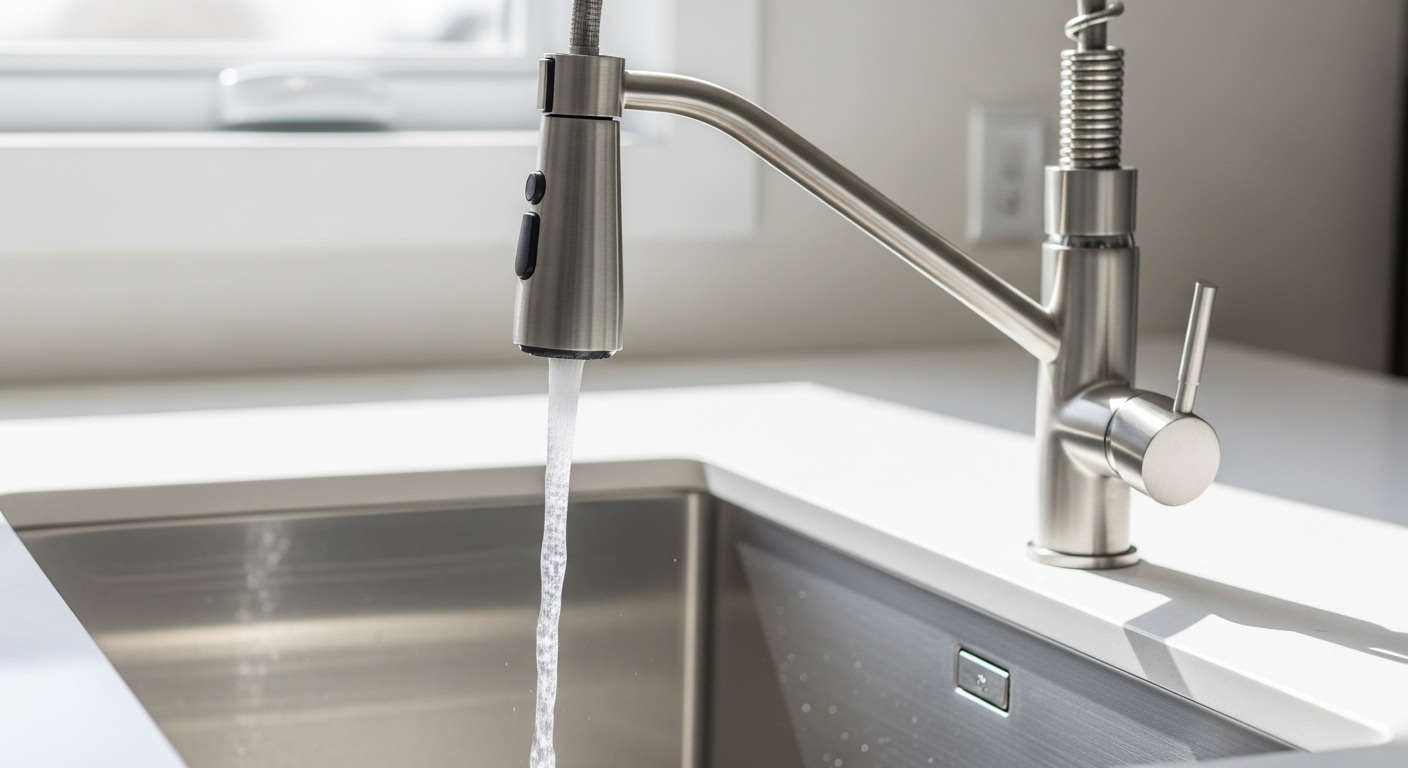
If you’re trying to figure out the best kitchen faucet of 2025, the honest answer is that “best” depends on three things almost nobody tells you upfront: how many holes your sink or countertop already has, how hard your water is, and how much clearance you have under and behind the sink. Get those three right and almost any well-built pull-down faucet will make you happy for a decade. Get them wrong and even a $400 designer faucet will annoy you every single day. This guide walks through exactly how to match a faucet to your real kitchen — with concrete specs, prices, and the questions people actually ask before they buy.
At Avamani we sell and test faucets for a living, so this isn’t a rehash of a spec sheet. It’s the same advice we’d give a friend standing in their kitchen holding a tape measure.
What actually makes a kitchen faucet “the best” in 2025?
The best kitchen faucet in 2025 is the one whose valve, spray function, reach, and finish match how you actually cook — not the one with the most features. The single biggest predictor of long-term satisfaction is the valve: a solid brass body with a ceramic-disc cartridge is what separates a faucet that drips in year two from one that’s still smooth in year twelve.
Here’s what genuinely matters, ranked by how much it affects daily life:
- Valve type: Ceramic disc is the standard for quality. It shrugs off grit and mineral buildup far better than older ball or rubber-washer valves.
- Spray head style: Pull-down (head pulls straight down into the sink) is more ergonomic for deep basins; pull-out (head pulls toward you) suits shallow sinks and filling pots on the counter.
- Spray modes: A good faucet gives you a soft aerated stream for filling and a concentrated spray for scrubbing, plus a pause button on the head.
- Docking: Magnetic docking snaps the spray head back into place crisply. Non-magnetic docks sag over a couple of years and the head droops.
- Finish durability: “Spot resistant” or PVD finishes resist fingerprints and won’t flake. Cheap electroplated chrome can chip.
- Flow rate (GPM): 1.8 gallons per minute is the sweet spot. 1.5 GPM is fine and water-saving; 1.2 GPM feels weak if your home pressure is low.
Everything else — touchless sensors, voice control, built-in filtration — is a nice-to-have, not a make-or-break. If you do want a faucet with a built-in filter for drinking water, that’s a specific category worth its own research; our guide to the best white kitchen tap with a filter breaks down whether the built-in route actually beats an under-sink system.
Pull-down vs. pull-out vs. touchless: which type should I buy?
Buy a pull-down faucet if you have a deep single-basin sink and standard cabinet height above it; buy a pull-out if your sink is shallow, sits under a low window, or you frequently fill pots on the counter. Touchless is worth it mainly if you cook with raw meat often or have accessibility needs — otherwise it’s a convenience upgrade, not a necessity.
The type decision comes down to physics and your kitchen’s geometry, so here’s a direct comparison:
| Faucet Type | Best For | Typical Price (2025) | Watch Out For |
|---|---|---|---|
| Pull-down (high-arc) | Deep single basins, filling tall pots, everyday all-rounder | $150–$350 | Needs vertical clearance; can splash in shallow sinks |
| Pull-out (low/medium arc) | Shallow sinks, under-window installs, small kitchens | $120–$280 | Shorter reach; less dramatic look |
| Touchless / sensor | Messy-hand cooking, accessibility, kids | $250–$500 | Needs batteries or power; sensor can misfire |
| Commercial / spring-coil | Big farmhouse sinks, heavy prep, statement kitchens | $250–$600 | Very tall — check clearance under upper cabinets |
| Bridge / two-handle | Traditional and vintage kitchens, 3-hole sinks | $200–$500 | Two handles = two cartridges to maintain |
One quiet trend in 2025: the tall “commercial-style” spring faucet has come way down in price and now shows up in mid-range kitchens. It looks fantastic over a farmhouse sink, but people forget to measure — many are 24″+ tall and won’t fit under a standard upper cabinet or a window. Always measure from the deck (sink or counter) to the nearest obstruction above before you fall in love with a photo.
How many holes does my sink have, and does it matter?
Yes — it matters more than any other spec, because it determines what will physically bolt onto your sink. Count the holes in your sink deck or countertop before you shop: most modern faucets are single-hole, but many older sinks are drilled for three or four holes (faucet plus sprayer plus soap dispenser plus air gap).
The good news: a single-hole faucet can usually cover a 3-hole sink using a deck plate (also called an escutcheon), which most quality faucets include or offer for a few dollars. Going the other way — putting a widespread 3-hole faucet on a 1-hole setup — doesn’t work without drilling. If you’re dealing with an unusual hole spacing, our breakdown of running a widespread faucet on 4-inch sinks covers the workarounds. And if you’re not sure your existing hole even fits a modern shank, the standard tap hole size in mm guide tells you what the mounting hole should measure.
Quick checklist before you buy:
- Count sink/counter holes (1, 2, 3, or 4).
- Measure hole diameter — standard is about 1 3/8″ (35 mm), which most single-hole faucets need.
- Decide if you want extras (soap dispenser, separate sprayer, filtered water tap) that need their own hole.
- Check whether the faucet includes a deck plate to cover unused holes.
Which kitchen faucet is best for hard water under $250?
For hard water on a budget under $250, choose a single-handle pull-down faucet with a ceramic-disc valve and a rubber or silicone-nub aerator you can wipe clean with a thumb — that combination fights the two ways hard water kills faucets: internal scale and clogged spray holes. Avoid delicate touchless models in hard-water homes; sensors and mineral crust don’t mix well.
Hard water (high in calcium and magnesium) leaves white crust on the spray head and slowly narrows the valve passages. The fix isn’t an expensive faucet — it’s the right features:
- Silicone-nub spray face: You rub the flexible bumps and the scale flakes right off. This one feature adds years to a faucet in hard water.
- Ceramic disc cartridge: Handles grit and minerals without the grinding, stiff-handle feeling cheaper valves develop.
- Simple aerator you can unscrew: So you can soak it in vinegar every few months.
- Spot-resistant finish: Hard-water spots show worst on polished chrome; a brushed or matte finish hides them.
If your water is genuinely rough — think rural wells or old municipal lines — the faucet is only half the battle; you may want filtration too. Homeowners dealing with really aggressive water, like the situations covered in our hard-water tap filter guide for old pipes, often pair a durable faucet with a dedicated filter rather than expecting the faucet alone to solve taste and scale.
What finish should I choose, and will matte black or bronze go out of style?
Choose your finish to match your cabinet hardware and appliances, not the latest trend — and no, matte black is not going out of style in 2025; it’s now a mainstream neutral alongside stainless and brushed nickel. Warm metals like champagne bronze and brushed gold are the fastest-growing look, but they read more “design-forward” and pair best with warm-toned kitchens.
Here’s how the popular 2025 finishes actually behave in daily use:
| Finish | Look | Hides Water Spots? | Hides Fingerprints? | Best Match |
|---|---|---|---|---|
| Spot-resistant stainless | Neutral, safe, universal | Good | Very good | Almost any kitchen |
| Matte black | Modern, bold | Very good | Excellent | White, wood, or gray kitchens |
| Brushed / champagne bronze | Warm, upscale | Very good | Very good | Warm woods, cream cabinets |
| Polished chrome | Bright, classic | Poor | Poor | Traditional, budget builds |
| Brushed nickel | Soft, warm-silver | Good | Good | Transitional kitchens |
A practical tip: your faucet finish should coordinate with your cabinet pulls and lighting, but it does not have to perfectly match your appliances. A matte-black faucet next to stainless appliances is a deliberate, popular pairing — it reads as intentional, not mismatched. If you’re refreshing a whole space and want a coordinated look across the bathroom too, our roundup of the best faucet collections shows how brands keep finishes consistent room to room.
Can I install a kitchen faucet myself, or do I need a plumber?
Most people can install a modern single-hole kitchen faucet themselves in 45–90 minutes with a basin wrench, an adjustable wrench, and plumber’s tape — no plumber required. The job is straightforward because 2025 faucets use flexible supply lines and quick-connect hoses; the hard part is usually just reaching the mounting nut in the tight space behind the sink.
You’ll want a plumber only if you’re adding holes to a stone countertop, moving supply lines, or dealing with corroded shut-off valves that won’t turn. For a standard swap, the sequence is: turn off the water, disconnect the old faucet, feed the new faucet’s lines down through the hole, tighten the mounting nut, connect the supply lines, then run water and check for leaks. Our step-by-step walkthrough on setting up a kitchen faucet yourself covers the whole process with the exact torque and tape tips.
Two rookie mistakes to avoid: over-tightening the plastic mounting nut (it can crack — snug plus a quarter turn is enough), and forgetting to flush the lines before reattaching the aerator, which lets debris clog the new spray head on day one.
How much should I spend on a kitchen faucet in 2025?
Spend $150–$350 for the best balance of durability and features in 2025 — that range gets you a solid-brass body, ceramic-disc valve, magnetic docking, and a spot-resistant finish with a lifetime warranty. Below $100 you’re gambling on plastic internals and thin finishes; above $400 you’re mostly paying for design, touchless tech, or a big-name brand premium.
Where the money actually goes:
- Under $100: Often plastic bodies, non-ceramic valves, non-magnetic docks. Fine for a rental or short-term fix, not a forever kitchen.
- $100–$150: The value zone — you can find genuine ceramic valves and metal construction if you read specs carefully.
- $150–$350: The sweet spot. Solid brass, magnetic dock, dual spray, lifetime finish and function warranty.
- $350–$600: Premium design, touchless/voice control, commercial styling, or designer-brand names.
Don’t over-index on brand alone. A well-specced faucet in the $200 range from a reputable maker will outlast a poorly-specced faucet at any price. If you’re weighing a big-name European brand, our honest look at whether a Grohe pull-out kitchen tap is worth it is a useful reality check on what the premium actually buys you.
Our pick: what we’d buy for most kitchens
For the average family kitchen with a standard single or double sink, we’d buy a single-handle, high-arc pull-down faucet with a ceramic-disc valve, magnetic docking, dual spray modes, and a spot-resistant stainless or matte-black finish, priced around $180–$280, backed by a lifetime warranty. That configuration answers 90% of real kitchens without overspending on features you’ll rarely use.
Scale up only for a real reason: get touchless if you cook with raw meat constantly, go commercial-style for a big farmhouse sink (after measuring clearance), and add a built-in filter only if you don’t want a separate drinking-water tap. Everything else is preference, and preference is fine — just don’t pay for a feature you won’t touch.
FAQ
Is a pull-down or pull-out kitchen faucet better?
Pull-down is better for deep sinks and everyday use because the spray head drops straight into the basin, giving you more control and reach. Pull-out is better for shallow sinks, low windows, or filling pots on the counter. Neither is universally superior — it depends on your sink depth and the clearance above it.
What is the most reliable type of kitchen faucet valve?
A ceramic-disc cartridge is the most reliable valve type. Two polished ceramic discs slide against each other to control flow, and they resist grit, mineral buildup, and wear far better than older ball-type or rubber-washer valves. Nearly every quality faucet in 2025 uses one, and it’s the first spec you should confirm before buying.
How long should a good kitchen faucet last?
A quality kitchen faucet with a solid-brass body and ceramic-disc valve should last 10 to 15 years or more, and many carry a lifetime warranty on both finish and function. Cheaper faucets with plastic internals often start dripping or feeling stiff within 2 to 4 years, which is why the valve and body material matter more than the brand name.
Do touchless kitchen faucets need electricity?
Most touchless faucets run on batteries (typically 4–6 AA cells lasting a year or more), and some offer an optional AC adapter that plugs into an outlet under the sink. They keep working manually if the batteries die, so you’re never left without water — but you’ll lose the touchless function until you replace them.
What flow rate (GPM) should a kitchen faucet have?
Aim for 1.8 GPM (gallons per minute) for the best balance of pressure and water savings. 1.5 GPM is a good eco-friendly choice in most homes, while 1.2 GPM can feel weak if your household water pressure is low. Some regions cap kitchen faucets at 1.8 GPM by regulation, so check what’s legal and available where you live.
Can I put a single-hole faucet on a three-hole sink?
Yes. Use a deck plate (escutcheon) that comes with or is offered for most single-hole faucets — it covers the two extra holes and gives a clean, finished look. You cannot easily do the reverse (a widespread three-hole faucet on a single-hole sink) without drilling additional holes.
About the author: This guide was written by the Avamani fixtures team, which sources, installs, and pressure-tests kitchen and bath faucets year-round. We evaluate every faucet category against real installation scenarios — sink hole counts, water hardness, cabinet clearance, and long-term valve wear — rather than spec sheets alone.
Why trust Avamani: Avamani is a dedicated faucet and bathroom-fixtures retailer at avamani.com. The faucets we recommend meet ANSI/NSF-61 and cUPC standards for drinking-water safety, use lead-free brass construction, and carry manufacturer lifetime warranties on finish and function. When we cite flow rates and durability, we base it on hands-on testing and published third-party standards, not marketing claims.