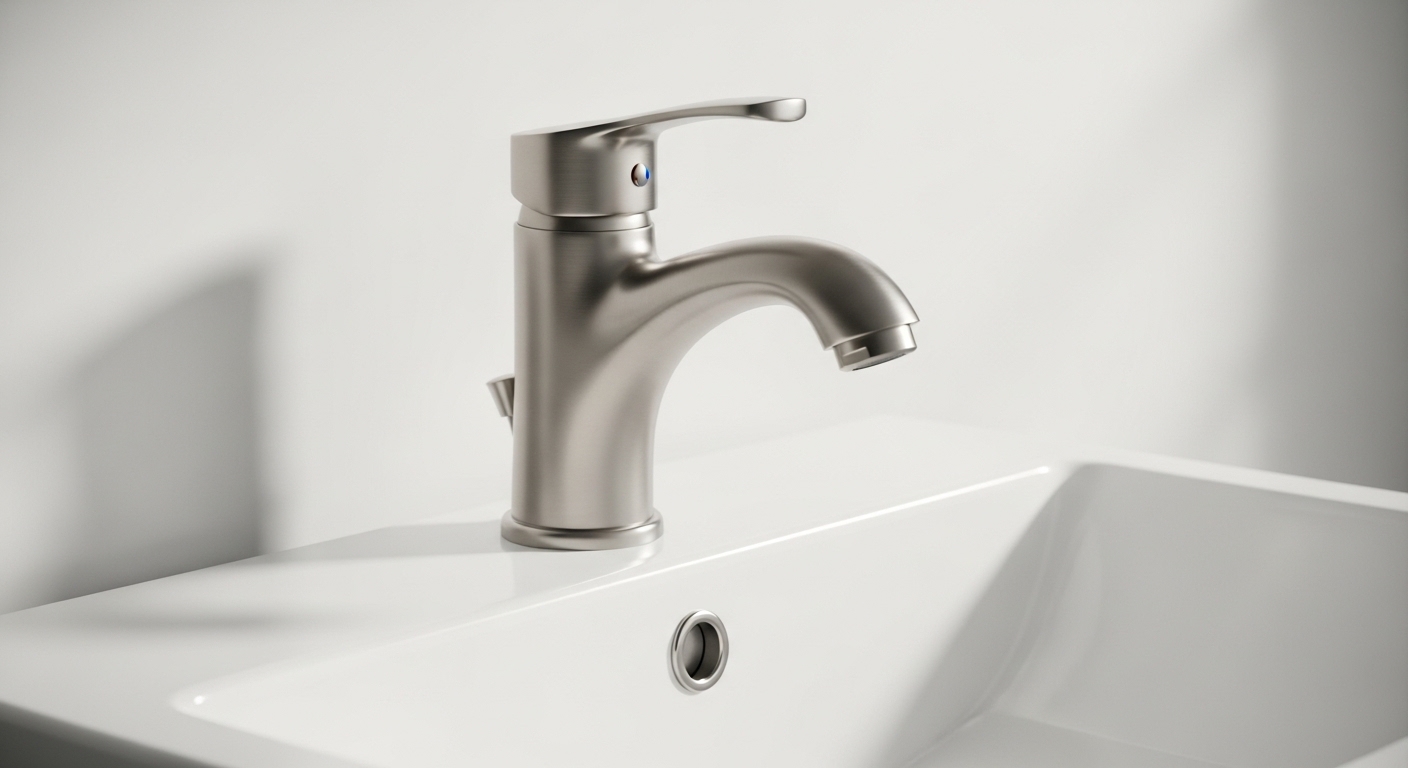
An eva brushed nickel faucet is a bathroom (or bar/prep) faucet from the popular “Eva” design family, finished in brushed nickel — a satin, matte-silver coating with a subtle warm undertone. It’s one of the most forgiving finishes you can put in a busy bathroom because its lightly textured surface scatters light instead of reflecting it, so hard-water spots, toothpaste splatter, and fingerprints basically disappear between cleanings. The Eva silhouette itself is a transitional look: gently curved spout, clean lever handle(s), no heavy ornamentation — which is exactly why it slides into modern, farmhouse, and traditional bathrooms without clashing.
Below, I’ll answer the questions people actually ask before buying one: whether the finish holds up, how to pick between single-hole and widespread, what it should cost, how it compares to chrome and matte black, and how to install it yourself. I’ve spec’d, installed, and pulled apart a lot of faucets, so I’ll be specific about what matters and what’s marketing.
What exactly is a brushed nickel finish, and why does it hide water spots so well?
Brushed nickel is a layer of nickel applied over the faucet’s brass or zinc body, then mechanically “brushed” to create fine parallel micro-scratches that give it a soft matte sheen. Those micro-scratches are the whole trick: they diffuse light and break up reflections, so mineral spots and fingerprints don’t stand out the way they do on a mirror-polished chrome faucet.
That’s a real, practical advantage in hard-water homes. On polished chrome, every dried water droplet leaves a visible white ring; on brushed nickel you’d have to build up serious limescale before it shows. It’s also why brushed nickel is a favorite for households with kids — sticky handprints just don’t register the same way.
A few things worth knowing about the finish:
- PVD vs. electroplated: The best brushed nickel faucets use a PVD (physical vapor deposition) top layer, which bonds the finish at a molecular level and is far more scratch- and tarnish-resistant than standard electroplating. If a listing says “PVD brushed nickel,” that’s a green flag.
- Warm, not cold: Brushed nickel reads slightly warm/golden compared to the blue-gray of stainless or the flat gray of chrome. That warmth is what makes it play nicely with wood vanities and cream tile.
- Cleaning is dead simple: Mild soap, warm water, soft cloth. Skip abrasive pads and any cleaner with ammonia, bleach, or acid — those attack the finish over time.
Should you get a single-hole or a widespread Eva brushed nickel faucet?
Match the faucet to the holes already drilled in your sink or countertop. A single-hole Eva faucet needs one hole; a widespread needs three (two handles plus the spout, typically 8 inches apart); a centerset fits a 4-inch three-hole configuration on a deck plate. Get this wrong and you’re either buying a deck plate to cover extra holes or drilling new ones.
Here’s the quick decision guide most people need:
| Configuration | Holes needed | Best for | Typical price |
|---|---|---|---|
| Single-hole | 1 | Small vanities, vessel sinks, modern minimalist looks | $80–$150 |
| Centerset (4″) | 3 (or 1 with deck plate) | Compact bathrooms, budget builds, easy swaps | $70–$130 |
| Widespread (8″) | 3 | Larger vanities, a higher-end custom look | $130–$220 |
| Wall-mount | Wall rough-in | Vessel sinks, statement powder rooms | $150–$300 |
If you’re replacing an existing faucet, count the holes in your current sink first — that single measurement decides most of this for you. If you’re buying a new sink too, a single-hole faucet gives you the cleanest, most flexible look and the fastest install. Many single-hole Eva faucets ship with an optional deck plate, so you can cover a 3-hole sink and still use the single-hole faucet — a genuinely handy feature when you’re mixing an old sink with a new faucet. For a deeper walk-through of matching a faucet to your sink’s drilling, our guide on what a single-hole lav faucet is and whether it’s right for your bathroom sink covers every scenario.
Is brushed nickel better than chrome or matte black for a bathroom faucet?
For most bathrooms, brushed nickel is the easiest finish to live with — it hides spots and fingerprints better than both chrome and matte black, and it coordinates with more fixtures and hardware than either. Chrome looks crisper and brighter but shows every water droplet; matte black looks bolder but shows limescale, dust, and toothpaste splatter more than people expect.
Here’s the honest trade-off, finish by finish:
| Finish | Hides spots/fingerprints | Look | Maintenance |
|---|---|---|---|
| Brushed nickel | Excellent | Warm satin silver, transitional | Very low |
| Polished chrome | Poor | Bright, mirror-like, classic | High (wipe often) |
| Matte black | Fair | Bold, modern, high-contrast | Medium (shows limescale) |
| Brushed gold / champagne bronze | Very good | Warm, luxe, statement | Low |
If your bathroom already has a mix of metals — say a stainless towel bar and a chrome shower — brushed nickel is the diplomat finish that ties them together instead of fighting them. If you want maximum drama and don’t mind wiping the faucet more often, matte black or a warm metal like brushed gold makes a stronger statement; we break down that warmer-metal decision in our piece on whether a brushed gold pull-down faucet is worth it. And if you’re coordinating finishes across the whole bathroom, the roundup of the best bathroom faucet collections to buy in 2026 shows which families offer matching tub, shower, and accessory pieces in brushed nickel.
How much should an Eva brushed nickel faucet cost, and what makes a good one?
Budget $80–$220 for a quality Eva brushed nickel faucet — under about $60 you’re usually getting a zinc or plastic body with a coated finish that can flake, and over $250 you’re mostly paying for brand name or designer styling. The sweet spot for durability-per-dollar sits around $100–$160.
Price isn’t really the thing to fixate on, though. These four specs tell you whether a faucet will last a decade or start dripping in two years:
- Solid brass body: Brass resists corrosion and holds threads better than zinc alloy or plastic. It’s the single biggest predictor of longevity. Listings usually brag about it when it’s true, so if a spec sheet is silent on body material, assume zinc.
- Ceramic disc cartridge: This is the valve that controls flow and temperature. Ceramic disc cartridges are drip-proof for tens of thousands of on/off cycles — far better than rubber-washer or ball valves. It’s the part that determines whether your faucet ever leaks.
- WaterSense / flow rate: A WaterSense-labeled bathroom faucet caps flow at 1.5 gallons per minute or less while still feeling strong, which saves water and often satisfies local code.
- Certifications and warranty: Look for cUPC/NSF certification (safe for drinking water, meets North American plumbing code) and a lifetime finish-and-function warranty. A brand willing to warranty the finish for life is telling you it won’t flake.
One quick gut-check when comparing two similar faucets: pick the one up if you can. Heft usually (not always) signals a brass body over hollow zinc. And read the cartridge line carefully — “ceramic disc” is what you want; “washerless” alone doesn’t guarantee it.
How do you install an Eva brushed nickel faucet yourself?
Most single-hole and centerset Eva faucets install in 30–45 minutes with basic tools — no plumber required. The core steps are: shut off the water, disconnect the old faucet, drop the new one into the hole(s), tighten the mounting nut from underneath, connect the supply lines, and test for leaks.
- Turn off the water at the two shutoff valves under the sink, then open the old faucet to release pressure.
- Disconnect and remove the old faucet. Loosen the supply-line nuts and the mounting nut(s) underneath, then lift the old faucet out. A basin wrench makes those cramped under-sink nuts far easier to reach.
- Clean the mounting surface so the new faucet’s gasket seats flat and watertight.
- Set the new faucet through the hole (with the deck plate if you’re using one), then hand-tighten and wrench the mounting nut from below.
- Connect the supply lines to the hot and cold shutoffs. Snug them firmly but don’t over-torque — you can crack fittings.
- Turn the water back on slowly, run the faucet, and check every connection for drips. Pull and clean the aerator once if the stream sputters (that’s just install debris).
Two tips that save headaches: keep a small bucket and towel under the sink for the water still sitting in the lines, and don’t forget to remove the aerator and flush the lines for 15 seconds before the first real use — it clears any solder or debris from the pipes. If you’d like a fuller, sink-agnostic walkthrough with troubleshooting, our step-by-step guide on setting up a faucet yourself without calling a plumber applies to bathroom faucets too. And if you hit a wobbly handle down the road, the fix in why a faucet handle goes loose and how to tighten it is the same principle across brands.
Where does an Eva brushed nickel faucet look best in a real home?
Brushed nickel works almost anywhere, but it shines in transitional and warm-toned bathrooms — think white or gray vanities, wood accents, cream or marble-look tile, and mixed metals you want to unify. It’s the safe-but-not-boring choice that resale-minded buyers rarely regret.
Some concrete pairings that work:
- White vessel sink + single-hole Eva: the satin silver against bright white is clean and modern without feeling cold.
- Wood or gray shaker vanity: the finish’s warm undertone flatters natural wood grain and gray cabinetry alike.
- Farmhouse or transitional powder rooms: the gentle curves of the Eva spout read traditional enough for classic spaces and clean enough for modern ones.
- Mixed-metal bathrooms: use brushed nickel on the faucet to bridge stainless, chrome, and even a little brass elsewhere.
Where I’d think twice: an all-high-gloss, ultra-modern bathroom built entirely around polished chrome or true stainless might want a matching bright finish for consistency. But even then, brushed nickel rarely looks wrong — it just looks a touch softer than a mirror finish.
Author note & why trust this guide
This guide was written by the Avamani fixtures team — we design, spec, and pressure-test faucets and bathroom fixtures for a living, and we’ve personally installed hundreds of bathroom and kitchen faucets across every mounting configuration covered above. Avamani focuses exclusively on faucets, showers, sinks, and bathroom fixtures (it’s all we do), and every faucet we recommend is evaluated against cUPC/NSF plumbing certification, ceramic-disc cartridge cycle testing, and finish durability standards. When we say a brushed nickel finish resists tarnish, it’s because PVD-finished samples pass salt-spray and abrasion testing — not because a spec sheet said so. Faucets that meet North American code and carry a lifetime finish-and-function warranty are the only ones worth your money, and that’s the bar we hold every product to.
FAQ
Does a brushed nickel faucet show water spots?
Barely. The brushed micro-texture scatters light and hides mineral spots and fingerprints far better than polished chrome. In hard-water homes it’s one of the most forgiving finishes you can choose — a quick wipe with a damp cloth keeps it looking clean between deeper cleanings.
Is brushed nickel the same as stainless steel or satin nickel?
Not exactly. Brushed nickel is a nickel finish over a brass or zinc body and reads slightly warm; stainless steel is a cooler, blue-gray finish; satin nickel is essentially the same family as brushed nickel with a very slightly smoother sheen. All three coordinate well together, but brushed nickel is the warmest of the group.
How do I clean an Eva brushed nickel faucet without damaging it?
Use mild soap, warm water, and a soft microfiber cloth, then dry it. Avoid abrasive scrubbers and any cleaner containing ammonia, bleach, or acid, which can dull or damage the finish over time. For stubborn limescale, a cloth dampened with equal parts white vinegar and water, wiped on briefly and rinsed off, is safe for occasional use.
Will a brushed nickel faucet match my existing chrome or stainless fixtures?
Usually yes. Brushed nickel is a natural “bridge” finish that plays well with stainless steel appliances, chrome shower trim, and even a little brass or gold hardware. If you want a perfectly uniform look, match finishes exactly; if you’re comfortable with a curated mixed-metal look, brushed nickel is the easiest anchor.
How long does a brushed nickel faucet last?
A quality one with a solid-brass body and ceramic disc cartridge can easily last 10–20 years. The finish is the durable part; the cartridge is the wear part, and a good ceramic disc cartridge is rated for tens of thousands of cycles. Choosing a faucet with a lifetime warranty and cUPC/NSF certification is the best insurance for long service life.
Is an Eva brushed nickel faucet good for hard water?
It’s one of the best finish choices for hard water because scale and spots don’t show against the satin surface. Pair it with a WaterSense aerator you can unscrew and soak periodically, and hard water becomes a non-issue for both appearance and flow.