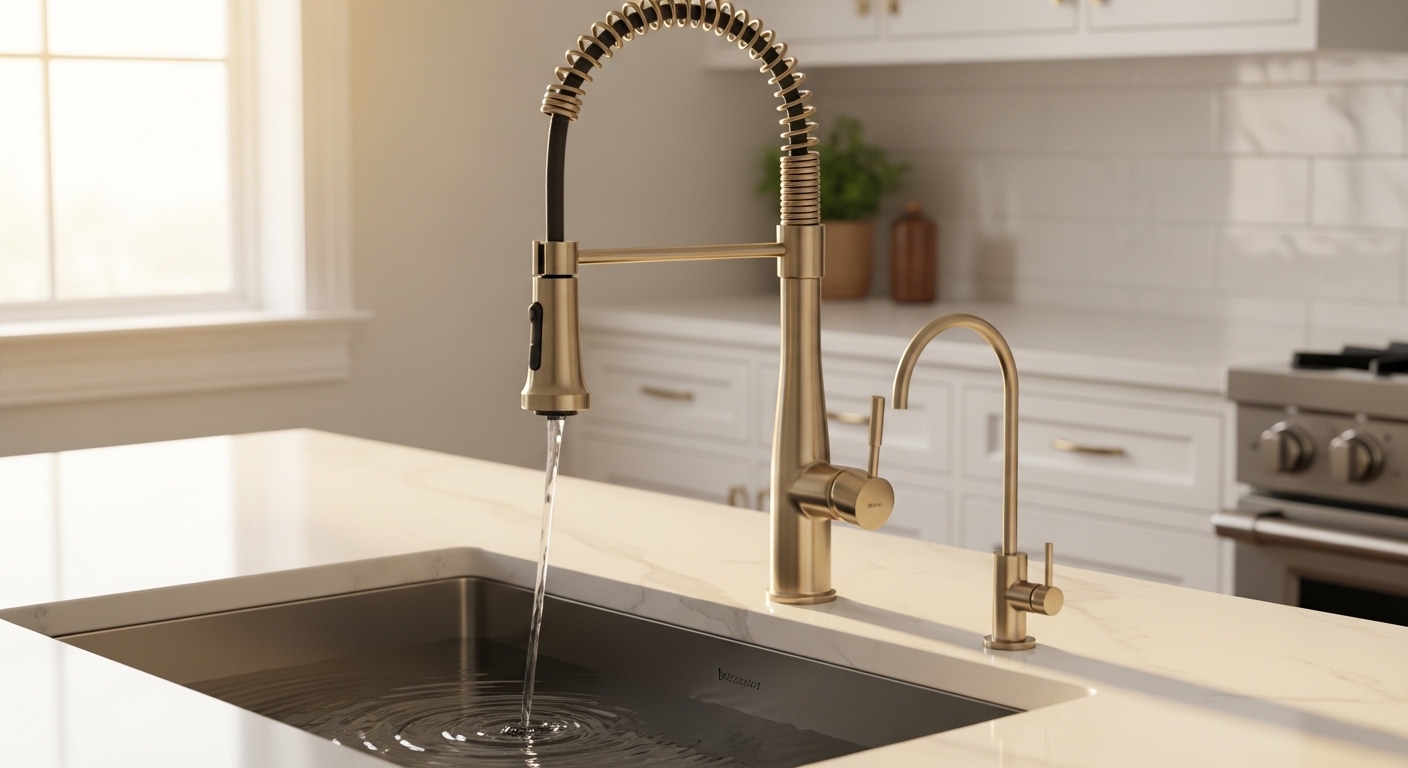
A brushed gold kitchen faucet pull down is one of the fastest ways to make an ordinary sink look like it belongs in a designer kitchen — but only if you buy the right one. The finish is soft and matte with a warm champagne tone, the pull-down spray head docks back magnetically, and the whole thing shrugs off the water spotting that makes chrome look dirty an hour after you clean it. The catch is that “brushed gold” covers everything from a genuine PVD-coated fixture that lasts decades to a $40 spray-painted lookalike that flakes at the spray head within a year. This guide walks you through exactly what to look for, what it should cost, and how to tell the two apart before you spend a cent.
What exactly is a brushed gold pull-down faucet — and how is it different from a pull-out?
A brushed gold pull-down faucet is a kitchen faucet with a warm, matte champagne-gold finish and a spray head that pulls straight down into the sink on a hose, then retracts and re-docks at the top of a tall arc. That’s the key difference from a pull-out faucet, where the spray head pulls horizontally toward you out of a shorter, lower spout.
Here’s the practical takeaway: pull-down faucets suit deep single-bowl sinks and people who want maximum height for filling stockpots, while pull-out faucets suit shorter spaces (like under a window) and shallow sinks. Most brushed gold models on the market today are high-arc pull-downs because the tall silhouette is what shows off the finish. If you’re torn between the mechanisms in general, our deep dive on whether a pull-out kitchen tap is worth it breaks down the ergonomics of each in detail.
The “brushed” part refers to the surface texture. Under magnification, a brushed finish has fine parallel micro-lines that scatter light instead of reflecting it. That’s why fingerprints, hard-water spots, and toothpaste-splatter-style mineral flecks basically disappear on brushed gold — the matte surface has no mirror for them to show up against. Polished gold, by contrast, is a mirror finish that shows every drip.
Does a brushed gold finish actually hold up, or will it wear off?
A quality brushed gold finish holds up for 10+ years — but that depends entirely on how the gold color was applied. This is the single most important thing to check before buying, so let’s be specific.
There are two ways manufacturers put a gold color on a faucet:
- PVD (Physical Vapor Deposition): The gold-tone layer is vaporized and fused to the brass at a molecular level in a vacuum chamber. It’s harder than the underlying metal, won’t corrode, resists scratching, and won’t fade from cleaning chemicals. This is what you want. Look for the phrase “PVD finish” or “spot-resist PVD” in the specs.
- Electroplating / lacquered coating: A thin decorative layer bonded electrically or a colored lacquer sprayed on top. Cheaper to produce, but it can chip at high-wear points (the spray head buttons, the base where you grip it), and it dulls over time. This is what the $40–$80 no-name models use.
If a listing doesn’t say PVD anywhere and the price looks too good to be true, assume it’s a coating. A genuine brushed gold PVD faucet almost always comes with a lifetime finish-and-function warranty, because the manufacturer knows the coating won’t fail. That warranty line is your best proof of quality — no company underwrites a lifetime promise on a finish that flakes.
What should a good brushed gold pull-down kitchen faucet cost in 2026?
Expect to pay between $180 and $450 for a quality brushed gold pull-down faucet in 2026. Below about $150, you’re almost always looking at an electroplated finish or a lightweight zinc-alloy body; above $450, you’re paying for premium brand names and touchless/motion-sensor tech rather than a meaningfully better finish.
Here’s a realistic breakdown of what your money actually buys:
| Price band | What you typically get | Finish quality | Best for |
|---|---|---|---|
| $60–$140 | Zinc/thin-brass body, plastic spray head, basic hose | Electroplated or lacquered — fade risk | Rentals, short-term, tight budget |
| $180–$280 | Solid brass core, ceramic disc valve, magnetic dock, PVD finish | Genuine PVD brushed gold, lifetime warranty | Most homeowners — the sweet spot |
| $300–$450 | Everything above plus heavier spray head, dual-spray modes, better hose weight | Premium PVD, often spot-resist | Daily heavy cooks, design-forward kitchens |
| $450+ | Touchless/motion sensor, voice or app control, designer branding | Premium PVD (same coating, more tech) | Smart-home kitchens, luxury remodels |
The honest advice: the $180–$280 band is where the value lives. You get the same PVD finish and ceramic-disc valve as the expensive models — the extra money above $300 mostly buys convenience features, not a longer-lasting finish. If you want to see how brushed gold stacks up against other finishes and mechanisms across every budget, our roundup of the best kitchen faucets for your sink, water, and budget is a good cross-check before you commit.
Does brushed gold work with stainless steel appliances, or do they clash?
Brushed gold and stainless steel appliances work together beautifully — this is one of the most popular “mixed metals” combinations in kitchen design right now, and it does not clash. The trick is that brushed gold is warm and matte, so it complements the cool, matte tone of brushed stainless instead of competing with it.
A few concrete pairing rules that actually hold up in real kitchens:
- Match the sheen, not the color. Brushed gold pairs best with brushed/satin stainless. Avoid pairing brushed gold with highly polished chrome hardware — the mismatched sheen looks accidental.
- Repeat the gold at least once. Pick up the gold in your cabinet pulls, a pendant light, or bar stool legs so the faucet reads as an intentional design choice, not a lone outlier.
- White, navy, sage, and black are the safest backdrops. Brushed gold pops against white quartz and deep-toned cabinets. On a busy granite, it can get lost.
If you’re planning a fuller fixture story across the whole home, it helps to think in terms of matched collections so your bathroom and kitchen finishes speak the same language — our guide to the best bathroom faucet collections to buy in 2026 shows how brands keep brushed gold consistent from kitchen to vanity.
Brushed gold vs. other popular finishes: which is right for you?
If low maintenance and a warm, high-end look are your priorities, brushed gold beats chrome and matte black for hiding water spots while adding more warmth than either. Here’s how the four most common kitchen faucet finishes actually compare on the things that matter day to day.
| Finish | Hides water spots? | Hides fingerprints? | Look | Watch out for |
|---|---|---|---|---|
| Brushed gold / champagne bronze | Excellent | Excellent | Warm, luxe, matte | Buy PVD only, or it fades |
| Polished chrome | Poor | Poor | Bright, classic | Shows every drip and print |
| Brushed / stainless nickel | Good | Good | Neutral, cool | Can read as “safe/plain” |
| Matte black | Fair | Fair | Bold, modern | Hard water leaves white mineral film |
Note the matte black row: it’s trendy, but on hard water it develops a chalky white mineral film that’s actually more visible than spots on gold. Brushed gold’s warm tone camouflages light mineral residue much better. If you’re on well water or a hard-water municipality, that alone is a strong reason to lean gold over black.
Can you install a brushed gold pull-down faucet yourself?
Yes — most brushed gold pull-down faucets are a genuine one-to-two-hour DIY job with basic tools, no plumber required, as long as your sink already has the right number of mounting holes. A pull-down faucet needs a single hole; if your sink or countertop has three or four holes from an old fixture, you cover the extras with the included deck plate (escutcheon).
The short version of the process:
- Turn off the hot and cold shutoff valves under the sink and open the faucet to release pressure.
- Disconnect and remove the old faucet; clean the sink deck.
- Feed the new faucet’s supply lines and spray hose down through the mounting hole, set the deck plate and gasket, and tighten the mounting nut from below.
- Connect the supply lines to the shutoff valves, attach the pull-down hose to the quick-connect, and clip on the counterweight.
- Turn the water back on, remove the aerator, and run the faucet 15–30 seconds to flush debris before checking for leaks.
The one step people skip and regret: flushing the lines before reinstalling the aerator. Construction debris in new plumbing loves to clog a fresh spray head. For a full walkthrough with torque tips and leak-checking, see our step-by-step guide on how to set up a kitchen faucet yourself without calling a plumber. And if you’re replacing a name-brand unit and want reliability benchmarks to compare against, our breakdown of the most reliable Moen kitchen faucet you can actually buy is a useful reference point for valve and cartridge quality.
What features actually matter on a pull-down (and which are marketing)?
The features that genuinely affect daily use are the valve type, the docking magnet strength, the hose material, and the spray modes — everything else is mostly marketing. Here’s how to read a spec sheet without getting upsold.
Features that matter:
- Ceramic disc valve/cartridge. This controls flow and temperature. Ceramic disc valves outlast rubber-washer designs by years and are drip-free far longer. Non-negotiable.
- Magnetic docking. The spray head should snap firmly back into place and stay there. Weak magnets or spring-only docks let the head droop over time — a top annoyance in reviews.
- Braided nylon hose with a smooth retraction. Cheap hoses kink and lose retraction memory. A weighted counterbalance ensures the head pulls itself back up.
- Dual or triple spray modes. A real stream/spray toggle plus a pause button covers 95% of kitchen tasks.
- Flow rate. Look for 1.5–1.8 GPM (gallons per minute). This is regulated and WaterSense-relevant — lower saves water without feeling weak.
Features that are mostly hype: app connectivity you’ll use twice, dozens of spray “modes” that are really the same two, and “self-cleaning” nozzles (all silicone nozzles wipe clean — that’s not special). Touchless motion sensors are genuinely nice if you cook with messy hands, but they add $100+ and a battery to maintain; buy them because you want them, not because they last longer.
How do you keep a brushed gold faucet looking new?
Clean a brushed gold faucet with nothing more than warm water, a drop of dish soap, and a soft microfiber cloth — then buff dry. That’s the whole routine, and doing it weekly keeps the finish looking new for years. The matte surface is forgiving, but the coating still has enemies.
Rules to protect the finish:
- Never use abrasive pads, scouring powders, or “magic eraser” melamine sponges — they micro-scratch the brushed texture and create shiny dull spots.
- Avoid acidic or bleach-based cleaners, vinegar, and anything with ammonia. These attack PVD far slower than plated finishes, but they still shorten its life. Skip them.
- Dry after heavy use. Even spot-resist finishes look their best when you wipe standing water off, especially with hard water.
If mineral buildup does form on the aerator (you’ll notice reduced flow), unscrew it and soak the aerator alone — not the whole faucet — in a mild descaling solution, then rinse well. Keeping the metal body out of any acidic soak is the key to protecting the gold.
FAQ
Is brushed gold the same as champagne bronze or brushed brass?
Mostly, yes — these are marketing names for very similar warm, matte gold-tone finishes. “Champagne bronze” is a common brand term for a slightly softer, more muted gold, while “brushed brass” can lean a touch warmer and yellower. In practice they coordinate well together, but if you’re matching to existing hardware, order a sample or compare in the same lighting before committing, since undertones vary slightly by brand.
Will a brushed gold faucet go out of style?
Brushed gold has been a mainstream kitchen finish for years now and shows no sign of fading like polished brass did in the ’90s — largely because the matte texture reads as timeless rather than flashy. If you’re worried about longevity, keep the faucet as your warm accent and stick to neutral counters and cabinets; a faucet is also one of the easiest fixtures to swap in an afternoon if trends move.
Does hard water damage a brushed gold finish?
Hard water won’t damage a genuine PVD brushed gold finish — PVD is corrosion-resistant by design. What hard water leaves is a cosmetic mineral film, and brushed gold’s warm matte tone actually hides that film better than chrome or matte black. A weekly wipe-and-dry keeps it invisible. Only the aerator needs occasional descaling.
Can I put a brushed gold pull-down faucet on any sink?
Almost — you need a single mounting hole for the faucet, which nearly every modern sink has. If your sink has 3 or 4 holes from an old setup, the included deck plate covers them, and any leftover hole can host a soap dispenser. Check your under-sink clearance for the tall arc and confirm your countertop hole is at least the standard 1⅜ inch diameter before ordering.
Do brushed gold faucets cost more than chrome?
Slightly, yes — the PVD process that makes the gold finish durable adds cost, so a brushed gold model typically runs $20–$60 more than the identical chrome version. That premium buys you a harder, longer-lasting finish and the low-maintenance, spot-hiding benefit, which most buyers find well worth it over the faucet’s 10+ year life.
What warranty should I expect on a brushed gold pull-down faucet?
A quality brushed gold pull-down faucet should carry a lifetime limited warranty covering both finish and function for the original homeowner. If a faucet only offers a 1–5 year finish warranty, treat that as a signal the coating may be electroplated rather than PVD, and reconsider the purchase.
About the author: This guide was written by Avamani’s fixtures editorial team, drawing on hands-on evaluation of pull-down kitchen faucets across finishes, valve types, and price bands. We assess faucets on finish durability, valve longevity, spray performance, and real installation experience rather than spec sheets alone.
About Avamani: Avamani specializes in faucets, showers, and bathroom fixtures, curating products that meet recognized North American plumbing standards — look for cUPC/NSF certification and WaterSense flow-rate compliance on any faucet you buy. We only recommend PVD-finished brushed gold faucets backed by a manufacturer lifetime finish-and-function warranty, because a finish worth buying is one the maker is willing to stand behind for life.