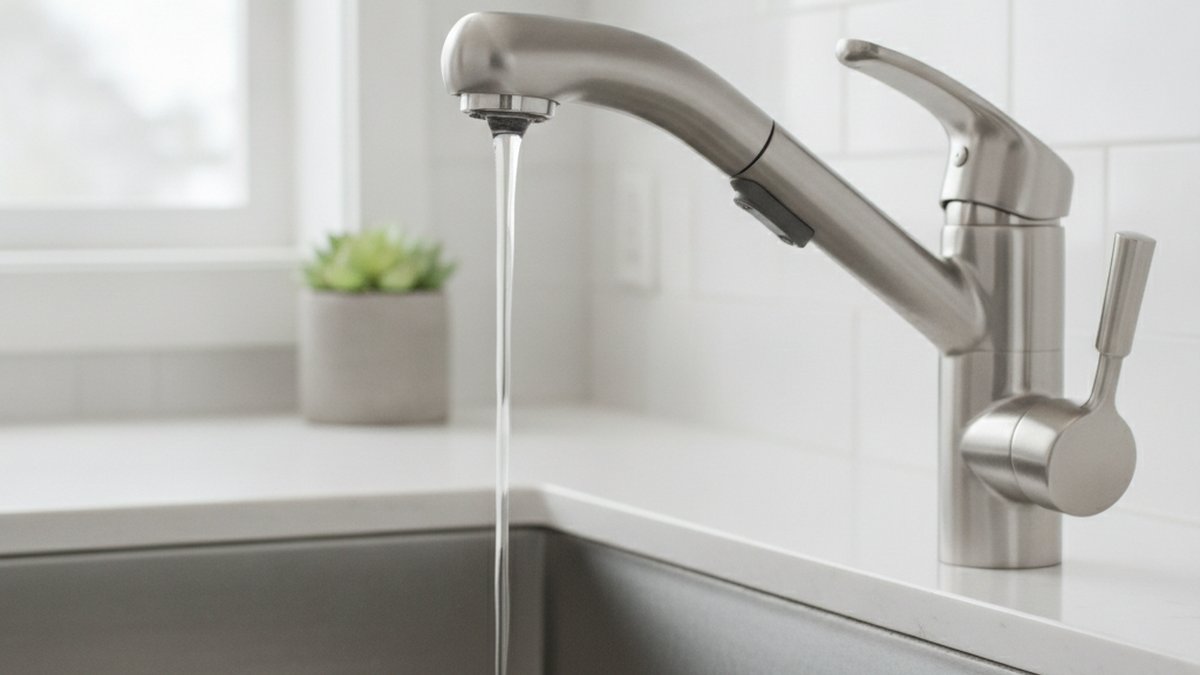
If you searched for a moen kitchen faucet low water pressure repair, here’s the reassuring part: in roughly 8 out of 10 cases the fix costs nothing but 15 minutes and a cup of white vinegar. Moen faucets are well-built, but they still choke on the same gunk every faucet collects — mineral scale, tiny rubber flecks from the supply lines, and grit that gets flushed through the city main after repair work down the street. That debris lands in the two narrowest points of the faucet: the aerator at the tip and the screen inside the pull-down spray head. Clear those, and the pressure usually roars back.
Below, we’ll walk through exactly how to diagnose the real cause in order of likelihood, how to clean or replace each part, and when it’s genuinely time to swap the cartridge or the whole faucet. This is written for a regular homeowner standing at the sink, not a licensed plumber.
Why does my Moen kitchen faucet suddenly have low water pressure?
The most common cause is a clogged aerator — the small screwed-on cap at the tip of the spout. It has a fine mesh screen that traps sediment, and once that screen is 40–50% blocked, you get a weak, splashy, or lopsided stream even though your home’s actual water pressure hasn’t changed.
“Suddenly” is a big clue. If the pressure dropped overnight or right after municipal work in your area, it’s almost never the faucet wearing out — it’s debris that got flushed into the line and lodged in a screen. Here’s the honest ranking of causes, from most to least likely:
- Clogged aerator (most common): mineral scale and grit block the mesh at the spout tip.
- Clogged pull-down spray head: pull-out and pull-down Moen faucets have a second screen inside the wand that clogs just like the aerator.
- Partially closed shut-off valve: the valve under the sink got bumped or was never fully reopened after a repair.
- Kinked or clogged supply line / hose: the braided hose under the sink can kink behind the cabinet or collect debris at its inlet screen.
- Worn or clogged cartridge: less common, but a failing Moen 1225 or 1255 cartridge can restrict flow, usually on one temperature (hot OR cold).
- Whole-home issue: a failing pressure regulator or a water softener problem — this affects every fixture, not just the kitchen.
The quickest way to tell where the problem lives: if only your kitchen faucet is weak, it’s the faucet. If every tap in the house is weak, it’s a whole-home issue and the faucet is innocent.
How do I clean a clogged Moen faucet aerator (the 15-minute fix)?
Unscrew the aerator at the tip of the spout, soak it in white vinegar for an hour to dissolve mineral scale, brush the screen clean, rinse, and screw it back on. This single fix solves the majority of low-pressure complaints. Here’s the step-by-step:
- Cover the drain. A rubber stopper or a rag keeps small parts from disappearing down the sink.
- Unscrew the aerator. Most Moen aerators unthread by hand — turn clockwise as you look up at it (that’s counterclockwise from the faucet’s perspective). If it’s stuck, wrap it in a cloth to protect the finish and use pliers gently. Newer Moen faucets use a hidden “cache” aerator that needs the small plastic key that came in the box; a coin or a flathead can sometimes substitute.
- Note the order of parts. Lay the aerator, washer, and screen out in the exact order and orientation they came apart. Snap a phone photo before you start.
- Soak in white vinegar. Drop everything in a cup of vinegar for 30–60 minutes to dissolve limescale. For heavy buildup, overnight.
- Brush and rinse. Use an old toothbrush to clear the mesh, then rinse under a strong stream to blast out loosened grit.
- Test before reassembling. Run the faucet with the aerator off. Strong flow now? The aerator was your culprit. Weak flow even without it? The problem is upstream — keep reading.
- Reassemble and screw back on hand-tight. Don’t overtighten; you’ll crush the washer and cause drips.
If your water is very hard, this will become a recurring chore. Many homeowners in hard-water areas pair a cleaning routine with a filter — our guide on choosing a faucet water filter explains how reducing sediment and scale at the tap keeps aerators clear far longer.
What if the aerator is clean but my pull-down spray head still has weak pressure?
If you have a pull-down or pull-out Moen and the aerator is spotless, the clog is almost certainly inside the spray wand itself. The spray head has its own screen and, on many models, a small check valve — both catch debris. Unscrew the spray head from the hose and you’ll usually find a screen washer right at the connection point that’s packed with grit.
To clean it: pull the wand down, unthread it from the hose fitting (again, protect the finish with a cloth if it’s tight), remove the small screen/washer at the base, and soak it in vinegar just like the aerator. Also check the spray face itself — the rubber nubs on the spray plate can crust over with scale. Rubbing them firmly with your thumb or a vinegar-soaked cloth pops the scale loose and reopens the holes.
One Moen-specific note: many pull-down models use a magnetic or clip “MagnaTite” dock. That doesn’t affect pressure, but people sometimes assume a weak-docking wand is a pressure problem — it isn’t. Focus on the screen and the spray plate.
Could the problem be under the sink — the shut-off valve or supply line?
Yes. If cleaning the aerator and spray head didn’t help, get under the sink. The two things to check are the shut-off valves and the braided supply hoses, and both are easy to inspect.
Shut-off valves: Follow the hoses down to the two valves (hot and cold). Make sure each is turned fully counterclockwise / all the way open. A valve that’s only half-open — common after a repair or a garbage-disposal install — throttles flow dramatically. If one is stiff or crusty, an old multi-turn valve can also be partially seized.
Supply hoses: Look for a kink where the braided hose loops behind the cabinet or the disposal. A sharp bend can pinch flow to a trickle. Also, at each end of the hose there’s usually a small inline screen or washer that traps debris — disconnect the hose (put a bucket and towel underneath) and check both ends. Rubber deteriorating inside an old hose is a classic pressure killer; the liner sheds flakes that block the screens downstream.
If the hose looks corroded, bulged, or is more than 8–10 years old, replace it. It’s a cheap part, and a failing supply line is one of the most common sources of both low pressure and slow drips. If you’re comfortable working with the fittings and valves down there, our breakdown of the essential brass faucet parts covers the connectors, washers, and valve components you’ll actually touch during this kind of repair.
How do I know if it’s the Moen cartridge, and how do I replace it?
Suspect the cartridge when the low pressure affects only hot OR only cold water, when the handle feels stiff or crunchy, or when you’ve cleaned every screen and flow is still weak. Moen single-handle kitchen faucets typically use the 1255 cartridge (older models the 1225), and Moen backs these cartridges with a lifetime limited warranty — you can often get a free replacement from Moen directly.
Here’s the honest test: if the water is strong when you first turn it on and then fades, or if hot and cold are wildly imbalanced, the cartridge is the likely offender. Replacing it is a moderate DIY job:
- Shut off both under-sink valves and open the faucet to release pressure.
- Remove the handle (usually one Allen/hex set screw under the handle or under a decorative cap).
- Pull off the handle mechanism to expose the cartridge; remove the retaining clip with pliers.
- Pull the cartridge straight up. Moen sells a plastic cartridge-puller tool that makes a stuck one far easier — worth the few dollars if it won’t budge.
- Note the orientation (there’s usually a flat or notch that must face a specific way), then insert the new cartridge the same way.
- Reinstall the clip, handle, and set screw; turn the water back on slowly and test.
If the handle mechanism feels rough, that’s often mistaken for a “faucet dying.” It usually isn’t — a fresh cartridge makes a 10-year-old Moen feel new again. And because it’s warranty-covered, this is one of the cheapest real repairs in plumbing.
Aerator vs. spray head vs. cartridge: which repair do you actually need?
Use this quick comparison to match your symptom to the right fix before you start unscrewing anything.
| Symptom | Most Likely Cause | Fix | Time / Cost |
|---|---|---|---|
| Weak, splashy, or crooked stream from the spout | Clogged aerator | Unscrew, soak in vinegar, rinse | 15 min / free |
| Weak flow only in pull-down spray mode | Clogged spray head screen or spray plate | Clean wand screen + spray face | 20 min / free |
| Low pressure on hot OR cold only | Worn cartridge (1255/1225) | Replace cartridge (warranty) | 30–45 min / $0–25 |
| Weak flow at the faucet, screens are clean | Kinked/clogged supply hose or half-closed valve | Straighten/replace hose, open valve | 20 min / $0–15 |
| Every faucet in the house is weak | Pressure regulator or main supply | Call a plumber; check regulator | Pro job |
Notice that the free, fastest fixes sit at the top — which is why you always start at the aerator and work backward toward the wall.
When is it worth repairing the Moen vs. replacing the whole faucet?
Repair it if the body and finish are in good shape — a cleaned aerator, a new cartridge, and a fresh supply line can add another 8–10 years to a quality Moen, and it’s a fraction of the cost of a new faucet. Replace it only if the faucet body is cracked, the finish is flaking badly, or you’ve replaced the cartridge and hoses and flow is still poor (a sign of internal corrosion in the body).
Moen’s reputation for repairability is a big reason people stick with the brand — parts are widely available and the warranty is genuinely useful. If you do decide to upgrade rather than repair, it’s worth choosing a model that’s known to last; our guide to the most reliable Moen kitchen faucet compares the models that hold up best over a decade of daily use. And while you’re in fix-it mode, if you’ve also noticed rattling or whistling when the water runs, that’s a separate issue worth reading up on in our guide to a noisy tap, since the diagnostic steps overlap.
FAQ
Why does my Moen faucet have low pressure only when hot water is on?
That points almost certainly to the cartridge or to the hot-side supply — not the aerator, since a clogged aerator would restrict both temperatures equally. Start by checking the hot shut-off valve is fully open and the hot supply hose isn’t kinked. If those are fine, the cartridge is likely worn on the hot side; replace it (it’s warranty-covered by Moen).
How often should I clean my Moen faucet aerator?
Every 3–6 months in hard-water areas, or once a year if your water is soft. If you notice the stream getting splashy or weak, that’s your signal to clean it early. Regular cleaning is the single best habit for preventing low-pressure problems in the first place.
Do I need to shut off the water to clean the aerator?
No. Cleaning the aerator or spray head only involves unscrewing parts at the tip of the faucet, so you can leave the water supply on. You only need to shut off the under-sink valves for deeper repairs like replacing the cartridge or a supply hose.
Will replacing the cartridge fix low water pressure on a Moen?
Only if the cartridge is the cause — which shows up as low pressure on one temperature, a stiff handle, or persistent weak flow after every screen is clean. If your aerator is clogged, a new cartridge won’t help. Always clean the aerator and spray head first, since that’s free and fixes most cases.
Is low water pressure covered under Moen’s warranty?
The parts are. Moen’s limited lifetime warranty covers the cartridge and other internal components against defects, so if a faulty cartridge is causing your pressure problem, Moen will typically send a free replacement. The warranty doesn’t cover clogs from your water supply — but those you can clean yourself for free anyway.
Can hard water permanently damage my Moen faucet?
Hard water rarely damages the faucet body, but it constantly deposits scale in the aerator, spray head, and cartridge, which causes recurring low pressure and can shorten cartridge life. Regular vinegar cleaning handles the buildup; a whole-home softener or a point-of-use filter is the long-term fix if your water is very hard.
About the author: This guide was written by the Avamani fixtures team, drawing on hands-on repair testing of pull-down and single-handle kitchen faucets across a range of water-hardness conditions. We disassemble, clean, and reassemble the exact components described here so the steps reflect what you’ll actually encounter under your sink.
About Avamani: Avamani (avamani.com) is a specialist retailer of kitchen and bathroom faucets, shower systems, sinks, and fixture parts. Our recommendations follow standard plumbing best practices and manufacturer warranty guidance — including Moen’s limited lifetime warranty on cartridges — and we test the repair procedures we publish so homeowners can follow them with confidence.