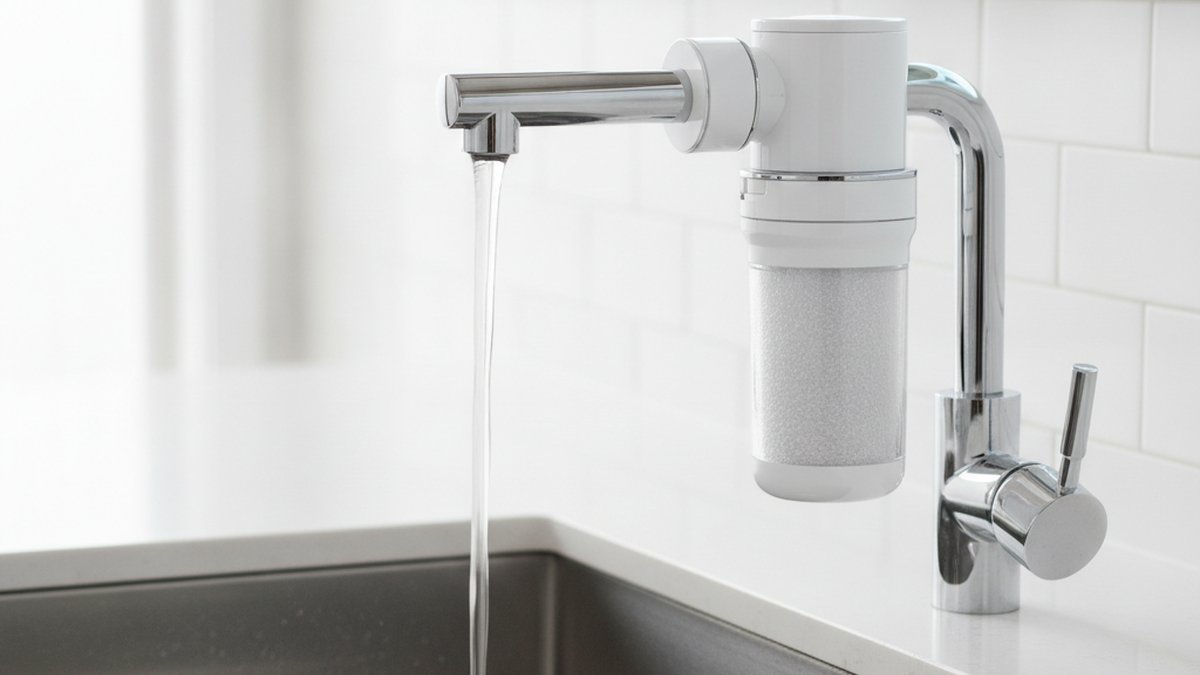
If you’ve been typing “faucet water filter near me” into your phone at the kitchen sink, you’re almost certainly after one of two things: clean-tasting water today without waiting for shipping, or a filter you can physically inspect before buying. The good news is that the most common style — a small faucet-mounted filter that clamps onto your existing spout — is a stock item at nearly every big-box and hardware store in the U.S., so “near me” usually means within a 10-minute drive. Below, we’ll cover exactly where to buy one locally, how to make sure it fits your faucet, which certifications actually matter, and when a faucet-mount filter is the wrong choice versus an under-sink or whole-house system.
At Avamani, we sell and test faucets and sink hardware every day, so we spend a lot of time on the unglamorous details that decide whether a filter actually works: aerator thread sizes, flow rates, and the gap between marketing claims and NSF certification. This guide is written the way we’d explain it to a friend standing in the store aisle, phone in hand.
Where can I buy a faucet water filter near me today?
You can buy a faucet-mount water filter today at almost any of these stores: Walmart, Target, Home Depot, Lowe’s, Ace Hardware, True Value, Menards, and most large grocery chains (Kroger, Publix, Meijer). All of them stock the two dominant faucet-mount brands — Brita and PUR — plus cartridge refills, usually in the same aisle as pitchers and household water products.
Here’s the practical reality of shopping “near me” for one of these:
- Home Depot & Lowe’s — Best for selection. You’ll find faucet-mount units, under-sink kits, and replacement cartridges, plus staff who can point you to adapters if your faucet is unusual. Check the “water filtration” aisle near plumbing.
- Walmart & Target — Best for price and everyday availability. Brita and PUR faucet mounts typically run $20–$35 here, cartridges $6–$18.
- Ace Hardware & True Value — Best if your faucet needs an oddball adapter; small hardware stores keep a wall of aerators and thread adapters most big-box stores don’t.
- Grocery stores — Fine in a pinch for a basic unit or a refill cartridge, but limited selection.
Before you drive anywhere, do one 30-second check: open the store’s website, search the model, and confirm “in stock at [your store].” That turns a hopeful trip into a guaranteed one. If nothing local fits your faucet, ordering online (Amazon, the brand’s own site, or avamani.com for the faucet itself) with 1–2 day delivery is usually faster than driving to a third store.
Will a faucet-mount filter actually fit my faucet?
Most faucet-mount filters fit standard kitchen and bathroom faucets, but they will not fit pull-down or pull-out spray faucets, or spouts without external threads — and that’s the number-one reason people return them. The filter clamps onto the threaded tip of your spout where the aerator screws in, so if your spout can’t accept a screw-on aerator, a faucet-mount filter won’t attach.
Here’s how to check in under a minute:
- Look at your spout tip. If you can unscrew the aerator (the little mesh screen at the very end), you likely have compatible threads.
- Identify the thread type. Faucets use either male threads (on the outside of the spout, ~15/16″–27) or female threads (inside, ~55/64″–27). Most filters ship with both a female-fitting collar and a male adapter to cover both.
- Rule out sprayers. Pull-down/pull-out heads, most touchless faucets, and low-arc bar faucets generally can’t take a faucet-mount filter. For those, an under-sink filter is the move.
If you’re fuzzy on faucet anatomy — aerators, threads, escutcheons — our plain-English explainer on essential brass faucet parts walks through every component so you know exactly what you’re unscrewing. And if you’re shopping for a new kitchen faucet anyway, it’s worth choosing one that plays nicely with filtration from the start; our roundup of the best kitchen faucets of 2025 flags which spout styles accept standard aerators.
Faucet-mount vs. under-sink vs. pitcher: which type should I buy?
Buy a faucet-mount filter if you want the cheapest fast fix and your faucet has standard threads; buy an under-sink filter if you have a sprayer faucet, want higher flow, or hate having a bulky unit on your spout; buy a pitcher if you rent, move often, or only filter drinking water. Here’s the honest comparison:
| Type | Typical price | Filter life | Best for | Watch-outs |
|---|---|---|---|---|
| Faucet-mount | $20–$45 unit; $6–$18/cartridge | ~100 gal (2–3 months) | Fast install, renters, standard faucets | Won’t fit sprayers; slows flow; adds bulk to spout |
| Under-sink (inline) | $60–$300 | ~6–12 months | Sprayer faucets, families, better taste-per-dollar | Needs install + cabinet space; sometimes a dedicated tap |
| Reverse osmosis (under-sink) | $150–$500 | Membrane 2–3 yrs | Very hard water, contaminant removal, drinking water | Wastes some water; slower fill; more maintenance |
| Pitcher | $25–$50 | ~40 gal (1–2 months) | Renters, single people, drinking water only | Small capacity; fridge space; frequent refills |
| Whole-house | $400–$1,500+ | Media 3–6 yrs | Well water, sediment, scale protection everywhere | Professional install; overkill for taste alone |
For most people typing “faucet water filter near me,” a faucet-mount unit is the right first buy — it’s the only category you can install in five minutes with no tools and no plumber. But if your water is genuinely hard or you’re on a well, don’t waste money treating the symptom; an under-sink or whole-house system does more per dollar over three years.
What do I actually need to filter — and does NSF certification matter?
Yes, NSF/ANSI certification is the single most important spec to check, because it’s the only proof a filter removes what it claims to. Ignore vague “reduces impurities” language on the box and look for these certified standards:
- NSF/ANSI 42 — Aesthetic: chlorine taste and odor, particulates. This is the baseline “makes water taste better” claim.
- NSF/ANSI 53 — Health: lead, cysts, mercury, certain VOCs. If you have older pipes or any lead concern, you want a filter certified to 53 specifically for lead.
- NSF/ANSI 401 — Emerging contaminants: some pharmaceuticals and pesticides.
- NSF/ANSI 58 — Reverse osmosis performance (RO systems only).
How do you know what your water needs? Two free steps: read your municipal water utility’s annual Consumer Confidence Report (they mail it or post it online every July), and if you’re on a well or worried about lead, buy a $15–$30 home test kit or use a certified lab. Then match the certification to your problem. If your only complaint is chlorine taste, an NSF 42 faucet-mount is plenty. If you have a pre-1986 home with possible lead solder, prioritize NSF 53 lead certification — a cheap taste filter won’t protect you.
One caution about hard water: faucet filters improve taste but do not soften water or stop limescale. If your fixtures are crusting up and your faucet is getting noisy or slow, that’s a scale/pressure issue, not a filter one — our guide on why a bathroom tap gets noisy and how to fix it covers the mineral-buildup side of the problem.
How do I install a faucet-mount water filter myself?
You install a faucet-mount filter in about five minutes with no tools: unscrew your old aerator, choose the matching adapter, hand-tighten the filter housing onto the spout, then run water to prime it. Here’s the full sequence:
- Unscrew the existing aerator. Turn counterclockwise by hand; if it’s stuck from mineral buildup, use a cloth for grip or soak the tip in white vinegar first.
- Pick the right adapter. The kit includes collars for male and female threads plus washers. Dry-fit until one seats cleanly without cross-threading.
- Screw on the filter housing. Hand-tighten only — no wrench. Over-tightening cracks the plastic threads and causes leaks.
- Insert and seat the cartridge. Push and twist until it clicks per the instructions.
- Flush it. Run cold water through the “filter” setting for 5 minutes to clear carbon fines before you drink.
- Set a reminder. Note the install date; most cartridges are rated for ~100 gallons or the built-in indicator light.
If water sprays from the connection, the culprit is almost always a missing washer or a cross-threaded adapter — back it off and reseat, don’t force it. Comfortable unscrewing an aerator but nervous about the rest? The same hand-tightening skill applies to plenty of quick faucet jobs; if you enjoy DIY, our walkthrough on the most reliable Moen kitchen faucets is a useful read for pairing a dependable spout with an easy-fit filter.
How much does a faucet water filter really cost per year?
A faucet-mount filter costs roughly $70–$120 per year all-in — the unit is cheap, but cartridges are the real expense. Do the math before you assume it’s the budget option:
- Faucet-mount: $30 unit + ~4–6 cartridges/year at $10–$18 each = ~$70–$120/year after year one.
- Under-sink carbon: $120 kit + 1–2 cartridges/year at $25–$45 = ~$50–$90/year ongoing — often cheaper per gallon.
- Reverse osmosis: higher upfront, but membrane lasts 2–3 years; annual cost ~$50–$100.
- Pitcher: refills every 1–2 months at $6–$8 = ~$50–$100/year, but far lower capacity.
The takeaway: faucet-mount wins on convenience and lowest upfront cost, but if you filter a lot of water, an under-sink system pays for itself within a year or two on cartridge savings. Buy local for the fast start, then decide whether your household volume justifies upgrading.
When should I skip the faucet filter and call it a plumbing problem?
Skip the filter entirely if your real issue is low pressure, leaks, rust-colored water, or scale — those are plumbing problems a filter can’t fix and may even worsen by restricting flow. A faucet-mount filter reduces flow rate noticeably (often to ~0.5 gpm on the filtered setting), so adding one to an already weak faucet makes the trickle worse. If you’re seeing brown water, that’s sediment or corroding pipes; if you’re seeing a slow drip after install, that’s a fitting issue. Solve the hardware first, filter second. When in doubt, upgrading to a solid, well-built faucet often fixes taste-adjacent complaints (stale water sitting in a cheap spout) more effectively than bolting a filter onto a failing fixture.
FAQ
Can I put a water filter on any faucet?
No. Faucet-mount filters only fit spouts with standard external or internal aerator threads. Pull-down and pull-out sprayers, most touchless faucets, and some low-profile bar faucets can’t accept one — for those, use an under-sink inline filter that connects to the supply line instead of the spout tip.
How often should I change a faucet water filter cartridge?
Change most faucet-mount cartridges every 100 gallons, which for an average household is about every 2–3 months. Many units have an electronic indicator or color-change window. Don’t stretch it — an exhausted carbon cartridge stops filtering and can actually harbor bacteria.
Do faucet filters remove lead?
Only if the specific model is certified to NSF/ANSI 53 for lead reduction — check the box, not the brand. Many cheaper taste-and-odor filters are certified only to NSF/ANSI 42, which does not cover lead. If you live in an older home with possible lead solder or service lines, buy a filter that explicitly lists NSF 53 lead certification.
Does a faucet water filter soften hard water?
No. Faucet filters improve taste and reduce chlorine and some contaminants, but they don’t remove the calcium and magnesium that cause hardness or limescale. For hard water you need a water softener or a reverse osmosis system; a faucet filter won’t stop scale buildup on your fixtures.
Is it cheaper to buy a faucet filter online or at a store near me?
Prices are usually within a few dollars either way; buy local when you need it today or want to confirm the thread fit in person, and buy online when you want a wider selection or a specific model your local store doesn’t stock. Cartridge refills are often cheapest bought online in multi-packs.
Will a faucet filter reduce my water pressure?
Yes, slightly. On the filtered setting, flow typically drops to around 0.5 gallons per minute — that’s normal and lets the carbon do its job. If your faucet already has weak pressure, an under-sink filter (which doesn’t choke the spout) is a better choice than a faucet-mount unit.
About the author: This guide was written by the Avamani fixtures team, which has spent years selecting, installing, and pressure-testing kitchen and bathroom faucets, aerators, and sink hardware across a wide range of U.S. water conditions. We evaluate thread compatibility and flow rates hands-on and cross-check every filtration claim against published NSF/ANSI certifications rather than marketing copy.
Why trust Avamani: Avamani (avamani.com) is a dedicated faucet and bathroom-fixtures retailer. Our recommendations are grounded in the same standards that govern reputable filters and fixtures — NSF/ANSI 42 and 53 for filtration performance, and manufacturer warranties (commonly 1–3 years on faucet-mount units, and limited lifetime coverage on many quality faucets). We only point you toward products backed by verifiable certification and clear warranty terms.