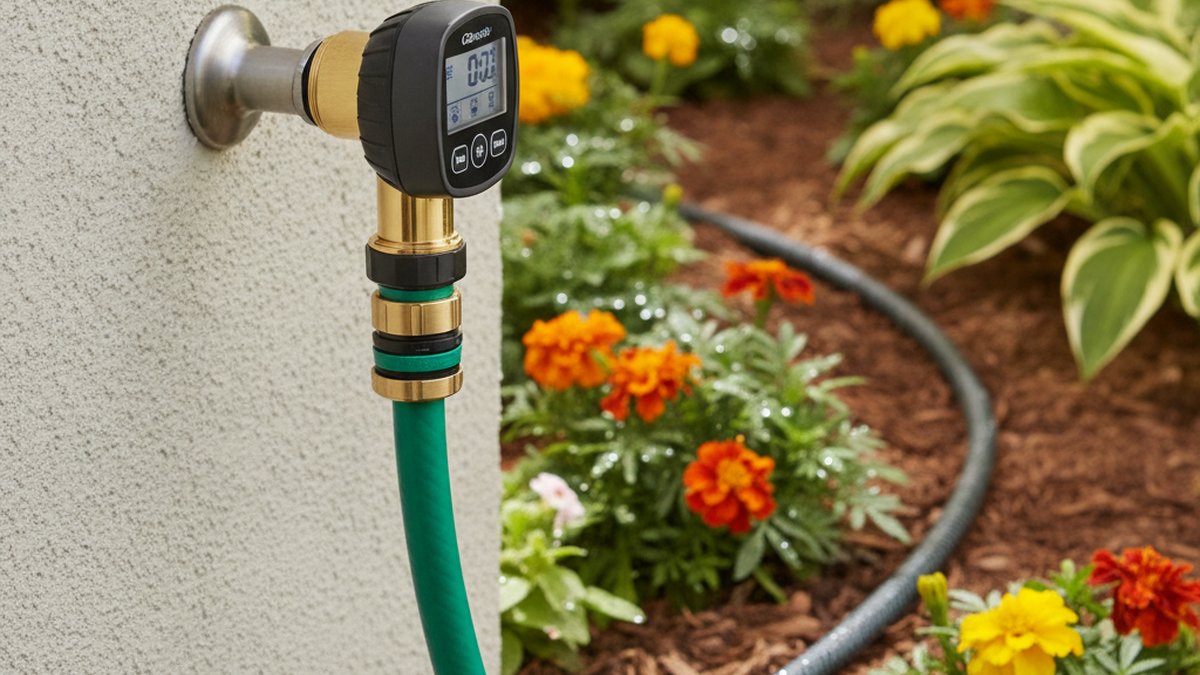
If you’ve ever come home to a swamp where your flower bed used to be, a garden hose valve with timer is the fix. It’s a small controller that threads directly onto your outdoor faucet (the hose bib) between the tap and your hose, and it opens and closes the water on a schedule you program — so your plants get watered at 6 a.m. whether you’re asleep, at work, or on vacation. Below, I’ll walk you through exactly what these do, the different types, what to look for, and which style makes sense for your setup and budget — the way I’d explain it to a friend standing in the garden aisle.
What does a garden hose valve with timer actually do?
It turns your outdoor faucet into an automatic watering system. You leave the tap fully open, and the timer’s internal valve — usually a solenoid or a small motorized ball valve — controls when water actually flows to your hose. You program a start time (say, 6:00 a.m.), a run length (say, 20 minutes), and a frequency (every day, every other day, or three times a week), and it handles the rest.
The core job is three things: start on time, run for the right duration, and shut off reliably. That last part matters more than people expect. A timer that opens perfectly but fails to close is worse than no timer at all — it’ll run your water bill up and drown your plants. That’s why the internal valve quality is the single most important spec, and why I steer people away from the flimsiest bargain-bin units.
- Set-and-forget scheduling — water at dawn or dusk when evaporation is lowest, without getting up.
- Vacation coverage — your tomatoes survive a week away.
- Water savings — precise run times stop the “I’ll just leave it on for a bit” overwatering that wastes hundreds of gallons.
- Zone control — dual-outlet models run a drip line to the veggie beds and a sprinkler to the lawn on separate schedules.
Which type of garden hose timer is best — mechanical, digital, or smart?
For most people, a battery-powered digital timer is the best balance of price, reliability, and control. Mechanical dial timers are cheapest but crude; smart Wi-Fi/Bluetooth timers give you phone control and rain skip but cost more and add a failure point. Here’s how the three stack up so you can match one to how you actually water.
| Type | Typical price | Best for | Watch out for |
|---|---|---|---|
| Mechanical (dial/twist) | $10–$20 | One quick job — “water for 30 min then stop.” No batteries. | No true scheduling; only runs when you manually twist it. Springs wear out. |
| Digital (battery, LCD) | $25–$60 | Everyday garden watering on a repeating schedule. The sweet spot. | Needs 2× AA/AAA batteries; check they’re included and swap yearly. |
| Smart (Wi-Fi / Bluetooth) | $45–$120 | Tech-savvy gardeners who want app control, weather-based skip, and multiple zones. | Wi-Fi range at the far end of a yard; app quality varies wildly by brand. |
If you’re on the fence, go digital. A mid-range digital timer does 95% of what a smart one does at half the price, and you’re not depending on a phone app that may stop getting updates. Reserve smart models for large yards with multiple watering zones or if rain-skip automation genuinely appeals to you.
Single outlet or dual outlet — which do I need?
Get a dual-outlet timer if you want to water two areas on different schedules from one faucet — it costs only a few dollars more and gives you far more flexibility. Get single-outlet only if you truly have one hose doing one job and want to save money and bulk.
Here’s the practical scenario: a dual-outlet timer lets you run a drip or soaker line to your raised vegetable beds for 30 minutes every morning on Outlet A, while Outlet B runs a lawn sprinkler for 15 minutes three times a week — completely independent programs from a single tap. That’s exactly the kind of split most home gardeners end up wanting within a season. Even if you only need one line today, the second outlet is cheap insurance for next spring.
How do I connect a hose timer without leaks?
The connection is where 90% of hose-timer frustration comes from, and it’s almost always a washer or a cross-threading problem — not the timer itself. A garden hose timer uses standard 3/4-inch GHT (garden hose thread) connections, the same thread as your outdoor faucet and hose, so it screws on hand-tight. Do it in this order:
- Check that your outdoor faucet has a good rubber washer inside the timer’s inlet — most come pre-installed. If it’s missing or cracked, that’s your leak.
- Thread the timer onto the faucet by hand only. GHT is designed to seal on the washer, not the threads — pliers just crack the plastic and strip it.
- Make sure you start the thread straight. Cross-threading plastic on metal is the number-one cause of a stripped, leaking timer.
- Attach your hose to the outlet, open the faucet fully, and run a test cycle. Feel every joint for weeping.
If you’re still getting a persistent drip at the faucet itself rather than the timer, the problem may be upstream at the bib. Our guide to the best outdoor faucet connection for a leak-free hose bib walks through washers, thread tape, and quick-connects that make every seasonal hookup easier. And if your outdoor faucet needs a backflow device, don’t skip our outdoor faucet vacuum breaker replacement walkthrough — many areas require a vacuum breaker on any hose bib feeding an irrigation timer.
What should I look for when buying — the specs that actually matter
Focus on the valve, the flow rate, and the battery system; ignore the marketing gimmicks. A timer lives outside in heat, cold, and UV for years, so build quality beats feature count. Here’s my checklist:
- Valve type: a motorized ball valve or a quality solenoid closes fully and repeatably. This is the make-or-break part.
- Flow rate / pressure range: most home timers handle 15–90 PSI. If you run drip irrigation, confirm it works at low pressure — some solenoids need a minimum PSI to actuate.
- Manual override button: lets you water by hand without wiping your schedule. A must-have.
- Rain delay: pause watering 24–72 hours after rain without reprogramming.
- Battery life and low-battery warning: look for a full-season runtime on 2× AA and an on-screen battery indicator, so it doesn’t quietly die mid-vacation.
- Housing: UV-stabilized, weather-sealed plastic with a hinged battery cover that keeps water out of the electronics.
One underrated detail: the internal parts. Timers with brass or stainless swivel inlets hold up far better than all-plastic ones, especially where you’re repeatedly threading and unthreading each season. If you like understanding what’s inside your fixtures, our primer on essential brass faucet parts explains why brass components resist corrosion and wear the way they do — the same logic applies to a hose timer’s inlet.
How much water (and money) does a hose timer actually save?
Realistically, a timer cuts outdoor water use by 20–50% for most households simply by ending overwatering and running at dawn when evaporation is lowest. The exact number depends on your habits, but the mechanism is straightforward: a hand-watered gardener almost always runs the hose longer than the plants need, and forgets it at least a few times a season.
Consider the math. A standard 5/8-inch hose flows roughly 9–17 gallons per minute wide open. Leave it running an extra 15 minutes because you got distracted, and that’s 135–255 gallons gone — from a single slip. A timer that shuts off precisely at 20 minutes, three days a week, simply never makes that mistake. Over a summer, a $40 timer often pays for itself in the first billing cycle in water-metered homes, especially in drought-restricted regions where watering windows are legally enforced.
Do smart Wi-Fi timers have downsides I should know about?
Yes — the two real ones are range and longevity. A Wi-Fi timer sitting at the far corner of your yard, behind brick or stucco, may struggle to hold a signal, and it depends on the manufacturer keeping their app and cloud service alive for years. Bluetooth-only smart timers dodge the cloud risk but require you to be within ~30 feet to change settings, which defeats the “control it from vacation” pitch.
My honest take: buy smart only if you genuinely want weather-based automatic skip (the timer pulls local forecast data and cancels watering before rain) or you’re managing multiple zones and love app dashboards. Otherwise a good digital timer with a manual rain-delay button gives you 90% of the benefit with none of the connectivity headaches. The best hardware in the world is worthless if the app gets abandoned in three years.
FAQ
Can I leave a garden hose valve with timer on the faucet over winter?
No — remove it before the first hard freeze. Water trapped inside the timer’s valve body will freeze, expand, and crack the housing or ruin the solenoid. At the end of the season, unthread the timer, drain it fully, pull the batteries, and store it indoors. Also open and drain the hose bib itself; a frost-free bib or an interior shutoff prevents burst pipes.
Will a hose timer work with low-pressure drip irrigation?
Usually yes, but check the minimum operating pressure before you buy. Many solenoid-based timers need around 10–15 PSI to actuate the valve, and some gravity-fed rain-barrel setups fall below that. If you’re running a rain barrel, look specifically for a “low-flow” or “rain barrel compatible” timer with a motorized ball valve, which opens mechanically regardless of pressure.
Do I still need a backflow preventer or vacuum breaker?
Often, yes — and in many jurisdictions it’s required by code on any outdoor faucet connected to irrigation. A vacuum breaker stops contaminated garden water from being siphoned back into your drinking supply if pressure drops. Some hose timers include an integrated check valve, but that’s not the same as a proper atmospheric vacuum breaker on the bib. Check your local plumbing code.
How long do the batteries last in a digital hose timer?
A quality digital timer runs a full watering season — roughly 6 to 9 months — on two AA or AAA alkaline batteries. Cold weather and frequent long cycles drain them faster. Replace the batteries at the start of every season as a habit, and choose a model with an on-screen low-battery warning so a dead cell doesn’t silently cancel your schedule while you’re away.
Can one timer water two different areas on different schedules?
Yes — that’s exactly what a dual-outlet timer is for. Each outlet has its own independent program, so you can run a soaker hose on your vegetable beds every morning for 30 minutes while a lawn sprinkler on the second outlet runs three evenings a week for 15 minutes. It’s the most flexible option for a typical home garden and costs only slightly more than a single-outlet unit.
Is a hose timer the same as a full in-ground sprinkler system?
No — a hose timer is a simpler, renter-friendly, above-ground alternative. It attaches to an existing faucet with no digging, no permits, and no professional install, and you can take it with you when you move. An in-ground system covers larger lawns more evenly and hides everything underground, but costs far more and is permanent. For beds, containers, small lawns, and gardens, a hose timer does the job for a fraction of the price.
The bottom line: is it worth it?
For anyone who waters on a schedule — which is most gardeners — a garden hose valve with timer is one of the highest-value upgrades you can make to your outdoor faucet setup. It saves water, protects your plants, and buys you freedom from the daily hose routine. Buy a mid-range dual-outlet digital model with a manual override and rain delay, thread it on hand-tight over a good washer, pull it indoors before winter, and it’ll serve you for years.
A note on testing and standards: When we evaluate any outdoor watering hardware, we look for GHT thread conformity, a stated PSI operating range, and — for the valve itself — full-close reliability across repeated cycles, since a valve that won’t shut is the primary failure mode. Prioritize timers backed by a manufacturer warranty (typically 1–2 years) and, where lead-free contact with potable water applies, components that meet recognized low-lead standards. Always confirm your local plumbing code’s backflow requirements before connecting any timer to a hose bib.
About the author: This guide was written by the Avamani fixtures team, who spend their days sizing, installing, and troubleshooting faucets, hose bibs, and outdoor connections. Avamani is a specialist in faucets and bathroom & outdoor fixtures, and we write these guides to help you buy the right part once — not three times. If you’re upgrading the faucet these timers thread onto, our related guides on outdoor faucet connections and vacuum breaker replacement pair naturally with this one.