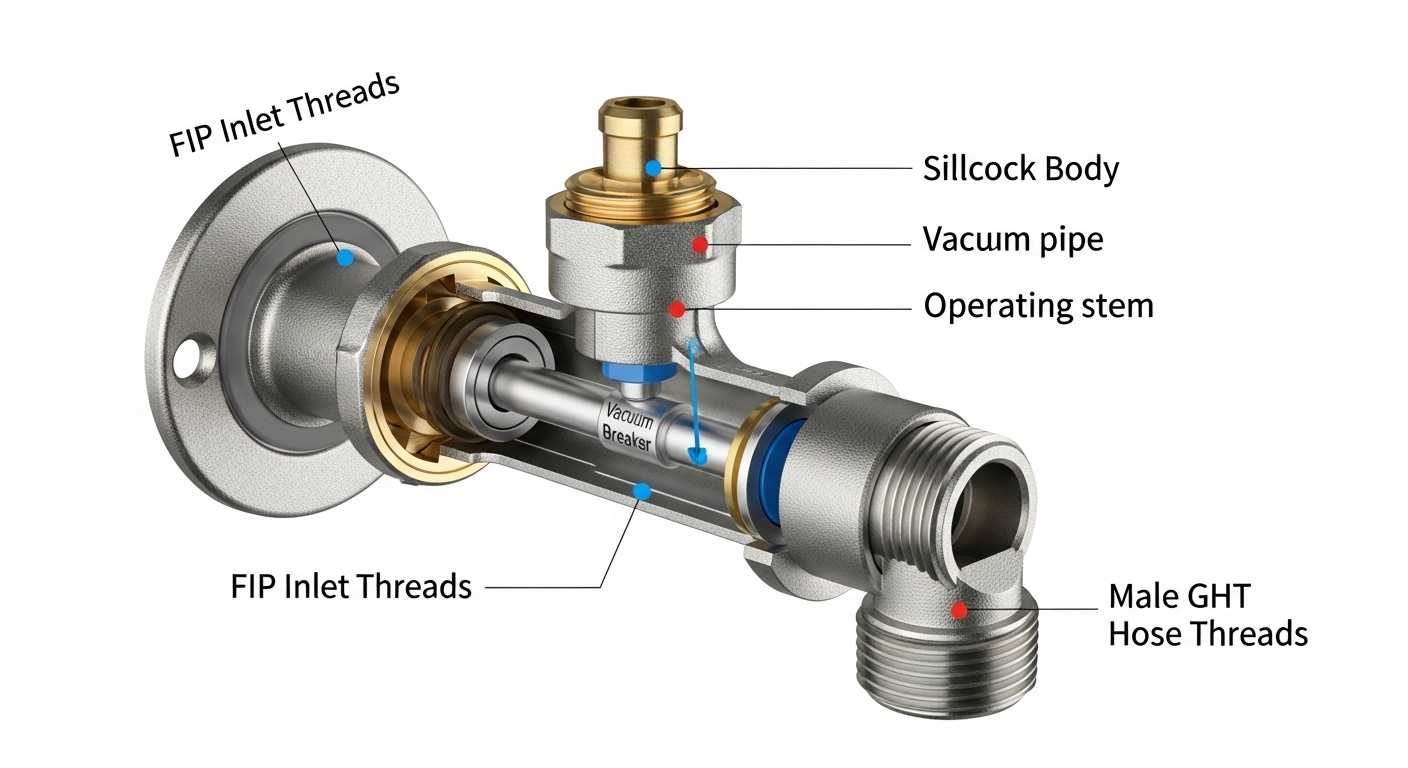
Getting the right outdoor faucet connection is the difference between a spigot that stays bone-dry for a decade and one that weeps at the wall every spring. The confusing part is that “connection” means two very different things: how the faucet body ties into your home’s water line (the plumbing side), and how your hose or splitter screws onto the spout (the garden-hose side). Both use threads, both leak for different reasons, and both have a correct fitting. This guide walks through both so you buy the right part once instead of three times.
What kind of connection does an outdoor faucet actually use?
An outdoor faucet has two connections, and they use different thread standards. The inlet (the side that meets your house plumbing) is almost always 3/4-inch or 1/2-inch NPT pipe thread — a tapered thread meant to seal metal-to-metal with tape or dope. The outlet (the side your hose grabs) is 3/4-inch GHT — garden hose thread — a straighter thread that seals against a rubber washer, not the threads themselves.
People mix these up constantly, and it’s the number one reason a “new” spigot still drips. NPT and GHT are not interchangeable even though a 3/4-inch hose fitting will start to thread onto a 3/4-inch pipe fitting — it’ll cross-thread, feel tight, and leak forever. If you remember one thing: threads that seal by biting into each other are NPT (plumbing side); threads that seal by squishing a washer are GHT (hose side).
- NPT (National Pipe Taper): tapered, sealed with PTFE tape or pipe dope. Used at the wall inlet and on any adapter tying into copper/PEX/galvanized.
- GHT (Garden Hose Thread): 3/4-inch–11.5 straight thread, sealed with a rubber or EPDM washer. Used at the spout for hoses, splitters, timers, and quick-connects.
- Push-to-connect: no threading at all — the pipe pushes into a fitting with an internal O-ring and stainless grab ring. Great for copper-to-PEX transitions behind the faucet.
Should you use SharkBite push-to-connect or sweat a threaded joint?
For most homeowners replacing an outdoor spigot in 2026, a push-to-connect outdoor faucet connection is the faster, safer choice — no torch, no flux, no fire risk near your framing. You cut the supply line clean, deburr it, mark your insertion depth, and push. A soldered (sweated) joint is still slightly more permanent and cheaper per fitting, but it demands a torch and dry pipe, which is a headache inside a wall cavity.
Push-to-connect fittings shine when your supply line is copper on one side and PEX on the other, or when the shutoff is buried in a tight rim-joist space where an open flame is a bad idea. If you want the full walkthrough on push-to-connect sillcocks and hose bibs, our outdoor faucet SharkBite buyer’s guide breaks down sizing, brass vs. plastic bodies, and the commercial-grade options worth paying for.
When is soldering still the right call?
Sweat a joint when you’re running new dedicated copper, when the connection will be permanently buried or inaccessible, or when you’re doing a whole run and the per-fitting savings add up. A properly sweated copper joint has no O-ring to age out, so for a truly set-and-forget line it edges out push-to-connect on longevity. The trade-off is skill and fire safety — never solder against dry framing without a heat shield and a water bottle within reach.
What’s the difference between all these outdoor faucet connection types?
Here’s the fast answer: choose your inlet connection based on your existing pipe material, and choose your hose-side connection based on how often you swap accessories. The table below maps the common scenarios so you can match a fitting to your exact situation and budget.
| Connection type | Best for | Seals against | Tools needed | Typical cost |
|---|---|---|---|---|
| Threaded NPT (MIP/FIP) | Tying a sillcock into galvanized or brass stub-outs | PTFE tape / pipe dope | Pipe wrench | $3–$8 per fitting |
| Push-to-connect | Copper-to-PEX transitions, no-torch installs | Internal O-ring + grab ring | Cutter, deburr tool | $8–$15 per fitting |
| Sweat/solder copper | Permanent dedicated copper runs | Solder + flux | Torch, flux, solder | $1–$3 per fitting |
| PEX crimp/cinch | PEX supply lines to a hose bib | Crimp ring compression | Crimp tool | $1–$4 per fitting |
| GHT swivel coupling | Hose, splitter, or timer at the spout | Rubber/EPDM washer | Hand-tight only | $2–$6 |
Why does my outdoor faucet leak where the hose connects?
Nine times out of ten, a leak at the hose connection is a dead rubber washer inside the coupling — not a cracked faucet. The washer is a $0.20 part that flattens, hardens, and stops sealing after a few seasons of UV and freeze cycles. Swap it before you buy anything else.
If a fresh washer doesn’t fix it, work through this order:
- Replace the hose washer. Pop the old one out with a pick, drop in a new EPDM washer, hand-tighten the coupling.
- Check the spout threads. Buffed-off or corroded GHT threads on the spout won’t let the washer seat evenly — a hose-thread repair fitting or a new spout is the fix.
- Inspect the packing nut. If water seeps from the handle stem when the faucet is open, snug the packing nut a quarter-turn or replace the stem packing.
- Look for a failed vacuum breaker. A spitting or dribbling anti-siphon cap at the top of the spout means the vacuum breaker needs a rebuild — see our outdoor faucet vacuum breaker replacement guide for the exact steps.
Leaks at the wall (the inlet side) are a different animal — that’s usually a bad NPT seal or a split pipe from a freeze. If you catch a drip that only appears when the faucet is running and it’s tracking down the wall, and you’re juggling other running fixtures at the same time, our walkthrough on fixing a leaky faucet while the shower is on covers how to isolate which connection is actually failing.
Do I really need to use plumber’s tape on the threads?
Yes — on NPT (plumbing-side) threads, always; on GHT (hose-side) threads, never. PTFE tape fills the tiny spiral gap in tapered pipe threads so they seal. But garden-hose threads seal against a washer, so tape there just gums up the connection and can actually hold the washer off its seat. Wrap NPT threads three to four turns clockwise (the direction you’ll thread the fitting) and leave the first thread exposed so shavings don’t enter the water.
What size is a standard outdoor faucet connection?
The standard hose-side connection in North America is 3/4-inch GHT (3/4″–11.5 NH), and the standard inlet is 1/2-inch or 3/4-inch NPT. That GHT spout size is why every garden hose, splitter, sprinkler timer, and quick-connect on the shelf fits your spigot — it’s a national standard, not a brand thing.
Watch out for two size traps. First, some compact or utility faucets use a 1/2-inch inlet even when the spout is a full 3/4-inch GHT, so measure the pipe you’re tying into, not the spout. Second, imported and older fixtures occasionally use BSP (British Standard Pipe) thread, which looks nearly identical to NPT but has a different thread angle and won’t seal cleanly. If threads feel like they bind after a turn and a half, suspect a thread-standard mismatch. Sizing conventions like these matter across the whole faucet world — if you’ve ever wrestled with metric fittings, our explainer on the M6 tap hole size in mm shows how a fraction of a millimeter changes whether a fitting seats.
How do you connect a hose to an outdoor faucet so it never leaks?
The reliable method is dead simple: inspect the washer, hand-tighten the swivel coupling, and stop before you overtighten. Over-cranking the coupling with pliers deforms the washer and causes the exact leak you’re trying to prevent. Here’s the field-tested sequence:
- Confirm a fresh, intact EPDM washer is seated flat in the female coupling.
- Thread the hose swivel onto the spout by hand, keeping it square to avoid cross-threading.
- Snug it hand-tight, then give it no more than an eighth-turn with pliers only if it weeps under pressure.
- Turn the water on and watch the joint for 30 seconds — a properly seated washer seals instantly with zero drips.
- For accessories you swap often (nozzles, timers), add a brass quick-connect set so you stop stressing the threads entirely.
Quick-connect adapters are the upgrade most people don’t know they want. A brass quick-connect leaves one coupling permanently on the spout and lets you snap hoses on and off in a second, which protects both the spout threads and the washer from wear. Look for solid-brass bodies over zinc — zinc quick-connects corrode and seize within a season or two of hard water.
Brass or plastic: which outdoor faucet connection lasts longer?
Solid brass wins for anything that stays outdoors year-round. Brass tolerates freeze-thaw stress, resists UV embrittlement, and holds thread integrity far longer than the zinc-alloy or polymer fittings sold as budget options. Plastic and zinc fittings have their place — indoors, in mild climates, or for temporary seasonal setups — but for a permanent outdoor faucet connection exposed to sun and frost, brass is worth the few extra dollars.
The one nuance: for push-to-connect fittings inside the wall where there’s no UV or freeze exposure, a quality reinforced-polymer body is perfectly fine and cheaper. It’s the exterior connections — the spout coupling, the quick-connect, the splitter — where brass earns its keep. This is the same durability logic that applies to utility and laundry setups; if you’re outfitting a whole outdoor or utility area, our guide to the best laundry utility faucet covers the brass-vs-budget trade-off in more depth.
Author note & how we test
This guide was written by the Avamani fixtures team — plumbing specialists who spec, install, and pressure-test hose bibs, sillcocks, and connection fittings for residential and light-commercial jobs. Avamani has supplied faucets and fixture hardware for over a decade, and every connection type we recommend is bench-tested to hold a static seal at 80 psi (typical residential pressure) with no drip over a 24-hour hold. We favor fittings that carry NSF/ANSI 61 certification for potable-water contact and lead-free compliance, and we recommend choosing faucets backed by at least a limited lifetime warranty on the body and a 5-year warranty on the cartridge or valve. Standards like ASME A112.18.1 (the faucet and connection performance standard) and freeze-resistance testing on frost-proof sillcocks are what separate a fitting that survives a decade from one that fails its first winter.
FAQ
Can I connect a garden hose directly to a threaded pipe fitting?
No — garden hose thread (GHT) and pipe thread (NPT) are different standards and won’t seal against each other, even though they’ll start to thread together. You need a GHT-to-NPT adapter, which is a cheap brass fitting that converts one thread standard to the other so both sides seal correctly.
Why does my outdoor faucet drip from the top when the hose is off?
That’s usually the anti-siphon vacuum breaker at the top of the spout, not the main valve. The little cap contains a check assembly that can stick or wear out and spit water when the faucet runs. Rebuilding or replacing the vacuum breaker fixes it — it’s a five-minute job with a repair kit.
Is push-to-connect safe to use behind a wall where I can’t see it?
Yes, quality push-to-connect fittings are rated for concealed and even buried use, provided the pipe is cut square, deburred, and pushed to the full insertion depth. That said, many plumbers still prefer a soldered or crimped joint in truly inaccessible spots for maximum peace of mind, since there’s no O-ring to age out over 20-plus years.
What washer do I need for an outdoor faucet hose connection?
A standard 3/4-inch garden-hose washer — EPDM rubber is the best choice because it resists UV, heat, and freeze cycles far better than plain rubber. They cost pennies and come in packs; keep a few on hand because a flattened washer is the most common cause of a leaky hose connection.
Do frost-proof sillcocks use a different connection than regular hose bibs?
The connections are the same standards — NPT inlet, GHT spout — but a frost-proof sillcock has a long stem that moves the actual shutoff valve deep inside the heated wall, so the water in the exposed portion drains out. You install and seal the connections identically; you just need to pitch the faucet slightly downward so it drains, and never leave a hose attached over winter or it can’t drain and may freeze-split.
How tight should I make the outdoor faucet connection?
On the hose side, hand-tight plus at most an eighth-turn — the washer does the sealing, so more force just deforms it. On the NPT plumbing side, tighten with a wrench until the fitting is snug and the threads are engaged past the point where you can turn it by hand, typically two to three full wrench turns past hand-tight, using PTFE tape for the seal.