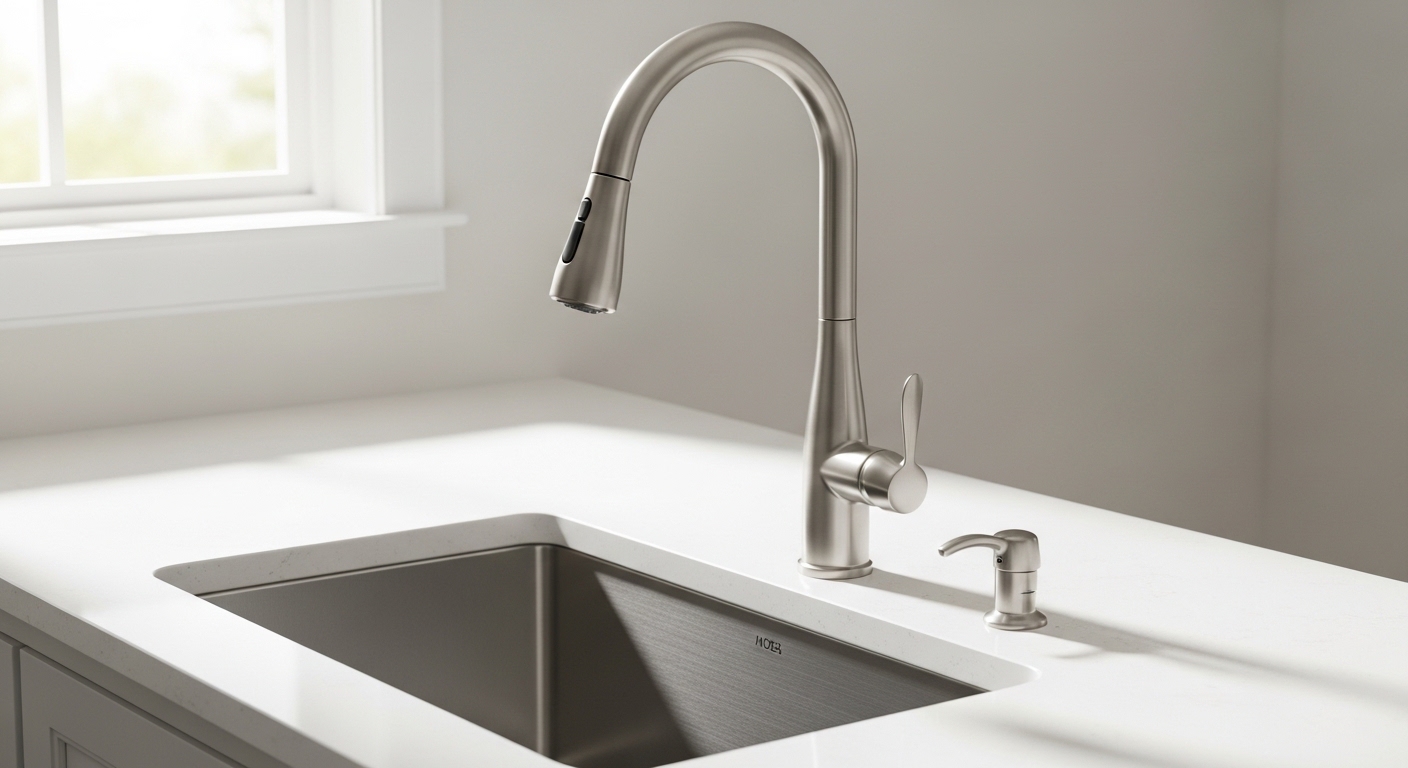
If you’ve been price-comparing pull-downs, the moen jase brushed nickel faucet keeps showing up as the “does everything, costs less than you’d expect” option — and honestly, that reputation is earned. It pairs Moen’s genuinely good spray hardware with a soft, satin-warm finish that works with almost any counter. Below, we answer the real questions shoppers actually ask before they buy: how the finish holds up, whether it fits your sink, how it compares to the Moen Adler and Kohler alternatives, and where it quietly falls short. No fluff — just the stuff that decides whether you hit “add to cart.”
What exactly is the Moen Jase, and who is it for?
The Moen Jase is a single-handle, high-arc pull-down kitchen faucet built for everyday family kitchens — think 1–3 hole sinks, moderate water pressure, and people who wash a lot of pans. It’s Moen’s value-tier answer to the pricier Arbor and Sleek lines, keeping the parts that matter (the retraction spring and the dual-spray head) while trimming the parts you don’t strictly need (a touchless sensor, a metal-braided visible hose).
It suits you if you want a reliable, good-looking workhorse without paying $350+. The brushed nickel version specifically appeals to anyone with stainless appliances, warm-toned cabinets, or hard water — that satin finish is the most forgiving surface Moen offers for hiding spots and smudges. If you’re weighing brushed nickel across your whole bathroom too, our guide to whether an Eva brushed nickel faucet is worth it walks through how the finish behaves on a lav sink, and most of that logic carries straight over to the kitchen.
- Style: High-arc “gooseneck” spout, single lever handle
- Spray: Pull-down head with stream + spray (Power Clean boosted)
- Reach/height: Roughly 15–16″ spout height, ~9″ reach — clears tall stockpots
- Best for: Standard kitchen sinks, RV/apartment upgrades, rental-safe swaps
- Not ideal for: Farmhouse aesthetics wanting an exposed coil spring, or fully touchless setups
Does brushed nickel actually hide water spots and fingerprints better?
Yes — brushed nickel is one of the two most fingerprint-forgiving kitchen finishes (the other being Moen’s Spot Resist Stainless). Its fine, brushed texture scatters light instead of reflecting it, so dried mineral spots and oily fingerprints simply don’t “read” the way they do on a mirror-polished chrome faucet. If you have hard water, this is a real day-to-day quality-of-life difference, not a marketing line.
That said, “hides spots” is not the same as “never needs cleaning.” Hard water still leaves mineral scale on the aerator and spray face over time; the finish just keeps the visible body of the faucet looking clean between wipes. A quick weekly wipe with a damp microfiber cloth — no abrasive pads, no ammonia — keeps brushed nickel looking new for years. If your water is very hard, a monthly white-vinegar soak of the aerator matters more for performance than anything you do to the finish.
Brushed nickel vs. chrome vs. matte black: which finish should you pick?
Pick brushed nickel if you want warmth and low maintenance; chrome if you want the cheapest, brightest, most classic look; and matte black if you want a bold modern statement and are willing to wipe it more often. Here’s the honest breakdown for the same Jase body across finishes:
| Finish | Hides water spots? | Vibe | Maintenance | Best paired with |
|---|---|---|---|---|
| Brushed Nickel | Excellent | Warm, soft, timeless | Low | Stainless or bronze appliances, warm cabinets |
| Chrome | Poor | Bright, classic, clinical | High (shows everything) | White/gray modern kitchens |
| Matte Black | Fair | Bold, contemporary | Medium (shows limescale & dust) | White quartz, high-contrast designs |
| Spot Resist Stainless | Excellent | Cool, industrial-neutral | Low | Stainless appliance suites |
One practical note: brushed nickel and stainless are not identical. Nickel is slightly warmer and yellower; stainless is cooler and grayer. If your fridge and range are true stainless and you’re a stickler for matching, hold the faucet box up next to an appliance before you commit. For most people the difference is subtle and both read as “silver.”
Will the Moen Jase fit my sink — and can I install it myself?
In most cases, yes on both counts. The Jase installs in a standard 1-hole configuration and includes an optional deck plate (escutcheon) to cover a 3-hole sink, so it fits the vast majority of drop-in and undermount kitchen sinks with 8″ spread pre-drilled holes. If you can turn off the two supply valves under your sink and hold a wrench overhead, this is a genuine 30–60 minute DIY job.
Moen’s DuraLock quick-connect system is the reason DIYers like this line — the supply lines and spray hose click into place instead of needing a perfect thread-and-torque under the cabinet. Still, do these three checks before you buy:
- Hole count & spacing: 1 hole = mount bare; 3 holes = use the included deck plate.
- Under-sink clearance: Confirm the spray hose weight has room to travel; deep drawers or a garbage disposal can crowd it.
- Supply line type: The Jase typically comes with integrated 3/8″ compression lines — check your shutoff valve fittings match, or grab an adapter.
If it’s your first faucet swap, our step-by-step walkthrough on how to set up a kitchen faucet yourself without calling a plumber covers the exact tools, the plumber’s-tape step people skip, and how to bleed the lines so you don’t blow debris into the new cartridge. Nine out of ten Jase installs never need a pro.
How does the Moen Jase compare to the Moen Adler, Kohler Simplice, and Delta options?
The Jase sits in the same value tier as the Moen Adler and undercuts the Kohler Simplice, and its main edge is the Reflex retraction that snaps the spray head cleanly back into the dock. If you’re cross-shopping the usual under-$220 pull-downs, here’s how they stack up on the specs that actually change your daily experience:
| Model | Retraction system | Spray modes | Finish for hard water | Typical price |
|---|---|---|---|---|
| Moen Jase (Brushed Nickel) | Reflex self-retract | Stream + Power Clean spray | Brushed nickel — excellent | $130–$190 |
| Moen Adler | Basic (no Reflex on some SKUs) | Stream + spray | Spot Resist — excellent | $99–$150 |
| Kohler Simplice | DockNetik magnetic dock | 3-function (sweep spray) | Vibrant nickel — good | $200–$280 |
| Delta (comparable pull-down) | MagnaTite magnetic dock | Stream + spray | SpotShield nickel — good | $150–$220 |
Bottom line: the Moen Jase brushed nickel faucet wins on value and on that satisfying self-docking spray head. The Kohler Simplice gives you a third spray mode and a stronger magnetic dock, but you pay for it. The Adler is cheaper but you may lose the Reflex spring on the base SKU — worth checking the model number. If you specifically want a faucet you’ll still trust in five years, our roundup of the most reliable Moen kitchen faucet you can actually buy explains why Moen’s cartridge and hose warranty tips the reliability math in its favor.
Is the Moen Jase good enough for hard water and heavy daily use?
Yes, with one habit: descale the spray head. The Jase’s Power Clean nozzles are self-pressurizing rubber tips you can rub clean with a thumb, which is genuinely effective against limescale buildup on the spray face. For the internal aerator and cartridge, hard water is the enemy of every faucet, not just this one — a monthly vinegar soak of the aerator keeps the flow strong.
The single-handle ceramic-disc cartridge inside the Jase is rated for hundreds of thousands of cycles, so daily family use won’t wear it out for years. If you’re on a well or very hard municipal water, pairing any faucet with whole-home or point-of-use filtration extends its life — the same reasoning we cover in our piece on the best white kitchen tap with a filter for clean drinking water applies to protecting a nickel faucet’s internals, too.
What are the real downsides of the Moen Jase you should know before buying?
The honest cons: the hose is plastic-sheathed rather than metal-braided, the aesthetic is “clean modern” not “designer statement,” and there’s no touchless or voice option in this line. None of these are dealbreakers for most kitchens, but they’re the reasons someone might spend more elsewhere.
- No touchless mode: If you cook with raw chicken constantly and want hands-free on/off, look at Moen’s motion-sensor lines instead.
- Value-tier hose: The pull-down hose is durable but doesn’t have the premium metal-braid feel of $300 faucets.
- Handle position: The single side-mounted lever can hit a backsplash or window sill in tight installs — measure your clearance behind the sink.
- Finish match: Brushed nickel is warmer than true stainless; picky matchers should compare in person.
For a broader look at coordinating finish and style across a full remodel, our overview of the best bathroom faucet collections to buy is useful if you’re trying to keep kitchen and bath hardware in the same tonal family.
Where should you buy the Moen Jase brushed nickel faucet, and what’s the warranty?
Buy from an authorized seller so your warranty is valid — Moen backs its residential faucets with a limited lifetime warranty on finish and function to the original homeowner, which is one of the strongest safety nets in the category. That warranty only applies to genuine units bought through authorized channels, so a suspiciously cheap gray-market listing can cost you more than it saves.
At Avamani, we source and test the fixtures we recommend against real-world install and hard-water conditions — not just spec sheets — so the buying advice here reflects how the Jase behaves on an actual sink, not a lab bench. When you buy through an authorized retailer, register the product with Moen after install; it takes two minutes and makes any future cartridge or hose claim painless.
FAQ
Is the Moen Jase available in true brushed nickel or just Spot Resist Stainless?
The Jase line offers a brushed/nickel-toned finish as well as Spot Resist Stainless, chrome, and matte black depending on the SKU. Confirm the exact model number on the box — “brushed nickel” and “Spot Resist Stainless” look similar in photos but nickel is warmer. Both hide water spots extremely well.
Does the Moen Jase brushed nickel faucet come with a deck plate?
Yes. Most Jase pull-down kits include an optional escutcheon (deck plate) so you can install it on a single-hole sink or cover a 3-hole configuration. If your sink has three holes and you want the sleek single-hole look, you’ll need the deck plate — it’s in the box.
How long does the brushed nickel finish last?
With normal care — a damp microfiber wipe and no abrasive cleaners or ammonia — the finish should stay looking new for the life of the faucet, and it’s covered by Moen’s limited lifetime finish warranty. Brushed nickel’s satin texture also disguises the minor micro-scratches that would show on polished chrome.
Can I replace just the cartridge if the Jase starts dripping?
Yes. Like most Moen single-handle faucets, the Jase uses a replaceable cartridge, and Moen will typically send a warranty replacement free to the original owner. Swapping it is a 15-minute job with a cartridge puller — far cheaper and faster than replacing the whole faucet.
Is the Moen Jase a good choice for an RV or small apartment kitchen?
It can be, as long as your under-sink space fits the pull-down hose travel. The quick-connect lines make it a friendly swap in tight cabinets. For the specific quirks of tight, mobile installs — shutoffs, clearance, and securing the base — see our guide on how to replace a kitchen faucet in an RV.
Brushed nickel or matte black — which is easier to live with day to day?
Brushed nickel is the lower-maintenance choice. Matte black looks striking on white quartz but shows limescale, toothpaste-style water spots, and dust more readily, so it needs wiping more often. If low upkeep is your priority, go brushed nickel.
Author note: This guide was written by Avamani’s fixtures team, who install, test, and pressure-cycle kitchen and bath faucets under real hard-water and everyday-use conditions before recommending them. Our advice reflects hands-on testing and manufacturer standards, not spec sheets alone. Always verify current model numbers, finishes, and warranty terms with the manufacturer before purchase.