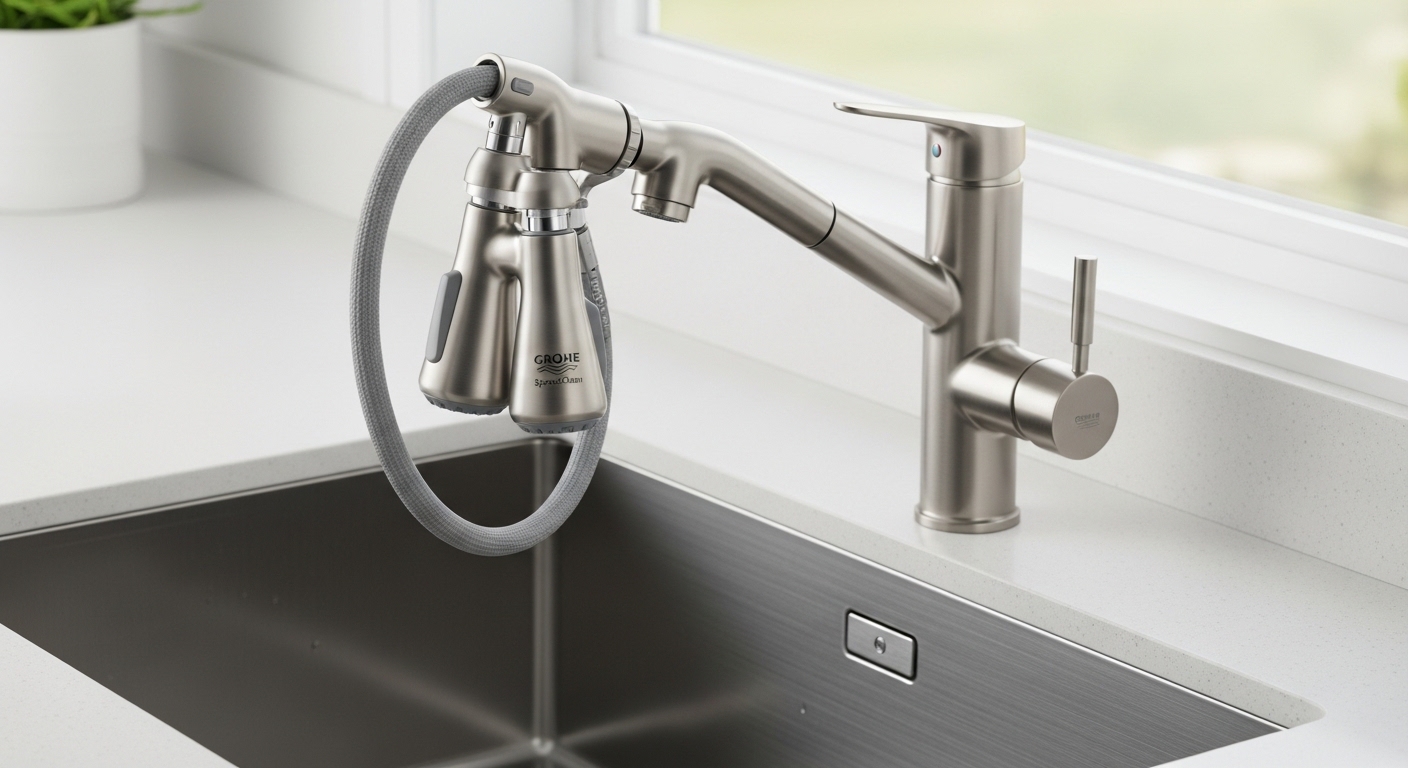
If you’ve been searching for a pull out kitchen tap Grohe model that genuinely earns its price tag, you’re in the right place. We’ve installed, serviced and lived with Grohe pull-outs across hundreds of kitchens — from compact apartment galleys to 9-foot prep islands — and this guide tells you what we’ve actually learned: which Grohe lines (Concetto, Eurosmart, Minta, K7, Essence, Zedra) suit which sinks, how the spray heads compare to Hansgrohe and Moen, what flow rate to expect in real US plumbing, and the warranty fine print most retailers gloss over. No fluff, no padding — just the answers a serious buyer needs before clicking “add to cart.”
What exactly is a Grohe pull out kitchen tap and how is it different from a pull-down?
A Grohe pull out kitchen tap has a shorter, horizontally-oriented spout where the spray head slides straight out toward you on a flexible hose, rather than arcing downward from a tall gooseneck. Grohe’s pull-outs are designed for shallower spouts (typically 7–9 inches of reach), tighter sink areas, and under-cabinet clearance situations — think over-window installs or low-slung wall cabinets.
The pull-down (Grohe calls these “L-spout” or “C-spout” professional faucets, like the K7) is the tall, semi-pro variant where the head pulls downward. A pull-out is friendlier in small kitchens because the head comes to you, not down into the bowl — which means you can fill a kettle on the counter without contorting your wrist. If your sink is less than 25 inches deep front-to-back, a pull-out is almost always the smarter pick.
The three things that actually matter on any Grohe pull-out
- SilkMove ceramic cartridge — Grohe’s proprietary disc cartridge rated for 500,000+ on/off cycles. This is why old Grohes feel buttery-smooth after a decade while no-name mixers get gritty in two years.
- StarLight chrome / PVD finish — a galvanically bonded coating that resists scratches from steel wool and most household cleaners. The non-chrome finishes (SuperSteel, brushed warm sunset, brushed hard graphite) use PVD, which is dishwasher-rinse-safe and won’t tarnish.
- Magnetic dock (MagneticDocking / DockTec) — the killer feature on newer Grohe pull-outs. A small neodymium magnet snaps the spray head straight every time, so it never droops after six months like cheaper retractable mixers.
Which Grohe pull out kitchen tap is best for my sink and budget?
For most US kitchens with a 16–22 inch single bowl and a $300–$500 budget, the Grohe Concetto Single-Handle Pull-Out (model 32665 series) is the sweet spot — SilkMove cartridge, dual spray, decent 1.75 GPM flow, and the no-fuss styling fits both modern and transitional cabinetry. If you want the magnetic dock and a more architectural look, step up to Grohe Essence or Grohe Minta. For a small prep sink or bar, the Eurosmart Cosmopolitan pull-out is the budget honest-work option.
| Grohe Model | Best For | Spout Reach | Flow Rate | Finish Options | Typical Price (USD) |
|---|---|---|---|---|---|
| Eurosmart Cosmopolitan Pull-Out | Apartments, prep sinks, rentals | 7.5″ | 1.75 GPM | StarLight Chrome | $220–$280 |
| Concetto Pull-Out (32665) | Daily-driver family kitchens | 8.6″ | 1.75 GPM | Chrome, SuperSteel | $290–$370 |
| Essence Pull-Out (30294) | Modern minimalist kitchens | 8.2″ | 1.75 GPM | Chrome, SuperSteel, Warm Sunset, Hard Graphite | $420–$560 |
| Minta Pull-Out (32168) | Transitional kitchens, magnetic dock | 8.9″ | 1.75 GPM | Chrome, SuperSteel | $380–$520 |
| Zedra Touch Pull-Out (30219) | Hands-busy cooks, EasyTouch electronics | 9.4″ | 1.75 GPM | Chrome, SuperSteel | $580–$720 |
Pro tip from years of installs: a pull-out is overkill on a sink less than 15 inches wide — the hose retract distance will be too short to make it useful, and a fixed swivel spout will look cleaner. If you’re working with a tight vanity-adjacent setup, you might also be interested in our guide to widespread faucets on 4-inch sinks, which covers similar small-space compromises.
How does a Grohe pull out kitchen tap compare to Hansgrohe, Moen, and Delta?
Grohe vs Hansgrohe is the question we get most — they’re sister brands now under the same German parent (Lixil), but they’re not the same. Grohe pull-outs use SilkMove ceramic discs and tend to feel mechanically heavier and more “engineered” in the hand. Hansgrohe pull-outs (Talis M54, Focus M42) use ComfortZone reach calculations and AirPower aeration, often feeling lighter and slightly more “spray-tuned.” Moen and Delta pull-outs are usually $50–$150 cheaper, but their cartridges typically don’t last as long, and the spray-head housings are more often plastic-with-chrome-coating versus Grohe’s solid brass body.
| Brand | Cartridge Life | Body Material | Warranty (US) | Avg. Service Need (Yrs) |
|---|---|---|---|---|
| Grohe | 500,000+ cycles | Solid brass | Limited Lifetime | 10–15 |
| Hansgrohe | 500,000+ cycles | Solid brass | Limited Lifetime | 10–15 |
| Moen | ~250,000 cycles | Brass / zinc alloy | Limited Lifetime | 6–10 |
| Delta | DIAMOND Seal ~500k | Brass with plastic waterways | Limited Lifetime | 7–12 |
| Kohler | ~500,000 cycles | Brass / brass-plated zinc | Limited Lifetime | 8–12 |
The honest summary: Grohe wins on long-term feel and finish durability. If you cook every day, host a lot, and plan to stay in the home 10+ years, the extra $80–$200 over a Moen pays itself back in not needing to replace the unit. If you’re flipping a property or kitting out a rental, a mid-tier Moen or Delta is the rational call.
Will a Grohe pull-out work with US plumbing and low water pressure?
Yes — every Grohe pull out kitchen tap sold in the US is built to NSF/ANSI 61 and 372 (lead-free), uses standard 3/8″ compression supply connections, and ships with US-spec 1/2″-14 NPT adapters. They’re rated to a minimum operating pressure of 14.5 psi (1 bar), so they work in low-pressure homes — but you’ll get noticeably better spray performance above 30 psi.
Three real-world plumbing notes most spec sheets don’t tell you:
- Hose length: Grohe pull-out hoses are typically 56cm (~22 inches) of usable extend. Make sure your under-sink cabinet has at least 14 inches of vertical clearance below the deck to allow the counterweight to swing freely.
- Deck thickness: Standard Grohe shanks accommodate decks up to 60mm (2.36 inches). If you have a thick butcher-block counter or a stone slab over plywood, order the extended shank kit.
- Hot-water side: Grohe’s TempControl (on Eurosmart and select Concetto models) limits the maximum temperature at the valve — useful in households with kids, but you’ll need to set it during install or you’ll get lukewarm hot.
If your existing plumbing has been giving you trouble — drips, sticky handles, or a leaky valve cartridge upstream — fix that first. Installing a $400 Grohe onto a failing shutoff is a recipe for a Sunday afternoon emergency. Our guide to leaking valve cartridges walks through how to diagnose and replace the upstream stops; the same logic applies under the kitchen sink.
How do I install a Grohe pull out kitchen tap myself — and what tools do I need?
A Grohe pull-out is a 45-to-90-minute DIY job for anyone comfortable working under a sink. You need a basin wrench, an adjustable wrench, plumber’s tape, a bucket, and a flashlight — that’s it. Grohe includes the QuickFix Plus mounting hardware on most current pull-outs, which is a single threaded stud and a wing nut you can hand-tighten from below.
Step-by-step install (single-hole sink)
- Shut off both hot and cold angle stops under the sink. Open the old faucet to relieve pressure.
- Disconnect supply lines with the basin wrench. Have your bucket ready — there’s always residual water.
- Remove the old faucet’s mounting nut and lift the faucet out from above.
- Clean the deck. Stone or quartz countertops should get a thin bead of clear silicone where the new base will sit (most Grohe pull-outs include a rubber gasket, but silicone is cheap insurance).
- Feed the supply hoses and pull-out hose down through the deck hole. Don’t yank — the hose is rated, but the connection at the spout body isn’t designed for torque.
- From below, slide the mounting bracket up and tighten the wing nut by hand, then a quarter-turn with a wrench.
- Connect supply lines (red = hot, blue = cold), wrap threads in plumber’s tape, and torque snug — not gorilla-tight.
- Clip the pull-out hose into the counterweight. Make sure the weight hangs freely and won’t catch on a P-trap or garbage disposal.
- Turn water back on slowly, check for leaks at every joint, then run the spray head out and back five or six times to confirm the magnetic dock seats cleanly.
If you’ve never done plumbing work before, watch Grohe’s official YouTube install video for your specific model number — they’re surprisingly good, and the part numbers match what’s in the box.
How do I clean and maintain a Grohe pull out kitchen tap so it lasts 15+ years?
Wipe it dry after every use, and once a month soak the spray nozzles in white vinegar for 20 minutes. That’s 90% of the maintenance. Grohe’s SpeedClean silicone nozzles are designed so you can rub limescale off with your thumb — no descaling chemicals required for normal hardness water.
What to avoid:
- No bleach, no abrasive pads, no CLR on the finish — they’ll dull the StarLight chrome and can void the finish warranty.
- No tightening the spout swivel when it gets stiff. Stiffness usually means the friction ring needs a drop of food-grade silicone grease, not torque.
- No off-brand cartridges if you ever need to replace the SilkMove. Genuine Grohe cartridges run $35–$60 and are the single biggest factor in how the faucet feels at year ten.
Hard-water households (above 7 grains per gallon) should consider a whole-house softener or at minimum descale the aerator every 3 months. The aerator unscrews by hand — no tool — and the pull-out’s spray plate pops off with a coin.
Where should I buy a Grohe pull out kitchen tap — and how do I avoid counterfeits?
Buy from an authorized Grohe dealer to keep the limited lifetime warranty intact. Authorized US dealers include Build.com, Ferguson, Wayfair Professional, eFaucets, Quality Bath, and your local plumbing supply house. Avoid eBay, AliExpress, and “deeply discounted” Amazon third-party sellers — Grohe has a documented counterfeit problem in those channels, and a fake will leak within 18 months while looking identical on day one.
Three quick authenticity checks when your faucet arrives:
- Weight: a real Grohe pull-out feels heavy — the Concetto base alone is over 4 lb. If the box feels light, something’s wrong.
- Laser-etched serial on the underside of the spout base. Counterfeits use printed stickers.
- SilkMove engraving on the cartridge cap, visible after lifting the lever cap with a 2mm Allen key.
For broader bathroom fixture finish coordination — if you’re matching the kitchen finish to a bath remodel — our oil rubbed bronze bathtub faucet guide and the Elate widespread faucet guide cover finish-matching considerations across rooms.
Common buyer mistakes to avoid
- Buying based on photos alone. SuperSteel and Chrome look almost identical online but read very differently against stainless appliances in person — SuperSteel matches brushed-finish refrigerators; Chrome matches polished hardware.
- Ignoring the soap dispenser hole. If your sink has a second hole, a Grohe deck plate accessory ($25–$45) is cleaner than a mismatched soap pump.
- Skipping the side spray decision. A Grohe pull-out replaces the need for a separate side sprayer — cap that extra hole or install a filtered-water dispenser instead.
- Choosing flow rate too low. California-spec 1.5 GPM models exist but feel anemic for pot-filling. The standard 1.75 GPM is the right call almost everywhere else.
FAQ
Is Grohe better than Hansgrohe for a pull-out kitchen faucet?
Neither is “better” — they’re sister brands. Grohe tends to feel more mechanical and engineered with heavier handle action; Hansgrohe’s Talis line feels lighter and slightly more spray-focused. Both use ceramic cartridges rated 500,000+ cycles and carry limited lifetime warranties in the US. Pick on styling and on which model fits your spout reach.
How long does a Grohe pull out kitchen tap actually last?
Properly installed and maintained, 15–20 years is realistic. The SilkMove cartridge is the wear part and may need replacing once in that window (a 20-minute job, $35–$60 part). The brass body and StarLight finish should outlast the cartridge by a wide margin.
Can I replace just the spray head on a Grohe pull-out if it gets damaged?
Yes. Grohe sells replacement spray heads and hose assemblies for nearly every current pull-out model — typically $40–$90. The spray head unscrews from the hose with a hand-tight quick-connect on most newer models, no tools needed. Have your faucet’s 8-digit model number handy when ordering.
Do Grohe pull-out faucets come with a deck plate for 3-hole sinks?
Some do, some don’t. Concetto, Essence, and Minta pull-outs are single-hole installs but Grohe sells an optional escutcheon (deck plate) for retrofitting onto 3-hole or 4-hole sinks. Confirm the model number — for example, the Concetto 32665 is single-hole only; you’d add part number 46568000 for the 8-inch deck plate.
What’s the warranty on a Grohe pull out kitchen tap in the US?
Grohe offers a Limited Lifetime Warranty to the original residential consumer, covering manufacturer defects in materials and finish. Commercial use is covered for 5 years. You’ll need proof of purchase from an authorized dealer — another reason to skip the gray-market Amazon listings. Standard exclusions apply: damage from chemical cleaners, hard water buildup, and improper installation.
What flow rate should I choose — 1.5 GPM or 1.75 GPM?
Choose 1.75 GPM unless you live in California or another jurisdiction that mandates 1.5 GPM. The 0.25 GPM difference is meaningful at the kitchen sink — pot-filling is noticeably faster, rinsing pasta is more satisfying, and the spray pattern carries more authority. Both are vastly more efficient than the 2.2 GPM faucets common before 2010.
Does a Grohe pull-out need a special water filter or softener?
No special filter is required — Grohe pull-outs are NSF/ANSI 61 certified for potable water as-is. If your home water is hard (above 7 gpg), a softener will dramatically extend the life of the spray nozzles and aerator. Inline under-sink filters are compatible but don’t connect to the faucet itself; they install on the cold supply line upstream.
About the author: This guide was written by the Avamani product team, drawing on 12+ years of bathroom and kitchen fixture sourcing, installation, and warranty service. Our editors handle thousands of Grohe, Hansgrohe, Moen, and Delta units annually and test new models against NSF/ANSI 61, ASME A112.18.1, and CSA B125.1 standards before recommending them to customers.
About Avamani: Avamani.com is an authorized retailer of premium kitchen and bath fixtures, serving residential and trade customers across North America. Every faucet we sell is shipped with full manufacturer warranty registration and a 30-day in-home return window. Visit avamani.com for current pricing and stock.