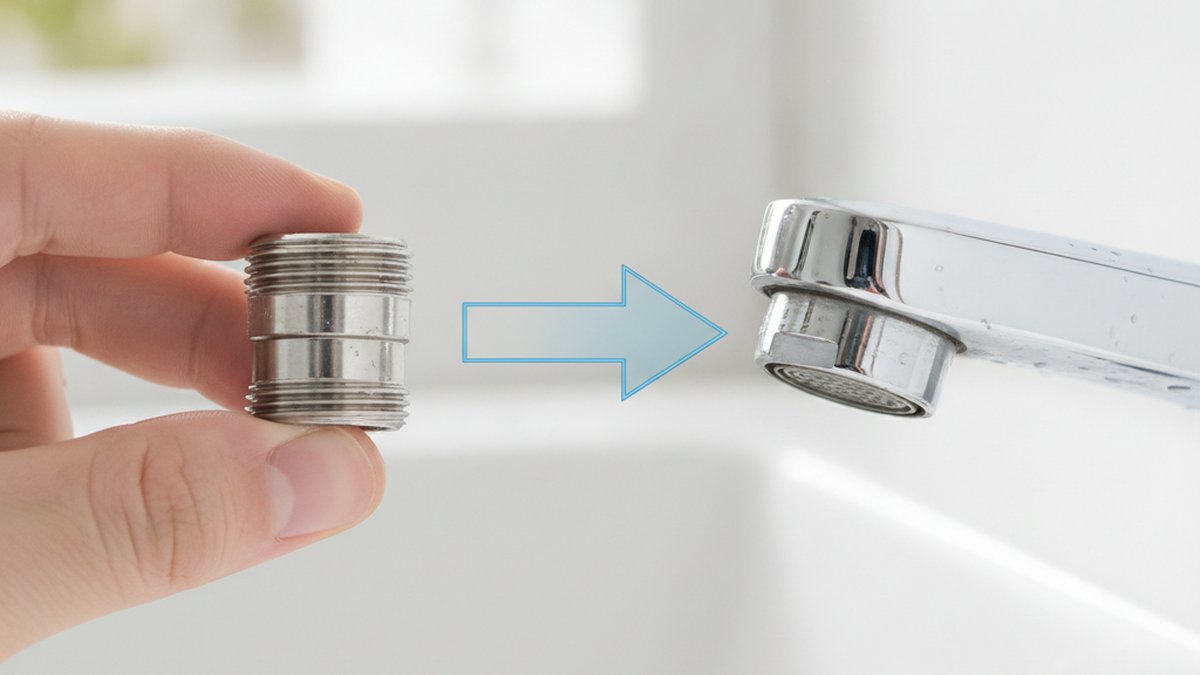
If you’ve ever unscrewed the tip of your kitchen or bathroom spout, held the little mesh insert in your hand, and thought “wait, do the threads go on the inside or the outside?” — you’re already asking the right question. A faucet aerator male is simply an aerator whose threads sit on the outer surface, so it threads into a spout with matching internal (female) threads. Get this one detail wrong and the part either spins loose, cross-threads, or won’t seat at all — no amount of Teflon tape fixes a gender mismatch. This guide walks you through exactly how to identify what you have, the sizes that actually exist, and how to buy the right replacement the first time.
Aerators look trivial, but they do real work: they mix air into the stream so water feels full-bodied while using less of it, they cut splashing, and they’re the cheapest single upgrade you can make to how a faucet feels. The catch is fit. Let’s make sure you never order the wrong one.
What exactly does “male” mean on a faucet aerator?
“Male” describes where the threads live: on a male aerator, the threads are on the outside of the aerator body, and they screw into the spout. On a female aerator, the threads are on the inside, and the aerator screws over the outside of the spout tip. That’s the entire distinction — it has nothing to do with flow rate, spray pattern, or finish.
Here’s the part that trips people up: an aerator is always the opposite gender of the spout it fits. A spout with internal (female) threads needs a male aerator. A spout with external (male) threads at the tip needs a female aerator. So when you shop for a “faucet aerator male,” you’re really telling the store, “my spout is threaded on the inside.” If you flip that logic, you’ll buy the wrong part every time.
There’s also a third category worth knowing: dual-thread (sometimes called “universal”) aerators. These have male threads on the outer ring and female threads on an inner ring, so a single part can mate with either spout type. They’re a handy insurance policy if you’re not 100% sure what you have, though they run a couple dollars more and are a hair bulkier.
How do I tell if I need a male or female faucet aerator?
Look at the tip of your spout: if the threads are on the inside of the opening (smooth on the outside, grooved inside), you need a male aerator; if the threads are on the outside rim of the spout tip, you need a female aerator. The whole diagnosis takes about ten seconds with the aerator removed.
Here’s the reliable, no-guesswork method:
- Remove the current aerator. Turn it counterclockwise (as you look up at the spout) by hand. If it’s stuck, wrap the tip in a cloth and use pliers gently, or a proper aerator key for recessed/cache aerators. If it’s genuinely seized, our guide on how to remove a Moen kitchen faucet aerator that won’t budge covers the tricks that actually work.
- Look at the spout threads, not the aerator. The spout tells you the truth. Threads on the inside wall of the spout opening = you need a male aerator. Threads on the outside of the spout lip = you need a female aerator.
- Confirm with the old part. If the old aerator had threads on its outer edge, it was male — buy male again.
- Measure the diameter if you want certainty (see the size section below). A cheap thread gauge or even a caliper removes all doubt.
One warning: don’t judge gender by eyeballing the assembled faucet. The aerator housing often hides the spout threads completely. You have to unscrew it first. And if your faucet uses a recessed or cache aerator (the mesh sits flush inside the spout with no visible edge), you’ll almost always need a small plastic or metal key to remove it — those are common on newer designer faucets.
What are the standard faucet aerator sizes (and which is male)?
In North America, the two sizes that cover the vast majority of home faucets are 15/16″-27 male and 55/64″-27 female for kitchens, and 13/16″-27 male or 3/4″-27 female for bathrooms. The “-27” refers to 27 threads per inch, which is standard across nearly all residential faucet aerators, so you mainly need to match diameter and gender.
The reason 15/16″ male and 55/64″ female are so common as a pair is that they’re designed to be roughly interchangeable in “regular”-size faucets — a manufacturer picks one or the other for a given spout. Bathroom faucets often run smaller (the “junior” sizes) because the spouts are narrower.
| Size name | Thread gender | Diameter | Typical use |
|---|---|---|---|
| Regular male (M) | Male (outer threads) | 15/16″-27 | Most standard kitchen faucets |
| Regular female (F) | Female (inner threads) | 55/64″-27 | Kitchen faucets with external spout threads |
| Junior male (M) | Male (outer threads) | 13/16″-27 | Many bathroom lavatory faucets |
| Junior female (F) | Female (inner threads) | 3/4″-27 | Compact/bathroom faucets with external threads |
| Tom Thumb / Cache | Usually male, recessed | Varies (key required) | Modern designer & European-style spouts |
Two practical notes. First, imported and European faucets often use metric threads (M18, M22, M24), which will not mate cleanly with North American 27-TPI threads even if the diameter looks close — this is the number-one reason a “correct-size” aerator leaks or won’t tighten. Second, if you’re standing in a hardware aisle unsure of your size, grab a dual-thread aerator or a multi-size aerator kit; it’s the fastest way to get a working part without a second trip.
Why would I replace a faucet aerator male instead of just cleaning it?
Replace it when the mesh screen is corroded, cracked, or clogged with mineral scale that won’t rinse out, when you want to change the flow rate, or when the housing threads are stripped — otherwise, a good cleaning usually restores performance for a few more dollars saved. A faucet aerator male part typically costs $3–$12, so replacement is cheap either way, but knowing the difference saves you the trouble.
Clean it first if your only symptom is reduced or uneven flow. Nine times out of ten, weak flow from a faucet tip is just limescale and grit trapped in the aerator, not a faucet problem. Unscrew it, soak the parts in white vinegar for 20–30 minutes, brush the screen with an old toothbrush, rinse, and reassemble in the same order. If flow is still weak after that, the issue may be upstream — our walkthrough on fixing a Moen kitchen faucet with low water pressure helps you tell an aerator problem apart from a cartridge or supply-line problem.
Replace the aerator outright when:
- The screen is torn, corroded, or crumbling — those bits end up in your glass.
- Scale has fused the internal parts so cleaning no longer restores flow.
- The outer (male) threads are stripped or cross-threaded and won’t hold.
- You want a different flow rate — e.g., dropping from 2.2 GPM to 1.5 GPM to save water, or moving to a spray/laminar pattern.
- You’re switching finishes to match a new faucet (aerators come in chrome, brushed nickel, matte black, brushed gold, and more).
On flow rate: aerators are stamped or packaged with a GPM (gallons per minute) figure. Standard kitchen aerators are around 2.2 GPM; water-saving models run 1.5, 1.0, or even 0.5 GPM. A lower number saves water and can make a weak-pressure home feel stronger because the air-water mix is denser — but go too low on a genuinely high-flow task (filling a stockpot) and it’ll annoy you. Match the number to how you actually use the tap.
How do I install a male faucet aerator without leaks?
Hand-tighten the male aerator clockwise into the spout until snug, then give it no more than a quarter-turn with a cloth-wrapped plier — over-tightening cracks the housing and strips the threads, which causes the very leaks you’re trying to prevent. A correctly seated aerator with a good washer rarely needs plumber’s tape at all.
Step by step:
- Check the rubber washer. Male aerators seat against a small rubber or fiber washer inside the assembly. Make sure it’s present, flat, and not torn — a missing or deformed washer is the most common cause of a drip around the tip.
- Start the threads by hand. Turn clockwise gently. If it resists in the first turn, back it off and restart — that resistance is usually cross-threading, and forcing it will ruin the spout threads.
- Snug it up. Hand-tight plus a light quarter-turn is plenty. The washer does the sealing, not brute force.
- Test. Run the water and check for drips at the seam. If it weeps, remove it, add two wraps of PTFE (plumber’s) tape to the male threads, and reinstall. Rarely necessary, but it works.
- Confirm the spray. A good aerator gives a soft, non-splashing, slightly cloudy (aerated) stream. If it’s spitting or spraying sideways, a part is misseated — take it apart and check the order of the screen, restrictor, and washer.
If your new aerator is fine but the faucet itself is making noise or chattering afterward, that’s usually unrelated to the aerator gender — see our piece on why a bathroom tap gets noisy and how to fix it for the actual culprits (loose washers, worn cartridges, or high pressure).
Which avamani faucet aerator male should you actually buy?
For most standard kitchen faucets, buy a 15/16″-27 male aerator in a flow rate of 1.5–2.2 GPM and a finish that matches your spout; for bathroom faucets, go with the 13/16″-27 junior male. If you’re unsure of your size or gender, a dual-thread universal aerator or a small multi-size kit is the safest single purchase.
A quick decision guide:
- Standard kitchen, known male spout: 15/16″-27 male, 1.8–2.2 GPM, aerated stream. This is the workhorse.
- Bathroom lavatory: 13/16″-27 male, 1.0–1.5 GPM — you rarely need high flow at a bathroom sink, and lower GPM saves water.
- Not sure of gender/size: dual-thread universal aerator — mates with male or female spouts.
- Hard-water home: choose a model with a removable, easy-clean screen and consider a lower GPM plus a whole-tap filter. If mineral buildup is a recurring headache, a faucet water filter paired with the right aerator keeps both scale and taste in check.
- Recessed/cache spout: buy the matching cache aerator and the key; don’t try to force a standard exposed aerator into a recessed tip.
Finish matters more than people expect. A gleaming chrome aerator sticking out of a matte-black or brushed-gold spout looks off. avamani aerators are offered in finishes that match our faucet lines, so the tip disappears into the design instead of clashing with it. And because the thread standard is consistent, you can upgrade the flow rate or spray pattern later without changing anything else.
FAQ
Is a faucet aerator male or female by default?
There’s no universal default — it depends entirely on your faucet. Regular kitchen faucets are very often male-threaded on the spout, meaning they take a female aerator, but plenty use the reverse. Always remove your existing aerator and look at the spout threads before buying. Threads on the inside of the spout = you need a male aerator.
Can I use a dual-thread aerator instead of buying a specific male one?
Yes. A dual-thread (universal) aerator has both male and female threads and will fit either spout type, so it’s the safest choice when you’re unsure. The only trade-offs are a slightly higher price and a marginally bulkier profile. For a clean, low-profile look on a designer faucet, a dedicated male aerator in the correct size is still the better match.
What size is a standard male kitchen faucet aerator?
The standard “regular male” size is 15/16″-27 — that’s 15/16 inch diameter at 27 threads per inch. Bathroom faucets more often use the “junior male” 13/16″-27 size. If your faucet is imported or European, check for metric threads (M18/M22/M24), which won’t fit North American sizes even when the diameter looks similar.
Why does my new male aerator still leak or drip?
The usual causes are a missing, torn, or misseated rubber washer; cross-threaded installation; or over-tightening that cracked the housing. Remove it, inspect the washer, restart the threads by hand, and snug to hand-tight plus a quarter-turn. If it still weeps, add two wraps of plumber’s tape to the male threads. If the drip is coming from the base of the faucet rather than the tip, the problem isn’t the aerator at all.
Do I need plumber’s tape on a male faucet aerator?
Usually not. Male aerators seal against an internal washer, not against the threads, so a good washer and correct tightening are enough. Use two wraps of PTFE tape on the male threads only if you get a persistent drip after confirming the washer is intact. Don’t overdo it — too much tape prevents the aerator from seating and can make leaks worse.
Will a lower-GPM male aerator fix my weak water flow?
Sometimes, yes. A lower-GPM aerator mixes more air into a smaller volume of water, which can make a low-pressure tap feel stronger and steadier. But if your flow is genuinely weak, clean or replace the aerator first, and if that doesn’t help, look upstream at the cartridge, supply valves, or lines — the aerator is only the last inch of the journey.
A note on expertise, testing, and warranty
About avamani: avamani designs and sells faucets, showerheads, and bathroom fixtures for everyday homes, and we’ve spent years fielding the same question from customers at the sink — “is mine male or female?” That hands-on support is why this guide leads with identification instead of a sales pitch. Our aerators are built to standard 27-TPI thread specifications and tested for flow consistency and leak resistance before they ship, and they’re backed by our fixture warranty. If a part arrives cross-threaded or fails to seal against a spec-compliant spout, we replace it.
Author note: This article was written by avamani’s fixtures content team and reviewed against real product specs and common plumbing standards (WaterSense flow-rate guidance for aerators is a useful reference if you’re targeting water savings). We test the parts we write about, and we link only to our own in-depth guides — like our explainers on removing a stuck aerator and diagnosing low water pressure — so you can go deeper without leaving reliable ground. When in doubt about fit, measure twice, match the gender to your spout, and buy once.