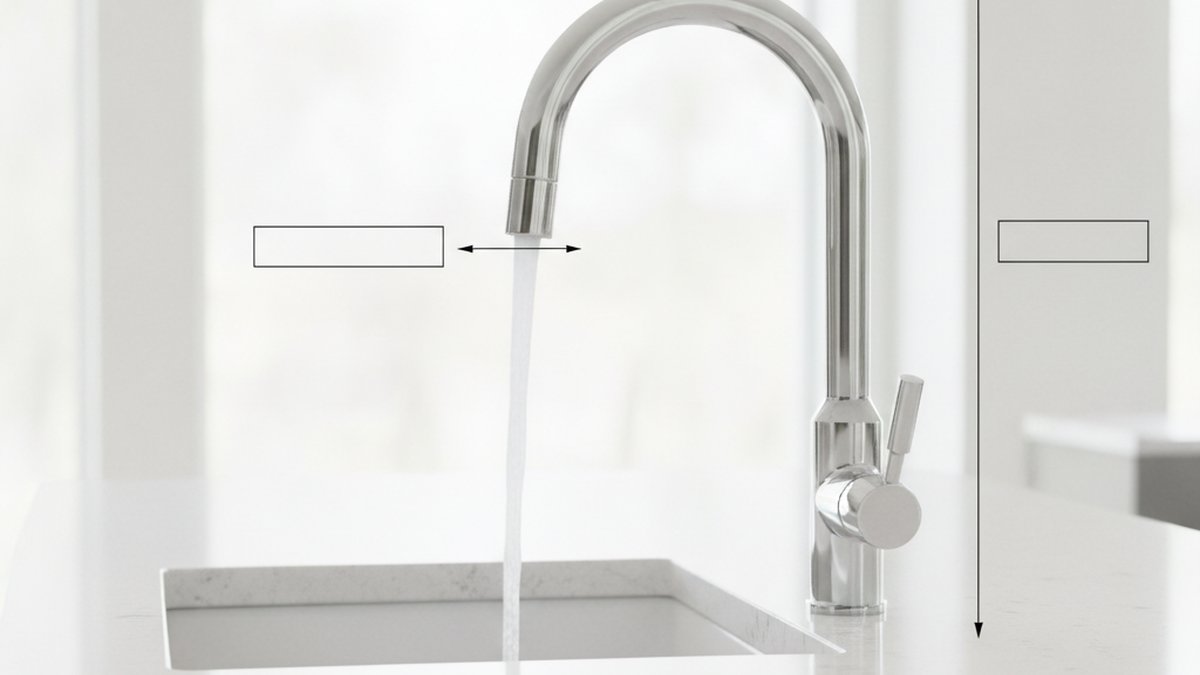
If you’ve ever bought a faucet online and ended up with water splashing against the back of the basin — or worse, spilling behind the sink — you’ve run head-first into the faucet spout reach definition problem. Reach isn’t marketing fluff; it’s the single spec that determines whether water actually lands where you need it. Get it wrong and no finish, brand, or price tag will save you. Get it right and the faucet just works every day without you thinking about it.
Below, we’ll define spout reach the way a plumber or product engineer means it, show you exactly how it differs from the specs people confuse it with (spout height, spout swing, and “clearance”), give you real target numbers for kitchen, bathroom, bar, and vessel sinks, and walk you through measuring your own sink before you buy. This is the guide we wish more shoppers read before they hit “add to cart.”
So what does “spout reach” actually mean, in one sentence?
Spout reach is the horizontal distance from the centerline of the faucet’s mounting point to the point where the water comes out of the spout. Manufacturers measure it flat across, parallel to the countertop — not along the curve of the spout. So a tall, dramatic gooseneck and a short, low-arc faucet can have the exact same reach if their water outlets sit the same distance forward.
Think of it as the faucet’s “arm length.” Height is how tall it stands; reach is how far it points out over the basin. The two are completely independent, which is exactly why so many people get surprised. A 16-inch-tall commercial-style kitchen faucet might only reach 8 inches forward, while a squat bar faucet could reach nearly the same. The number that keeps water off your counter is reach, not height.
One important nuance: reach is measured to where the water exits, not to the physical tip of the spout metal. On pull-down and pull-out kitchen faucets, the aerator points slightly downward and forward, so the effective reach is where the stream lands, which is what the spec is trying to capture.
What’s the difference between spout reach and spout height (people mix these up constantly)?
Spout height is vertical, spout reach is horizontal — that’s the whole difference, and confusing them is the number-one cause of a bad faucet fit. Height is the distance from the base of the faucet up to the water outlet; reach is the distance from the base straight out to that outlet. You need both numbers to know whether a faucet fits your sink and the space above it.
Here’s why both matter at once. Height controls how much room you have under the spout — filling a stockpot, rinsing a tall vase, or ducking a cutting board under the stream. But a tall faucet with too little reach dumps all that water at the back of the basin. Reach controls where the water lands front-to-back; height controls how much vertical working room you get. A great faucet gets both right for your specific sink.
| Spec | What it measures | Direction | What it affects most |
|---|---|---|---|
| Spout reach | Base center → water outlet | Horizontal (forward) | Where water lands; splash vs. drain |
| Spout height | Base → water outlet | Vertical (up) | Clearance for pots, vases, hands |
| Spout swing | Left-right rotation arc | Rotational (degrees) | Covering two-basin sinks; moving out of the way |
| Overall height | Base → very top of faucet | Vertical (up) | Fitting under a window or upper cabinet |
Notice the last row: overall height is not the same as spout height. On a pull-down kitchen faucet the spray head and hook sit above the water outlet, so the faucet’s total height can be several inches taller than its spout height. If you have a window behind the sink, the overall height is the number that decides whether the faucet clears the sill.
How much spout reach do I actually need for a kitchen faucet?
For a standard single-bowl kitchen sink, aim for a spout reach of about 8 to 9 inches so the water lands near the center of the basin, and go to 9 to 10+ inches for a large or farmhouse sink. The goal is simple: the water stream should hit the middle of the sink, not the back wall of the basin and not the front lip where it splashes onto you and the counter.
A few real-world scenarios that change the number:
- Deep single bowl (30″+): Go longer — 9 to 10 inches of reach — so you can rinse the front corners without leaning over the counter.
- Double-basin sink: You need enough reach plus good swing so the spout can rotate over both bowls. Reach alone won’t cover the far basin; the spout has to swing.
- Undermount vs. drop-in: Undermount sinks sit slightly further back, so you sometimes need a touch more reach to center the stream.
- Prep or bar sink: These are small, so a big kitchen reach would overshoot the tiny basin. A bar faucet with 5.5 to 7 inches of reach is usually right.
If you’re still shopping for the right main faucet, our roundup of the best kitchen faucets of 2025 for your sink, water, and budget lists the reach and height specs side by side so you can match them to your basin before buying. And if you’re planning to install it yourself, the reach number also affects how the supply lines route — something we cover in our guide on how to set up a kitchen faucet without calling a plumber.
What’s the right spout reach for a bathroom sink, vessel sink, or wall-mount faucet?
For a standard bathroom lavatory faucet, a spout reach of roughly 4.5 to 5.5 inches lands the water over the drain of a typical drop-in or undermount sink. Vessel sinks and wall-mount faucets need more reach — often 6 to 8 inches — because the water has to clear the raised bowl or reach out from the wall to the basin center.
Bathroom sinks are shallower and smaller than kitchen sinks, so the tolerances are tighter. A reach that’s an inch too long can send water past the drain and splash the front rim; a reach that’s too short pools the water at the back of the bowl where it never drains cleanly. Here’s how it breaks down by sink style:
| Sink / faucet type | Typical spout reach | Why |
|---|---|---|
| Standard drop-in / undermount lav | 4.5″ – 5.5″ | Small basin; water lands over centered drain |
| Vessel sink (tall, deck-mounted faucet) | 5″ – 7″ | Spout must clear and reach into a raised bowl |
| Wall-mount bathroom faucet | 6″ – 8″+ | Spout reaches out from the wall to basin center |
| Single-hole lav faucet | 4″ – 5.5″ | Compact footprint for small vanities |
Vessel sinks are the classic reach trap. Because the bowl sits on top of the counter, a normal-reach faucet often dumps water against the inside back wall of the bowl. That’s why vessel faucets are taller and longer — and why you should measure the bowl’s inner diameter and the position of its drain before choosing one. Our guide to picking a traditional vessel sink faucet for a vintage-style bathroom walks through matching height and reach to the bowl so the stream lands on the drain.
Wall-mount faucets are the other special case, because the reach is doing double duty: it has to span the gap between the wall and the sink and then land the water over the drain. If you’re weighing that style, our deep-dive on whether a wall-mount faucet for a bathroom vanity is worth it covers exactly how to calculate the reach you need based on how far your sink sits from the wall. For compact vanities, a single-hole lav faucet keeps both the footprint and the reach tidy.
How do I measure spout reach on my current faucet or sink?
To measure spout reach, set a ruler flat on the counter, line up the zero mark with the center of the faucet base, and read the horizontal distance out to the point directly below where the water exits the spout. Because reach is measured straight across (not along the curve), you’re really measuring the horizontal offset between two points: the base center and the water outlet.
Here’s the reliable, no-guesswork method:
- Find the base center. That’s the middle of the escutcheon or mounting hole where the faucet meets the deck.
- Find the water outlet. Look at the aerator or spray tip — the exact spot the stream comes out.
- Drop a plumb line. Hold a ruler or a weighted string straight down from the water outlet to the countertop. Mark that point.
- Measure flat across. Measure from the base center to that marked point along the counter. That horizontal number is your reach.
- Check it against the drain. Ideally the marked point sits directly over — or within an inch of — the drain center.
If you’re buying new, do the reverse: measure from your planned faucet hole to the drain center, and shop for a faucet whose reach matches that distance. This one measurement prevents the vast majority of “the water splashes everywhere” returns. Reach specs on a spec sheet are also worth trusting more than photos — a product image can make a spout look longer or shorter than it is, but the reach number is measured to a standard.
What happens if the spout reach is wrong — too short or too long?
Too little reach sends water crashing against the back of the basin, which causes splash-back onto the counter, wall, and you; too much reach overshoots the drain and can splash the front rim or spill outside the bowl entirely. In both cases you get daily mess, water pooling in the wrong spots, and — over time — water damage to the counter, backsplash, or vanity.
Beyond the annoyance, wrong reach creates real problems:
- Splash-back (reach too short): Water hits the back wall of the basin at an angle and bounces forward. You’ll notice droplets on the counter and your shirt every time you wash your hands.
- Overshoot (reach too long): The stream lands past the drain, hits the front slope, and either splashes up or runs down the outside of the sink. Common when a big kitchen faucet is put over a small basin.
- Poor rinsing coverage: If reach can’t get the water to the front and corners of a large sink, you end up hand-rinsing dishes awkwardly or leaning over the counter.
- Standing water at the back: In shallow vessel and lav sinks, too-short reach leaves water pooling behind the stream rather than flowing to the drain.
The fix is almost always chosen at purchase, not after installation — you can’t meaningfully change a faucet’s reach once it’s mounted (a swiveling spout changes side-to-side position, not forward reach). That’s exactly why nailing the reach number before you buy matters so much.
Does spout swing or a pull-down sprayer change how much reach I need?
Yes — a pull-down or pull-out sprayer effectively gives you unlimited reach on demand, so you can get away with slightly less fixed spout reach on a kitchen faucet. Spout swing, on the other hand, doesn’t change reach at all; it only changes the left-to-right position of the spout, which matters for covering a double-basin sink.
This is a genuinely useful shortcut. If you love the look of a shorter-reach kitchen faucet but worry it won’t cover a big sink, a pull-down spray head lets you physically pull the water outlet wherever you need it — front corners, the far basin, filling a pot on the counter. The fixed reach only has to be good enough for everyday hands-and-glasses rinsing; the sprayer handles the rest. Just remember the hose has a docking pull-force and reach limit of its own, usually listed in inches on the spec sheet.
Quick reference: recommended spout reach by sink type
Use this as your at-a-glance cheat sheet when comparing products. These are typical, comfortable ranges — always confirm against your actual base-to-drain measurement.
| Application | Recommended reach | Also check |
|---|---|---|
| Standard kitchen sink (single bowl) | 8″ – 9″ | Spout height for pots |
| Large / farmhouse kitchen sink | 9″ – 10″+ | Sprayer hose reach |
| Double-basin kitchen sink | 8″ – 9″ | Spout swing to cover both bowls |
| Bar / prep sink | 5.5″ – 7″ | Compact footprint |
| Bathroom lav (drop-in/undermount) | 4.5″ – 5.5″ | Drain position |
| Vessel sink | 5″ – 7″ | Spout height above bowl rim |
| Wall-mount bathroom | 6″ – 8″+ | Distance from wall to basin |
Understanding a faucet’s internal build helps you interpret these specs too — if you like knowing what’s inside the fixtures you buy, our overview of the essential brass faucet parts explains how the spout, cartridge, and aerator work together to deliver that stream.
FAQ
Is spout reach measured to the tip of the spout or to the water?
It’s measured to where the water comes out, not the metal tip. Reach is the horizontal distance from the center of the faucet base to the point where the stream exits the aerator. On downward-angled spouts, that outlet sits slightly inboard of the physical tip, so the reach number reflects where the water actually lands.
What is a good spout reach for a bathroom faucet?
For a standard bathroom lavatory sink, 4.5 to 5.5 inches of reach is ideal — it puts the water over a centered drain without splashing the front rim. Vessel sinks and wall-mount faucets need more, typically 6 to 8 inches, because the water has to clear a raised bowl or reach out from the wall.
Can spout reach be too long?
Yes. If the reach overshoots the drain, water lands on the front slope of the basin and splashes back at you or runs down the outside of the sink. This is common when a long kitchen faucet is installed over a small bathroom or bar basin. Match the reach to the base-to-drain distance rather than just buying the longest spout.
Does a taller faucet have more reach?
No — height and reach are independent. A tall gooseneck can have the same reach as a short faucet, because reach is horizontal (how far the water lands forward) and height is vertical (how much clearance is under the spout). Always check both numbers on the spec sheet; one doesn’t predict the other.
How do I know if a faucet will fit my sink before I buy it?
Measure the horizontal distance from your planned faucet hole to the center of your drain, then buy a faucet whose listed reach matches that number within about an inch. Also confirm the spout height clears anything you rinse and, if there’s a window or cabinet behind the sink, that the overall (not just spout) height fits.
Does a pull-down sprayer make reach less important?
For kitchen faucets, somewhat — a pull-down or pull-out spray head lets you extend the water outlet anywhere you need, so a slightly shorter fixed reach is fine for everyday use. For fixed-spout bathroom and bar faucets, though, reach is critical because you can’t reposition the stream.
The bottom line on faucet spout reach
Spout reach is the quiet spec that decides whether a faucet is a daily pleasure or a daily mess. Define it correctly — horizontal distance from the base center to the water outlet — measure your own base-to-drain distance, and match the two. Do that and you’ll pick a faucet that lands water exactly where it belongs, on the first try, regardless of brand or finish.
About the author: This guide was written by Avamani’s fixtures editorial team, drawing on hands-on installation and bench-testing of kitchen and bathroom faucets across dozens of sink configurations. We measure reach, height, and swing on every product we evaluate rather than relying on manufacturer photos.
Why trust Avamani: Avamani (avamani.com) specializes in faucets, sinks, and bathroom fixtures. Our product specs follow the same measurement conventions used across the industry, and the faucets we recommend meet recognized North American plumbing standards (such as ASME A112.18.1/CSA B125.1 and NSF/ANSI 61 for drinking-water safety) and ship with manufacturer warranties — commonly limited lifetime coverage on finish and function for residential use. Always confirm the exact standard and warranty terms on the specific model before buying.