If you’ve been searching for a tap water filter Ireland homeowners actually rate, the honest answer is that there’s no single “best” — there’s a best for your water and your kitchen. Irish tap water is generally safe to drink straight from the mains (Uisce Éireann / Irish Water treats it to EU drinking-water standards), but “safe” and “tastes good and protects your fittings” are two different things. Chlorine taste, limescale from hard water, occasional discolouration from old cast-iron mains, and lead from pre-1970s service pipes are the four reasons Irish households actually buy a filter.
This guide walks through the real options — jug, tap-mounted, under-sink carbon, and reverse osmosis — what each one realistically removes, what they cost in euro, and how to match the filter to your situation. We sell the taps these systems connect to, so we’ll also be straight with you about where a filter helps and where it’s overkill.
Do I actually need a tap water filter in Ireland, or is the tap water fine?
For most people on the public supply, you don’t strictly need one — Irish mains water meets EU standards — but a filter is worth it if you don’t like the chlorine taste, you’re in a hard-water area, or your home still has old lead or galvanised pipework. Those are the situations where a filter changes something you can actually taste or measure.
Here’s how to decide quickly. You probably benefit from a filter if any of these apply to you:
- You can smell or taste chlorine from the cold tap — very common after treatment-plant top-ups, and the single most fixable issue.
- You’re in a hard-water area — much of the east coast, the midlands and Dublin sit on limestone, so you get limescale on the kettle, spotting on glasses, and shorter life from appliances.
- Your house was built before about 1970 and may still have a lead communication or service pipe, or internal lead plumbing.
- You’re on a private well (roughly one in ten Irish households) — these aren’t treated by Uisce Éireann, so you’re responsible for testing and treatment yourself.
- You’ve had a boil-water notice or seen occasional brown/cloudy water from disturbed mains.
If none of those apply and you’re happy with the taste, a simple filter jug in the fridge may be all you ever want. If two or more apply, a plumbed-in system pays for itself in taste, convenience and protected appliances.
What are the main types of tap water filter, and which suits my kitchen?
The four common types are filter jugs, tap-mounted filters, under-sink carbon systems, and reverse osmosis (RO). They climb in price, performance and plumbing effort in roughly that order — a jug needs zero tools, RO needs an under-sink install and a dedicated tap.
Quick plain-English breakdown before the comparison table:
- Filter jug — a carbon-and-resin cartridge in a pour-through jug. Cheap, no installation, improves taste and softens slightly. Slow, small capacity, and the cartridges add up over a year.
- Tap-mounted filter — a small unit that screws onto your existing spout with a switch for filtered/unfiltered. Cheap and easy, but bulky on the tap, restricts flow, and won’t fit many modern pull-out or designer spouts.
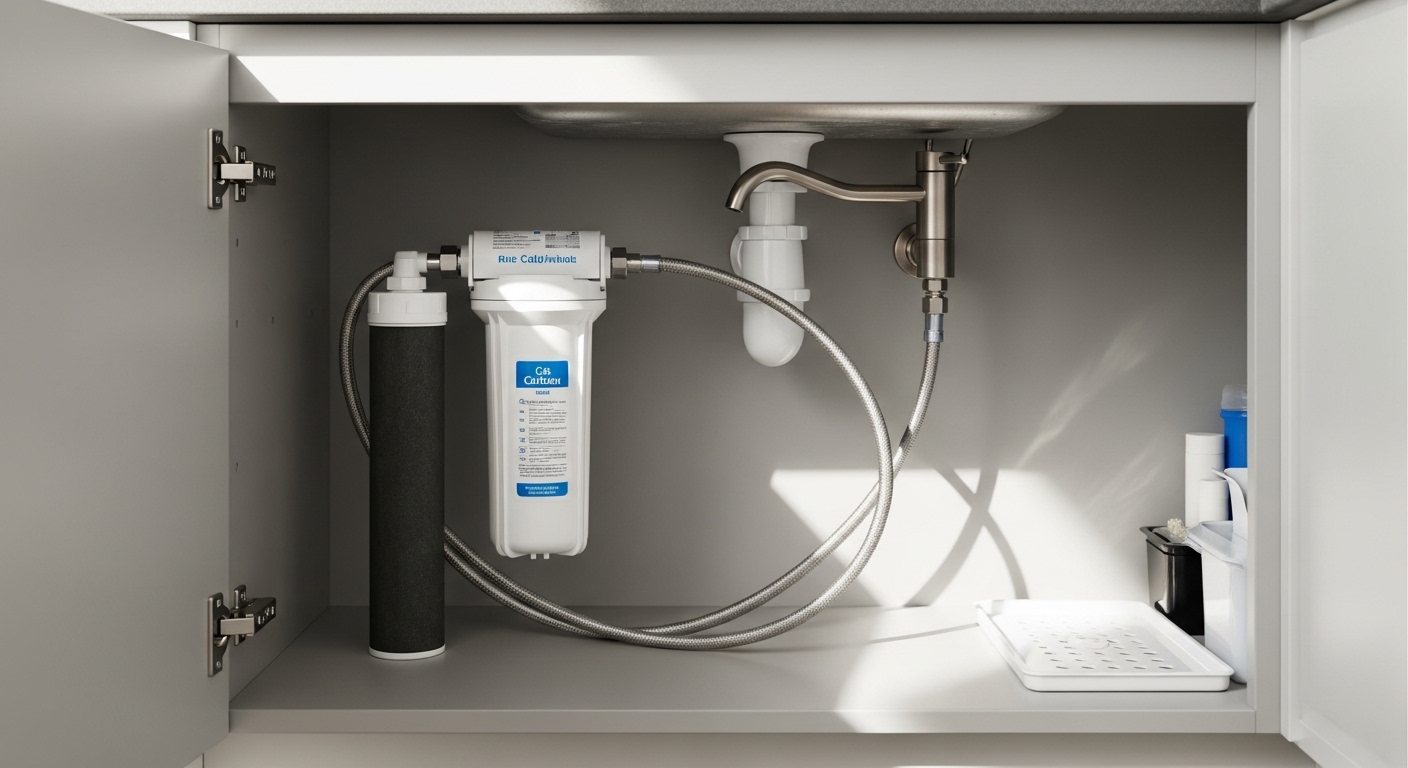
- Under-sink carbon system — a cartridge (or twin cartridge) hidden in the cabinet, feeding either your main cold line or a separate filter tap. The sweet spot for most Irish homes: good flow, long cartridge life, out of sight.
- Reverse osmosis (RO) — a multi-stage membrane system that strips out almost everything, including dissolved minerals, fluoride and most contaminants. Best purity, but wastes some water, needs a tank, and the water tastes “flat” unless remineralised.
| Filter type | Typical cost (Ireland) | Removes | Flow / convenience | Best for |
|---|---|---|---|---|
| Filter jug | €25–€45 + ~€40/yr cartridges | Chlorine taste, some limescale, some metals | Slow, manual refill | Renters, light use, trying before committing |
| Tap-mounted | €30–€70 | Chlorine, sediment, some lead | On-demand but restricts flow | Quick fix on a standard spout |
| Under-sink carbon | €120–€300 fitted | Chlorine, sediment, VOCs, taste/odour, some lead | Full flow, hidden, ~6–12 month cartridges | Most family kitchens |
| Reverse osmosis | €250–€600 fitted | Up to 95–99% of dissolved solids, fluoride, nitrates, lead | Slower fill via tank, some waste water | Wells, very hard water, max purity |
For the majority of readers, the under-sink carbon system is the answer. It connects neatly under the counter, doesn’t ruin the look of a nice spout, and gives you full-pressure filtered water. If you already love your main kitchen tap and don’t want to change it, a dedicated 3-way or separate filter tap lets you keep it and add filtered water alongside. If you’re choosing a new main tap at the same time, our guide to whether a Grohe pull-out kitchen tap is worth it covers the flow-rate and spout-reach numbers that matter when you’re also routing a filter line.
Which tap water filter is best for hard water in Dublin and the east coast?
For hard water specifically, a carbon filter alone won’t fix limescale — you want either a reverse-osmosis system at the tap or a whole-house water softener upstream, and many Dublin homes end up combining a softener for the house with a simple carbon filter for drinking taste.
This is the most misunderstood point in the whole topic, so let’s be precise. Hardness is dissolved calcium and magnesium. Standard activated-carbon filters (jugs, tap-mounted, basic under-sink) improve taste and remove chlorine, but they do not meaningfully reduce hardness — so your kettle will still scale up. To actually deal with limescale you have two routes:
- Point-of-use reverse osmosis at the kitchen sink — removes the dissolved minerals from your drinking and cooking water, so no scale in the kettle and cleaner-tasting tea and coffee. Doesn’t help the rest of the house.
- Whole-house water softener plumbed in where the mains enters — protects every appliance, your shower fittings, the immersion and the washing machine. Then a small carbon filter on the kitchen cold line tidies up taste for drinking.
Eastern and midland counties — Dublin, Kildare, Meath, Louth, parts of Galway and the limestone belt — tend to have the hardest water, often 200–350 mg/l as calcium carbonate. If you’re in Connemara, parts of Wicklow or the granite west, your water may already be soft and acidic, in which case you don’t need softening at all and a plain carbon filter is plenty. Don’t buy a softener for soft water.
Will a tap water filter remove lead from old Irish pipes?
Yes — but only the right kind. Look for a filter specifically certified for lead reduction (typically a high-grade carbon block rated to NSF/ANSI 53), not a basic taste-and-odour cartridge or a plain jug, which are only certified to NSF/ANSI 42 for taste.
Lead is a genuine concern in older Irish housing stock. Homes built before the 1970s may still have a lead service pipe between the street main and the house, or internal lead plumbing, and Uisce Éireann has run a multi-year programme to replace public-side lead pipes — but the section on your property is your responsibility. Lead leaches more in soft, acidic water and when water sits still overnight.
If lead is your worry:
- Choose an under-sink carbon block or reverse-osmosis system explicitly certified for lead reduction — check the box or spec sheet for the NSF/ANSI 53 claim.
- In the meantime, run the cold tap for 1–2 minutes first thing in the morning before drinking, to flush water that’s been standing in the pipe.
- Only ever use the cold tap for drinking and cooking — hot water dissolves more lead.
- If you suspect a lead service pipe, get your water tested; well owners especially should test annually.
One practical note for installation: any plumbed-in filter needs a tidy tap connection, and the tap-hole and thread sizing on your sink determines what fits. If you’re adding a dedicated filter tap, it’s worth understanding standard fixing sizes first — our explainer on the M6 tap hole size in mm covers why thread and hole dimensions matter so you don’t end up with a tap that won’t seat properly.
How much does a tap water filter cost to run in Ireland per year?
Budget roughly €40–€120 a year in replacement cartridges for most systems, on top of the upfront cost. The filter hardware is a one-time spend; the running cost is almost entirely cartridges, and that’s where people get caught out.
Here’s a realistic yearly picture:
- Filter jug: €25–€45 upfront, then ~€40–€60/yr because cartridges only last about a month each.
- Tap-mounted: €30–€70 upfront, ~€50–€80/yr in cartridges depending on use.
- Under-sink carbon: €120–€300 fitted, then ~€40–€90/yr — cartridges typically last 6–12 months, which is why the cost-per-litre is so much better.
- Reverse osmosis: €250–€600 fitted, ~€80–€120/yr across the pre-filters and membrane (the membrane itself can last 2–3 years).
The cheapest option to buy (a jug) is often the most expensive to run per litre, while an under-sink system costs more up front but works out cheaper over three to five years and is far less hassle. If you drink a lot of filtered water — a family making tea, coffee, pasta and topping up bottles all day — plumbed-in always wins on cost and convenience.
Worth saying clearly: a tap water filter is not the same product as the cooking-water “pot filler” filters people sometimes ask about. Those are a niche convenience over the hob, not a drinking-water purification system — we broke down whether they’re worth it in our honest look at the pot filler faucet filter, and the short version is they solve a different problem than the one this guide is about.
Can I fit a tap water filter myself, or do I need a plumber?
A jug or tap-mounted filter needs no tools and no plumber. An under-sink or RO system is a competent-DIY job if you’re comfortable with a shut-off valve and push-fit connectors — otherwise it’s an hour or two for a plumber, typically €60–€150 labour.
If you’re fitting an under-sink system yourself, the basic sequence is:
- Turn off the cold-water supply at the isolation valve under the sink.
- Fit the supplied tee/diverter valve onto the cold feed.
- Mount the filter housing inside the cabinet, leaving room to swap cartridges.
- If you’re adding a separate filter tap, drill or use the spare hole in the sink/worktop and seat the tap (check your thread and hole size first).
- Connect the hoses, open the valve slowly, check for leaks, and flush the new cartridge for a few minutes before drinking.
The most common mistakes are over-tightening push-fit fittings and not flushing the cartridge, which leaves the first few glasses tasting of carbon dust. If you ever notice drips after install, the same diagnostic logic applies as with any fitting — our guide on a leaking shower faucet valve walks through how to trace a leak back to the cartridge, O-ring or connection, and the principles carry straight over to an under-sink filter.
What should I look for when buying a tap water filter in Ireland?
Prioritise certification, flow rate, cartridge cost and the right tap connection — in that order. A filter that’s cheap to buy but has expensive proprietary cartridges and a slow flow rate will annoy you for years.
A quick buyer’s checklist:
- Certification: NSF/ANSI 42 for taste/chlorine, NSF/ANSI 53 if you need lead or specific contaminant reduction, NSF/ANSI 58 for RO membranes. These are independent test standards, not marketing claims.
- Flow rate: at least 2 litres/minute for an under-sink unit so filling a pot doesn’t feel painful.
- Cartridge life and price: check litres-rated and the replacement cost — not just the headline price.
- Tap compatibility: standard cartridges and standard tap threads beat proprietary lock-ins; check your sink has a spare hole or you’re happy to drill one.
- Warranty and support: a 2–5 year warranty on the housing and tap signals the maker stands behind it.
If you’re renovating the whole kitchen or bathroom around the same time and want fittings that look cohesive with a new filter tap, our roundup of the best bathroom faucet collections is a useful place to match finishes across taps and accessories so your filter tap doesn’t stick out.
FAQ
Is Irish tap water safe to drink without a filter?
Generally yes, if you’re on the public mains. Uisce Éireann treats water to EU drinking-water standards and publishes results. A filter is about taste, hardness, and peace of mind around old pipes — not because the mains supply is unsafe. Private well owners are the exception: you must test and treat your own supply.
Does a tap water filter remove fluoride in Ireland?
Standard carbon filters do not remove fluoride. Ireland adds fluoride to public water supplies, and only reverse osmosis or a specialist activated-alumina filter will significantly reduce it. If fluoride reduction is your goal, a point-of-use RO system at the kitchen sink is the practical choice.
How often should I change my filter cartridge?
Follow the litres-rating, but as a rule: jug cartridges monthly, tap-mounted every 2–3 months, under-sink carbon every 6–12 months, and RO pre-filters every 6–12 months with the membrane every 2–3 years. Hard water and heavy use shorten these. A drop in flow or a return of chlorine taste means it’s overdue.
Will a filter help with limescale in my kettle?
Only certain types. A basic carbon filter improves taste but won’t reduce hardness, so you’ll still get scale. To stop limescale you need reverse osmosis at the tap or a whole-house water softener. Much of Dublin, the east coast and the limestone midlands have hard water, so this matters there more than in the soft-water west.
Can I connect a water filter to my existing kitchen tap?
Often yes. You can either add a separate dedicated filter tap, fit a 3-way tap that handles hot, cold and filtered through one spout, or use a tap-mounted unit on a standard spout. Modern pull-out and designer spouts usually need a separate filter tap rather than a screw-on unit, so check your spout type and sink hole availability first.
Is reverse osmosis worth it for an Irish home?
It’s worth it if you’re on a well, have very hard water, or want the purest possible drinking and cooking water with fluoride and nitrate reduction. For a typical mains-supplied home that just wants better-tasting, chlorine-free water, an under-sink carbon system is cheaper, wastes no water, and is usually enough.
The bottom line
Match the filter to your water, not to the lowest price tag. If you just want better-tasting water, an under-sink carbon system with a tidy filter tap is the smart buy for most Irish kitchens. If you’re fighting hard water in Dublin or the east, think reverse osmosis at the tap or a softener for the house. If old lead pipes worry you, insist on a cartridge certified to NSF/ANSI 53. Get those three calls right and you’ll never think about your drinking water again.
Author note: This guide was written by the Avamani fixtures team, who specify and supply kitchen and bathroom taps, filter taps and connections for Irish and international homes. We test fittings for flow rate, thread tolerance and finish durability, and we reference independent NSF/ANSI water-treatment standards rather than marketing claims. Avamani-supplied filter taps carry a manufacturer warranty; always confirm certification and warranty terms for the specific filter cartridge or system you pair with your tap. This article is general guidance, not a substitute for testing your own supply — well owners in particular should test annually.