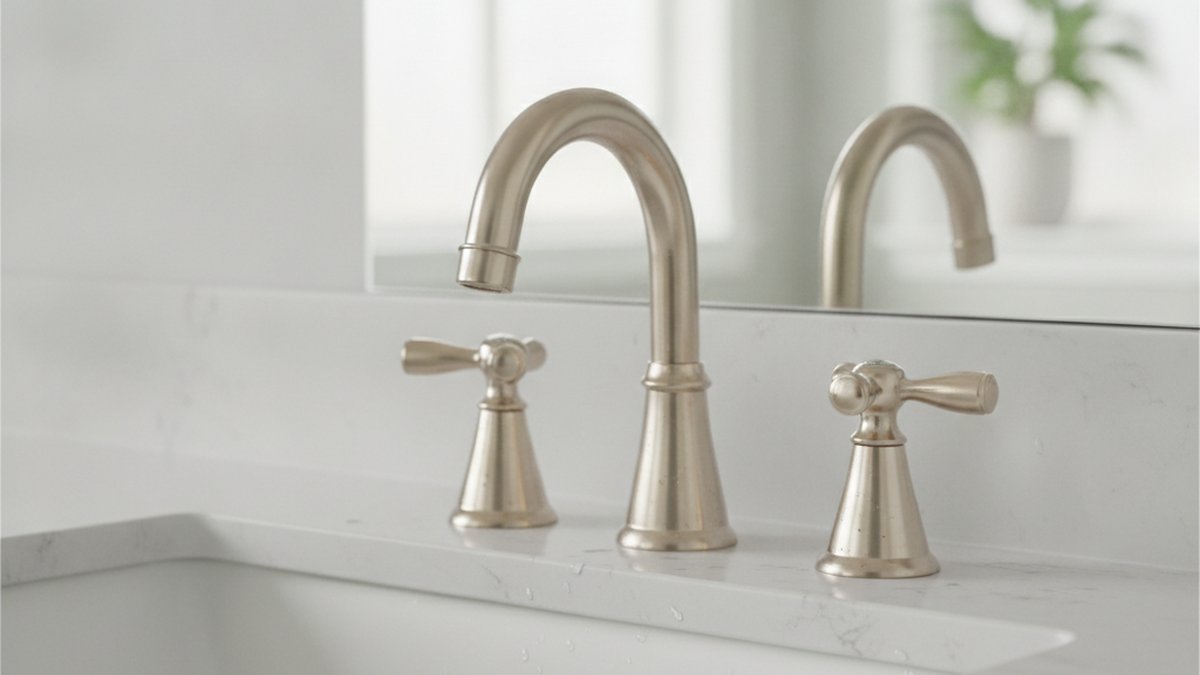
If you’ve been comparing finishes and configurations, a polished nickel faucet centerset is one of the easiest ways to give a bathroom sink a high-end, timeless look without going full designer-budget. “Centerset” tells you how it mounts (three holes spaced 4 inches apart, with the spout and both handles on one shared base plate), and “polished nickel” tells you the finish — a warm, silvery-white metal with a bright, reflective shine that reads slightly softer and more golden than chrome. Put them together and you get a faucet that fits the most common bathroom sink drilling in North America while looking noticeably more upscale than the builder-grade chrome that came with the house.
Below, we’ll answer the real questions people ask before they buy — how it differs from chrome and brushed nickel, whether it fits your sink, how to keep it looking good, and what a fair price actually is — so you can decide with confidence instead of guessing.
What exactly is a “centerset” faucet, and how do I know my sink fits one?
A centerset faucet is a three-hole faucet where the spout and two handles sit on a single connected base plate (called an escutcheon), and the outer holes are drilled 4 inches apart, center to center. If your bathroom sink or countertop has three holes and they measure 4 inches from the far edge of the left hole to the far edge of the right hole, a centerset is exactly what you need.
This is the single most common bathroom sink configuration in American homes, which is why centerset faucets are everywhere. But it’s worth double-checking before you order, because two similar-looking layouts trip people up:
- Centerset (4-inch spread): three holes, 4 inches apart, handles and spout on one unified plate. This is what a polished nickel centerset is built for.
- Widespread (8-inch spread): three separate pieces — spout in the middle, two handles 6 to 16 inches apart with nothing connecting them on top. A centerset will not cover these holes.
- Single-hole: one hole only, one lever. Some centersets ship with an optional deck plate to cover the two extra holes, but confirm that’s included.
Measure first. A tape measure across the deck takes ten seconds and saves a return. If you’re unsure how far the spout will actually reach over your basin, our plain-English guide to faucet spout reach explains how to make sure water lands in the drain and not on the front rim of the bowl.
Polished nickel vs. chrome vs. brushed nickel — which finish should I actually pick?
Choose polished nickel if you want a warm, luxurious shine and don’t mind occasional wiping; choose chrome if you want the cheapest bright finish and maximum spot-hiding is not a priority; choose brushed nickel if you hate cleaning fingerprints and prefer a satin, matte look. All three are durable, but they photograph and age very differently.
Here’s the honest breakdown. Chrome is cooler and bluer, brighter in a hard, mirror-like way, and it’s the least expensive. Polished nickel has the same shine but a warmer, softer, slightly yellow-gold undertone that flatters cream, beige, marble, and warm-wood vanities. Brushed nickel is the same base metal as polished nickel but with a brushed satin texture instead of a mirror polish — great at hiding water spots, but a completely different, more casual look.
| Feature | Polished Nickel | Chrome | Brushed Nickel |
|---|---|---|---|
| Look | Warm, bright, mirror shine | Cool, bright, mirror shine | Warm, satin/matte |
| Undertone | Slightly golden/warm | Slightly blue/cool | Warm, muted |
| Hides water spots | Moderate | Poor | Excellent |
| Hides fingerprints | Moderate | Poor | Excellent |
| Typical price (quality) | $120–$350 | $70–$200 | $90–$280 |
| Best paired with | Classic, transitional, marble | Modern, budget builds | Contemporary, high-traffic |
| Cleaning effort | Wipe after use ideal | Frequent wiping | Low |
One thing people don’t realize: polished nickel is a genuinely premium finish that many manufacturers charge more for than chrome, because it’s harder to plate consistently. That warmth is the whole reason designers reach for it in traditional and transitional bathrooms. If you’re leaning brushed instead, it’s worth reading how a satin finish wears in real life in our look at the Eva brushed nickel faucet and the popular Moen Jase brushed nickel faucet — the same shape can feel like a totally different faucet once the finish changes.
Does a polished nickel finish tarnish or spot easily in hard water?
No — polished nickel doesn’t tarnish or rust, and it actually hides hard-water spotting a little better than chrome because its warmer tone masks the faint white mineral film. It’s not fingerprint-proof, though, so in a busy bathroom you’ll see the occasional smudge that a quick wipe removes.
Nickel is naturally corrosion-resistant, and on a quality faucet the polished nickel is electroplated over a solid-brass body, giving you a hard, sealed surface that shrugs off moisture. The thing to protect against isn’t corrosion — it’s cleaning damage. Polished (mirror) finishes show micro-scratches more than brushed ones, so the enemy is abrasive pads and harsh chemicals, not water itself.
Keep it looking new with a simple routine:
- Wipe the faucet dry with a soft microfiber cloth after heavy use — this alone prevents 90% of spotting.
- For built-up water spots, use a 50/50 mix of white vinegar and water, wipe on, then rinse and dry within a minute or two.
- Never use abrasive scrubbers, scouring powder, or bleach-based/ammonia cleaners — they can dull the plating over time.
- Once a month, a tiny amount of car wax or a dedicated metal polish keeps the shine deep and beads off water.
If your home has genuinely hard water and you’re fighting mineral buildup everywhere, it’s often the aerator clogging rather than the finish failing — the fix is usually just soaking the aerator, similar to what we cover in our guide on removing a stubborn faucet aerator.
How much should I pay for a good polished nickel centerset in 2026?
Plan on $120 to $350 for a well-made polished nickel faucet centerset with a solid-brass body and a ceramic-disc cartridge; anything under about $80 is usually zinc-alloy or plated plastic with a thinner finish that won’t hold up. The sweet spot for most homeowners is the $150–$250 range, where you get real brass construction, a lifetime finish warranty, and handles that feel solid instead of hollow.
What actually drives the price:
- Body material: solid brass lasts decades and resists corrosion; zinc alloy is cheaper and more prone to cracking at threads. This is the biggest quality tell.
- Cartridge type: ceramic-disc cartridges are the gold standard — they’re drip-free for years and turn smoothly. Rubber-washer or cheap compression valves fail sooner.
- Finish quality: a thick, evenly plated polished nickel resists dulling; bargain finishes can wear thin at the handles.
- Warranty: reputable brands offer a lifetime limited warranty on finish and function for residential use — a signal they expect it to last.
Spending a bit more upfront on brass and a ceramic cartridge is almost always worth it, because the failure point on cheap faucets is a leak or a flaking finish two or three years in — exactly when you thought you were done thinking about it. If you like the polished-metal look but want a warmer, more vintage vibe, the same logic applies to related finishes like a vintage copper tap; construction quality matters more than the metal color.
Is a polished nickel centerset good for a traditional or vintage-style bathroom?
Yes — polished nickel is arguably the ideal finish for traditional, vintage, and transitional bathrooms, because its warm shine echoes the look of antique metals while still being bright and clean. It pairs beautifully with cross handles, lever handles, marble or quartz countertops, subway tile, and cream or wood vanities.
This is where polished nickel really earns its price over chrome. Chrome can look a little cold and modern in a classic space, while polished nickel has the warmth that period-style bathrooms want. Pair it with cross-handle levers for a fully traditional look, or with smooth lever handles for a transitional space that bridges classic and modern.
Because a centerset base plate is compact, it also suits smaller powder rooms and guest baths where a sprawling widespread faucet would feel oversized. If your project leans vintage — a vessel bowl, an antique-style vanity, or a period remodel — you may also want to compare mounting styles; our guide to choosing a traditional vessel sink faucet covers when a taller spout beats a standard deck-mounted centerset.
Can I install a polished nickel centerset faucet myself?
Yes — swapping in a centerset faucet is one of the most beginner-friendly plumbing jobs and usually takes 30 to 60 minutes with basic tools, no soldering, and no special skills. If your sink already has the standard 4-inch three-hole drilling, it’s a direct replacement.
Here’s the short version of the job:
- Turn off both shut-off valves under the sink and open the faucet to release pressure.
- Disconnect the supply lines with an adjustable wrench, then loosen the mounting nuts holding the old faucet from below.
- Lift out the old faucet and clean the deck of old putty or grime.
- Set the new centerset — most modern models use a gasket, so plumber’s putty is optional — and tighten the mounting nuts by hand, then snug with a wrench.
- Reconnect the supply lines (add new braided stainless lines if the old ones look tired), turn the water back on, and check for drips at every connection.
Tools you’ll want: an adjustable wrench, a basin wrench for tight spots, plumber’s tape for threaded connections, and a bucket and towel for the inevitable trickle. If the shut-off valves are old or seized, replace them while you’re under there. When you’re understanding which internal parts wear out and might need attention over time, our overview of essential brass faucet parts explains what’s inside the faucet you’re installing.
Author note & why you can trust this guide
This guide was written by the Avamani fixtures team — plumbing-product specialists who spec, test, and photograph bathroom faucets for a living. We evaluate faucets the way an owner experiences them: mounting fit, cartridge feel after repeated cycling, finish durability under cleaning, and how the metal actually looks in real bathroom lighting rather than a studio. Avamani is a dedicated faucet and bathroom-fixtures brand, and our recommendations favor solid-brass bodies and ceramic-disc cartridges because that’s what survives daily use.
On standards: look for faucets that meet ANSI/NSF 61 and NSF 372 (lead-free wetted surfaces, required for U.S. residential potable water) and carry cUPC certification for code compliance. A quality polished nickel centerset should also come with a lifetime limited warranty on finish and function for residential use — if a faucet only offers a one-year warranty, treat that as a hint about how long the maker expects it to last.
FAQ
Is polished nickel the same as chrome?
No. They look similar from across the room, but polished nickel has a warmer, slightly golden undertone while chrome is cooler and bluer. Chrome is brighter and harder-looking; polished nickel is softer and reads more expensive. Chrome is also usually cheaper, while polished nickel is considered a premium finish.
Will a polished nickel centerset fit my existing bathroom sink?
It will if your sink or countertop has three holes drilled 4 inches apart, center to center — the standard centerset spread. Measure from the center of the left hole to the center of the right hole. If they’re 8 inches apart or separated with no connecting plate, you have a widespread configuration and need a different faucet.
How do I clean a polished nickel faucet without ruining the finish?
Wipe it dry with a soft microfiber cloth after use, and for spots use a 50/50 white-vinegar-and-water mix, then rinse and dry. Never use abrasive scrubbers, scouring powder, bleach, or ammonia-based cleaners — those can dull or scratch the polished plating. A monthly coat of metal polish or car wax keeps the shine deep.
Does polished nickel tarnish or turn yellow over time?
No. Nickel is corrosion-resistant and won’t rust or tarnish like unlacquered brass or copper. On a quality faucet the finish is electroplated over solid brass and stays bright for many years. Its warm tone is built into the plating from day one — it doesn’t develop or “patina” the way raw copper does.
Is a two-handle centerset better than a single-handle faucet?
Neither is universally better — it’s about your sink and preference. Two-handle centersets give you separate hot and cold control and a more classic look, which suits traditional bathrooms. Single-handle faucets are easier to adjust temperature one-handed and look more modern. Since a centerset covers three holes, a two-handle model is the natural fit for the most common sink drilling.
Are polished nickel faucets worth the extra money over chrome?
For most people, yes — if you want warmth and a high-end look, especially in a traditional, transitional, or marble bathroom. Polished nickel typically costs $30–$100 more than a comparable chrome faucet, but that warmer tone is exactly what makes a space feel custom rather than builder-grade. If your bathroom is starkly modern or strictly budget-driven, chrome may serve you just as well.