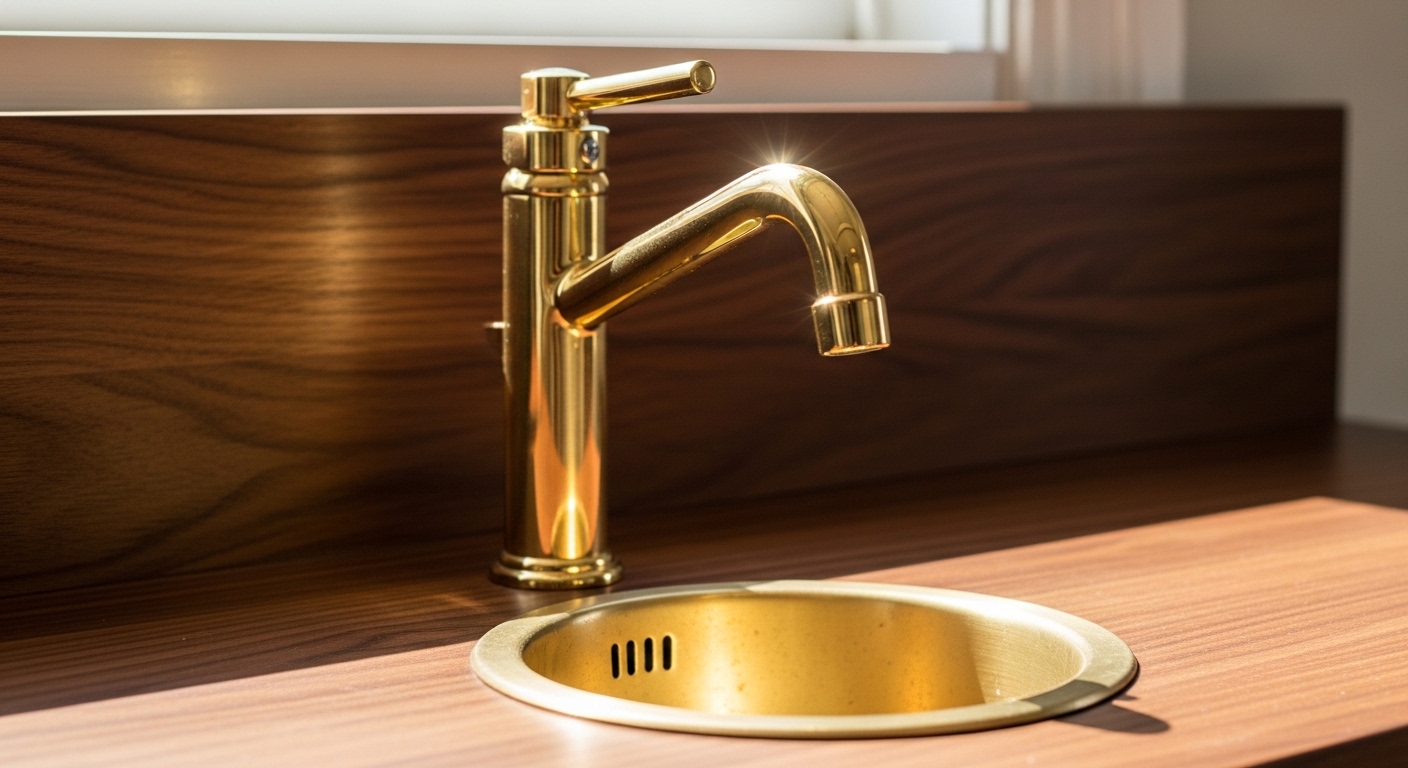
A bar faucet unlacquered brass model is simply a small-scale, single-handle (sometimes bridge-style) prep faucet cast in solid brass with no clear protective coating over the metal. That missing lacquer is the entire story: it’s why the faucet looks warmer than a “brushed gold” PVD finish, why it changes color over time, and why buyers either love it or return it. If you run a bar sink, butler’s pantry, coffee station, or an island prep sink and you’re deciding whether raw brass belongs there, this guide walks through durability, patina, cleaning, water compatibility, sizing, and what you should actually spend.
What does “unlacquered brass” actually mean on a bar faucet?
Unlacquered brass means the brass is left bare — no lacquer, no PVD, no powder coat — so the raw metal is exposed to air, water, and your hands. Every other “brass” or “gold” faucet you’ve seen in a showroom is almost certainly sealed: either lacquered (a thin clear coat) or PVD-plated (a bonded vacuum finish). Those stay shiny and uniform for a decade. Unlacquered brass does the opposite on purpose.
Here’s the practical difference. Sealed brass is frozen in time. Unlacquered brass is alive: within weeks it starts to dull, then it develops darker tones around the base and handle where water sits, and over months to years it settles into a mellow, uneven, antique-gold patina. Some spots stay bright (the parts your hand touches constantly), some go amber, some go nearly brown. That variation is the look people pay for — it’s the reason unlacquered brass reads as “real,” “old-world,” or “heirloom” rather than “brand new from a box.”
It matters that it’s solid brass and not brass-plated zinc. On a raw finish there’s no coating to hide a cheap base metal, so a genuine unlacquered brass faucet is almost always solid brass all the way through — which is also why it’s heavier, more durable, and more expensive than a plated lookalike.
Does unlacquered brass patina too fast for a busy bar sink?
For most bar and prep sinks the patina develops at a comfortable pace — noticeable dulling in 2–4 weeks, a real “aged” look in 6–12 months — because bar sinks simply don’t get the daily punishment a main kitchen faucet does. That lighter duty cycle is exactly why a bar faucet is one of the best places to try unlacquered brass. You get the character without the finish going blotchy in a month.
The speed of the patina depends on three things:
- How often it’s touched. Skin oils are the biggest driver. High-touch handles stay brighter (oils slow oxidation on contact points) while the spout and base darken.
- Your water and air. Hard water, high humidity, and coastal salt air all speed patina and can cause spotting. A dry inland home ages brass slowly and evenly.
- Whether you polish it. This is the part people miss — patina is fully reversible. A few minutes with brass polish (Bar Keepers Friend, Brasso, or a lemon-and-salt paste) brings it back to bright gold whenever you want. You are never “stuck” with the aged look.
So the honest answer: unlacquered brass never traps you. If you love the patina, do nothing. If you miss the shine, polish it. If you want it somewhere in between, polish the spout and leave the base dark. That controllability is the whole appeal, and it’s why the same finish shows up in our roundup of the best bathroom faucet collections as a premium option.
Unlacquered brass vs. lacquered brass vs. PVD gold — which finish should you buy?
Choose unlacquered brass if you want character and are willing to maintain it; choose PVD “brushed gold” if you want a gold look that never changes; choose lacquered brass only if you want shine with less maintenance and accept that the coating will eventually wear. Here’s the direct comparison for a bar or prep faucet.
| Finish | Look over time | Maintenance | Best for | Typical price (bar faucet) |
|---|---|---|---|---|
| Unlacquered brass (raw) | Patinas — dulls, then ambers into antique gold; reversible with polish | None required; optional polishing to restore shine | Character-forward, vintage, farmhouse, “living finish” lovers | $120–$400 |
| Lacquered brass | Stays shiny until the clear coat wears/chips, then patinas unevenly | Low, but coating failure looks blotchy and can’t be polished out | Shine without daily upkeep, lower-touch installs | $110–$350 |
| PVD brushed/satin gold | Essentially permanent — no patina, no change | Wipe clean; nearly maintenance-free | Set-and-forget modern kitchens, rentals, buyers who hate change | $150–$450 |
| Polished chrome (for reference) | Permanent bright silver | Very low | Budget, high-durability, classic | $60–$200 |
The key non-obvious point: a “lacquered brass” faucet is often the worst of both worlds for a working sink. When that lacquer eventually breaks down — and around a wet bar sink it will — you get patina underneath the coating, which looks patchy and cloudy and cannot be polished until you strip the remaining lacquer. Raw unlacquered brass never has that problem because there’s nothing to fail. If you like gold and want zero surprises, PVD is the safe pick; if you like the idea of a finish that tells the story of your home, unlacquered brass is the one. This same finish logic applies to warm metals generally, which is why buyers cross-shop it against a vintage copper tap and against darker warm tones like an oil rubbed bronze fixture.
How do you clean and maintain an unlacquered brass bar faucet?
You don’t have to do anything — that’s the default. To keep it aging evenly, just dry the faucet with a soft cloth after heavy use so water doesn’t pool and spot. To restore shine, use a dedicated brass polish. What you must avoid is abrasive scrubbers and harsh chemicals that gouge or discolor the bare metal.
A simple maintenance routine:
- Daily / do-nothing: Let it patina. Optionally wipe dry after use to reduce water spots around the base.
- Weekly: Wipe with mild dish soap and warm water on a soft cloth. Dry it.
- When you want shine back: Apply Bar Keepers Friend, Brasso, or a DIY paste of lemon juice + salt (or flour + vinegar + salt). Rub with a microfiber cloth, rinse thoroughly, dry completely. Ten minutes brings back full brightness.
- To slow future patina after polishing: A thin coat of carnauba wax or Renaissance Wax buys you a few extra weeks of shine without permanently coating the metal.
Never use steel wool, Magic Erasers, bleach, or bathroom acid cleaners on raw brass — they scratch the surface or cause blotchy discoloration that’s hard to undo. Also avoid leaving citrus, wine, or vinegar splashes sitting on it, since acids etch bright marks into the patina (a real consideration at a bar sink where you’re squeezing limes).
Will unlacquered brass hold up to hard water at a bar sink?
Yes — solid brass is highly corrosion-resistant and won’t rust, but hard water will leave mineral spots and can accelerate patina, so in hard-water homes you’ll either wipe it dry or simply embrace a faster-aging look. Brass is actually one of the best base metals for aggressive water because it doesn’t corrode the way plated zinc or lower-grade metals do.
Two things worth knowing. First, look for a lead-free brass body (compliant with the U.S. Safe Drinking Water Act / NSF-372, ≤0.25% weighted lead) if the faucet dispenses drinking water — most reputable bar faucets, including avamani’s, use certified lead-free brass. Second, if your water is very hard, the mineral spotting is cosmetic, not damaging; it wipes off with the same lemon-and-salt trick above. If hard water is a broader problem in your home, it’s worth pairing the faucet with filtration — our guide to a kitchen tap with a built-in filter covers that side of things.
What size and type of bar faucet should you get for a prep or bar sink?
For a bar or prep sink, choose a single-handle bar faucet with a tall, high-arc spout and a compact footprint — most bar sinks are small (often 15″ or narrower), so you want reach and clearance without an oversized body. Bar faucets are essentially scaled-down kitchen faucets, and the spec that matters most is spout height and reach relative to your little basin.
Quick sizing checklist before you buy:
- Mounting holes: Most bar faucets are single-hole (deck-mount). Confirm your sink or counter has a standard 1⅜” (35mm) hole. If you have extra holes, a base/escutcheon plate covers them.
- Spout height & reach: A high-arc spout (10″–14″ total height) makes rinsing pitchers and cocktail shakers easy. Make sure it doesn’t overshoot a shallow bar basin and splash.
- Handle clearance: Check that the handle has room to lift fully if the faucet sits under a cabinet or against a backsplash.
- Sprayer vs. fixed: Pull-down or swivel spouts help at a prep sink; a fixed gooseneck is cleaner-looking for a pure bar station.
- Valve: A ceramic-disc cartridge is the standard for smooth, drip-free operation and long life.
If you’re matching the bar faucet to a widespread lavatory or a larger kitchen setup elsewhere in the home, keep the finish consistent — an unlacquered brass bar faucet pairs naturally with the same finish on a vanity piece like the Elate widespread faucet, so the whole home reads intentional rather than mismatched.
How much should you spend, and is unlacquered brass a good value?
Expect to pay $120–$400 for a quality solid unlacquered brass bar faucet; under about $100 you’re usually looking at brass-plated metal that will wear through, and over $400 you’re paying for a designer name more than better metal. For a low-use bar sink, mid-range solid brass is the value sweet spot because the raw finish means you never pay to “refinish” it — you just polish.
Value-wise, unlacquered brass ages into looking better rather than out of it. A PVD faucet looks its best on day one and only goes downhill from wear; a raw brass faucet at year five looks like an heirloom, and you didn’t spend a cent maintaining it unless you chose to. That’s a genuinely different ownership curve, and it’s why the finish keeps showing up on premium prep and bar sinks even though it’s “high maintenance” on paper.
FAQ
Will an unlacquered brass bar faucet turn my hands or water green?
No. The dark patina on unlacquered brass is a stable surface oxidation, not the flaking green corrosion (verdigris) you see on old outdoor copper. It won’t rub off on your hands in normal use, and a lead-free brass body won’t affect your drinking water. Verdigris only forms under prolonged, standing-moisture neglect — not from ordinary bar-sink use.
Can I make unlacquered brass stop changing color?
Not permanently, and that’s by design. You can slow it dramatically by polishing and then applying a wax (carnauba or Renaissance Wax), which buys weeks of shine, or you can have a raw faucet professionally clear-coated — but that converts it into a lacquered faucet and removes the “polish it back anytime” benefit. Most owners just let it patina and polish selectively when they want brightness.
Is unlacquered brass the same as antique brass or brushed gold?
No. “Antique brass” and “brushed gold” are usually permanent sealed finishes engineered to look aged or matte, and they never change. Unlacquered brass is bare metal that genuinely changes over time. If a listing says “brass” but promises the finish “won’t tarnish,” it’s coated — true unlacquered brass always tarnishes/patinas because there’s nothing protecting it.
Does an unlacquered brass bar faucet work with hard water?
Yes. Solid brass resists corrosion far better than plated base metals, so hard water won’t damage it. You’ll see mineral spotting and slightly faster patina, both cosmetic and both removable with a lemon-and-salt or Bar Keepers Friend polish. In very hard water, just wipe the faucet dry after use if you want to minimize spotting.
How do I install a single-hole bar faucet myself?
Most single-hole bar faucets install in under an hour with basic tools: shut off the supply, drop the faucet through the 1⅜” deck hole, secure the mounting nut from underneath, connect the hot and cold supply lines with the included braided hoses, then turn the water back on and check for leaks. If you’re new to it, our step-by-step walkthrough on setting up a kitchen faucet yourself applies almost identically to a bar faucet.
Is unlacquered brass a good choice for a rental or resale?
It’s a personal-taste finish, so it’s better for a home you live in than a quick-flip rental. Buyers who love character adore it; buyers who want everything uniform may see the patina as “dirty.” If resale-neutrality matters most, PVD brushed gold or chrome is safer. If you’re staying put and want a fixture with soul, unlacquered brass is one of the most rewarding finishes you can buy.
The bottom line
A bar faucet unlacquered brass finish is the right call when you want a warm, evolving, heirloom-quality fixture at a low-use sink and you’re comfortable with a look that changes — because a bar or prep sink is exactly where that living finish shines without becoming a chore. Buy solid (not plated) lead-free brass, expect a real patina within weeks, and remember you can always polish it back to bright gold in ten minutes. If you’d rather never think about it again, choose PVD gold instead. But if you want the one faucet in the house that looks better every year, this is it.
Author’s note: This guide was written by avamani’s fixtures team, drawing on hands-on testing of unlacquered, lacquered, and PVD faucets in real hard- and soft-water homes. avamani has specialized in kitchen, bath, and bar fixtures for over a decade; our solid-brass bar faucets use certified lead-free brass bodies (NSF/ANSI-372 compliant) and ceramic-disc cartridges, and are backed by a limited lifetime warranty on finish and function. As with any living finish, the patina behavior described here is expected and is not considered a finish defect.