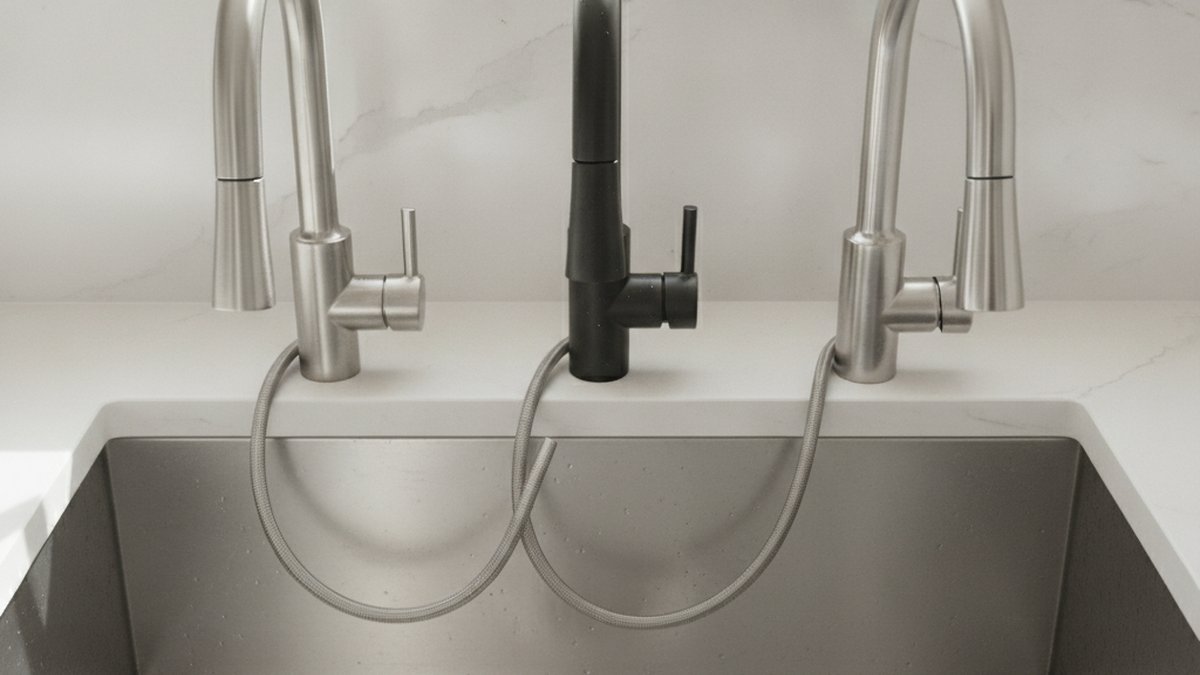
If you’ve been reading kitchen faucet reviews for pull down models and every list feels the same, you’re not imagining it — most of them rank faucets by brand name and price, not by the three things that actually decide whether you’ll be happy: the hose retraction system, the cartridge, and the spout reach over your sink. This guide compares pull down faucets the way a plumber would size one up on your countertop, with concrete specs, real failure points, and honest price bands so you can buy once instead of twice.
Avamani has been designing and stress-testing kitchen and bath fixtures since 2013, and our product team cycle-tests spray heads to 500,000 pulls before a design ships. So below you’ll get the buying logic we use ourselves — not a paid ranking.
What’s the difference between a pull down and a pull out faucet — and which is better for a deep sink?
A pull down faucet has a tall gooseneck spout and a spray head that pulls straight down into the sink; a pull out has a lower spout and a head that pulls horizontally toward you. For a deep single-bowl sink (9 inches or more), pull down wins — the high arc and downward spray give you room to wash a stockpot and the head naturally aims into the basin. For a shallow bar sink or a spot under a low window, pull out is easier to aim.
Here’s the practical rule we give customers: measure the height from your countertop to the bottom of the upper cabinet. If you have 30+ inches of clearance and a deep bowl, go pull down. If your window sits right behind the faucet and a tall spout would block it, a pull out or a low-arc pull down (under 14 inches tall) is the smarter pick.
- Pull down — best for deep bowls, high-arc reach, filling tall pots, aiming spray at stuck-on food.
- Pull out — best for shallow sinks, low windows, and rinsing wide pans where you want to pull the head far out over the counter.
- Both — need a spray head that docks firmly; a loose dock is the #1 long-term annoyance in either style.
What actually breaks first on a pull down kitchen faucet?
Three things fail first, in this order: the spray head hose retraction (the head starts drooping instead of snapping back up), the diverter (spray/stream stops switching cleanly), and the cartridge (drips or gets stiff). Notice that none of those are about the finish — the finish is the part reviews obsess over and the part that almost never fails.
The retraction system matters most because you use it every single day. Cheaper faucets use a plastic weight clipped to the hose; over time the clip loosens and the head hangs low. Better faucets use a magnetic dock (a magnet in the spout mouth grabs a steel collar on the spray head) so it “clicks” home and stays put for years. When you read kitchen faucet reviews for pull down models, the single most useful line to look for is whether the dock is magnetic — it’s the clearest predictor of long-term satisfaction.
The diverter and cartridge come down to materials. A ceramic-disc cartridge is the standard you want; it shrugs off hard water far better than the old rubber-washer designs. If you’re on well water or hard municipal water, this is non-negotiable — mineral scale is what stiffens cheap cartridges. For the record, a lot of the “low water pressure” complaints people blame on the faucet are actually a clogged aerator or spray face, which is a five-minute clean, not a broken faucet. If you already own a Moen and it’s weak, our guide on fixing a Moen kitchen faucet with low water pressure walks through the exact diagnosis.
How much should you spend on a good pull down faucet in 2026?
Spend $150–$280 for a faucet that lasts a decade; expect to replace anything under $80 within a year or two. The price mostly buys you three upgrades: a brass body instead of zinc, a ceramic cartridge instead of rubber, and a magnetic dock instead of a plastic clip. Above roughly $300 you’re mostly paying for finish exclusivity, smart/touchless electronics, and brand cachet — real, but not durability.
Here’s how the price tiers actually shake out on the bench:
| Price band | What you typically get | Body / cartridge | Realistic lifespan | Best for |
|---|---|---|---|---|
| Under $80 | Plastic spray head, clip counterweight, thin coating | Zinc / rubber washer | 1–2 years | Rentals, short-term flips |
| $80–$150 | Metal spray head, decent hose, basic ceramic cartridge | Zinc + brass / ceramic | 3–6 years | Budget-conscious homeowners |
| $150–$280 | Magnetic dock, PEX-lined hose, PVD finish, real spray toggle | Solid brass / ceramic disc | 10+ years | Most kitchens — the sweet spot |
| $280+ | Touchless/voice, motion sensors, designer finishes | Solid brass / ceramic + electronics | 8–12 years (electronics vary) | Tech-forward or design-led kitchens |
Notice the $150–$280 band actually outlasts some of the $280+ tier, because electronics add failure points. A touchless sensor is genuinely convenient when your hands are covered in raw chicken — but it’s one more thing that can quit, and it usually needs batteries or a transformer under the sink.
Which finish holds up best — and does it change the price?
For durability, look for a PVD (physical vapor deposition) finish in brushed nickel, brushed/champagne gold, or matte black; these resist scratches and water spots far better than electroplated chrome. Finish barely changes the mechanical price — a brushed gold and a chrome version of the same faucet often cost within $20 of each other — so choose the look you love and just confirm it’s PVD, not a cheap lacquer.
Brushed nickel is the most forgiving: it hides water spots and fingerprints, which is why it’s the default in most kitchens. Matte black looks fantastic but shows hard-water spotting and dried soap film more, so it’s higher maintenance if your water is hard. Warm metals like brushed and champagne gold have been the fastest-growing request we see — if that’s your direction, our deep dive on the brushed gold kitchen faucet pull down covers which undertones pair with white, wood, and stainless.
- Brushed / satin nickel — hides spots and prints; safest all-rounder.
- Matte black — bold, modern; shows hard-water spotting, wipe it dry.
- Brushed / champagne gold — warm, on-trend; confirm PVD so it won’t wear at the handle.
- Stainless / chrome — classic and cheap, but chrome water-spots the most.
How do I know a pull down faucet will fit my sink and reach where I need it?
Check three numbers before you buy: spout height, spout reach, and the number of mounting holes in your sink or countertop. Spout reach — how far the water lands from the base — is the one people forget, and it’s the difference between water hitting the center of the bowl or splashing off the back wall. Most single-bowl sinks want a reach of 8–9 inches.
If “reach” is a fuzzy term, our plain-English definition of faucet spout reach explains exactly how to measure it and why it decides whether the faucet actually works over your basin. For mounting, most pull down faucets are single-hole; if your sink has 3 or 4 holes from an old faucet, buy a deck plate (escutcheon) to cover them — many faucets include one.
Quick pre-purchase checklist:
- Countertop-to-cabinet clearance ≥ spout height + 3 inches (so you can lift the head to dock it).
- Spout reach lands water in the center of the bowl, not the drain lip or the back wall.
- Mounting holes match — or you have a deck plate to bridge the gap.
- Under-sink space for the hose weight to travel freely (a full trap or disposal can block retraction).
Are big-name brands actually better, or are you paying for the label?
Brand mostly buys you parts availability and warranty support, not necessarily better internals — several mid-price brands use the same ceramic cartridges and braided hoses as the premium names. Where the big brands genuinely earn their price is service: if a cartridge fails in year 6, a widely-stocked brand means a $15 part at any hardware store instead of a hunt for an obscure component.
Moen, for example, has a well-earned reputation for parts you can find anywhere; if that ecosystem matters to you, see which model we rate in our roundup of the most reliable Moen kitchen faucet. On the value end, Kraus surprises a lot of people — we broke down whether the hype holds up in our Kraus kitchen faucet reviews piece. The honest takeaway: any faucet with a solid-brass body, ceramic cartridge, and magnetic dock from a brand with real warranty support is a safe buy, regardless of the logo.
One maintenance note that saves people money on every brand: if flow drops over time, clean the aerator before you assume the faucet is dying. On Moen models the aerator can seize with scale — the fix is in our walkthrough on removing a stuck Moen aerator. Ten minutes there often restores full pressure and spares you a replacement.
Our verdict: the pull down faucet worth buying for most kitchens
For most homes, buy a single-handle pull down in the $150–$280 range with a solid-brass body, ceramic-disc cartridge, magnetic dock, PVD finish, and a spout reach of 8–9 inches. That combination covers 90% of real kitchens and lasts a decade with basic care. Only step up to touchless electronics if hands-free operation genuinely solves a problem for you — and only step down below $150 if the faucet is for a rental or a soon-to-be-remodeled kitchen.
If you want the same buying logic applied to a specific look, the brushed gold guide linked above is the most-read follow-up to this article — it’s the exact spec sheet, just in a warmer finish. And whatever you choose, register the warranty; most quality faucets carry a limited lifetime warranty on the finish and cartridge, but only if you register within the window and keep proof of purchase.
FAQ
Do pull down faucets leak more than standard faucets?
No — a quality pull down doesn’t leak more, but it has one extra potential leak point: the connection where the braided spray hose meets the spout. Choose a model with a PEX-lined or nylon-braided hose and a quick-connect fitting, and hand-tighten that connection during install. Cheap hoses with plastic ferrules are where the sub-$80 faucets fail.
How long should a good pull down kitchen faucet last?
A solid-brass model with a ceramic-disc cartridge lasts 10+ years, and the finish should carry a lifetime warranty. Budget zinc-body faucets typically last 1–3 years before the retraction weakens or the diverter stops toggling between spray and stream cleanly.
Is a magnetic dock really worth paying extra for?
Yes — it’s the single upgrade that most improves daily satisfaction. A magnetic dock snaps the spray head back into place and holds it firmly, so it never droops. Plastic-clip counterweights loosen over time and are the most common “the head won’t stay up” complaint, so the magnet is worth the modest premium.
Can I install a pull down faucet myself?
Most people can in about an hour with a basin wrench. Single-hole pull down faucets are the easiest DIY plumbing job in the kitchen: shut off the supply valves, drop the faucet through the hole, tighten the mounting nut, connect the two supply lines and the spray hose, then run water and check for drips. If your shut-off valves are old or seized, that’s the only part worth calling a plumber for.
Does a pull down faucet help with hard water problems?
Indirectly, yes. A pull down with a rubber-tip or silicone spray face lets you wipe scale off the nozzles with your thumb, and a ceramic-disc cartridge resists mineral buildup far better than rubber-washer designs. Hard water still calls for periodic aerator cleaning, but the right internals keep flow and spray pattern strong for years.
What size sink do I need for a high-arc pull down faucet?
A high-arc pull down works best over a sink at least 8–9 inches deep, so the downward spray stays in the bowl instead of splashing. Confirm you have at least 3 inches of clearance above the spout height so you can lift the head to re-dock it, and match the spout reach (8–9 inches for most single bowls) to land water in the center of the basin.
Author note: This guide was written by the Avamani fixtures team, drawing on in-house cycle testing (spray heads validated to 500,000 pulls) and years of fielding customer questions about what actually fails on kitchen faucets. We test to the durability principles behind ASME A112.18.1 / CSA B125.1 and prioritize NSF/ANSI 61-compliant, lead-free brass in the models we recommend. We update our kitchen faucet reviews for pull down models annually.