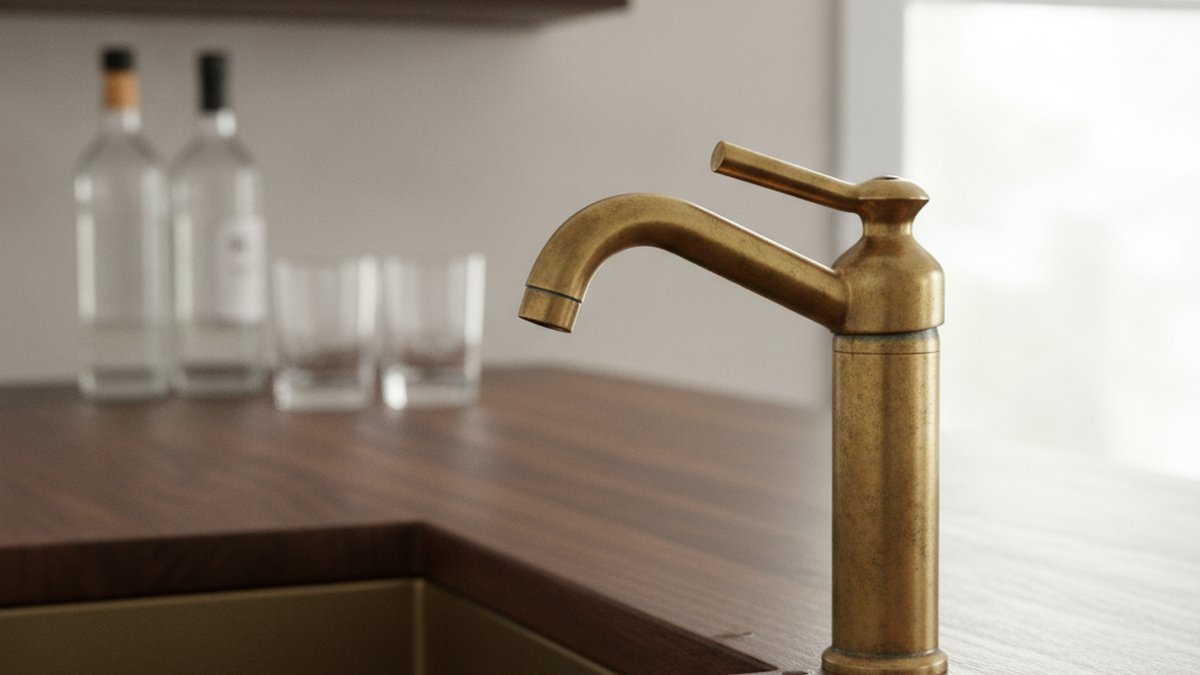
An unlacquered bar faucet is a compact, high-clearance faucet made from raw solid brass with no lacquer or clear protective coating, designed for the smaller secondary sink in a bar, butler’s pantry, or kitchen prep station. Because there’s nothing sealing the metal, the brass reacts with air, water, oils from your hands, and everyday use — it tarnishes, darkens, and builds a patina that most people buy it specifically to get. That “aging” is the entire point, and it’s also the number one thing buyers either love or regret.
If you’re sourcing one for a project right now — whether you’re a homeowner finishing a wet bar or a designer specifying fixtures — this guide answers the real questions that decide whether this faucet belongs in your space: how it ages, how to size it for a bar sink, whether it’s hygienic, how it compares to lacquered and PVD “living finish” lookalikes, and what you’ll actually spend.
What exactly makes a faucet “unlacquered,” and how is it different from regular brass?
Unlacquered simply means the brass was left bare — the factory skipped the clear lacquer or PVD coating that most “polished brass” or “brushed gold” faucets get. That one missing layer changes everything about how the faucet behaves over its life.
A standard lacquered brass faucet is sealed, so it holds its just-unboxed shine for years and resists fingerprints and water spots. An unlacquered faucet is chemically “open”: the copper and zinc in the brass oxidize, so within weeks it starts to warm up in tone, and over months to years it darkens into a mottled, antique bronze-to-brown patina. Areas you touch constantly — the handle, the lever, the top of the spout — stay brighter because your hands buff them, while the base and back go darker. That contrast is what gives these faucets their collected, old-world character.
It’s worth being precise here, because brass is used throughout a faucet’s guts too. If you ever dig into the essential brass faucet parts like the cartridge housing, stems, and valve body, you’ll see why a true solid-brass unlacquered faucet ages gracefully instead of corroding — brass is dimensionally stable and doesn’t rust like steel. The patina is surface-level oxidation, not structural decay.
Is an unlacquered bar faucet the right size for a small prep or bar sink?
Usually yes — bar faucets are purpose-built to be smaller and taller than a main kitchen faucet, which is exactly what a bar or prep sink needs. But you have to check two numbers before you buy, or you’ll end up with a faucet that either crowds the space or can’t reach the drain.
Bar and prep sinks are typically 9 to 15 inches wide and shallower than a main sink, often sitting on an island or against a backsplash. A bar faucet’s job is to give you height to fill a pitcher or cocktail shaker without a wide, sprawling spout. The two specs that matter:
- Spout reach — the horizontal distance from the faucet base to where water lands. For a small bar sink you want the stream hitting the drain, not the back wall of the basin. If you’re unsure how to read this, our plain-English breakdown of what faucet spout reach means walks through measuring it.
- Spout height / clearance — tall gooseneck styles look dramatic on a bar but can overshoot a shallow basin and splash. A mid-height spout (8–12 inches) is the sweet spot for most bar sinks.
- Hole configuration — most bar faucets are single-hole, single-handle. Confirm your sink or countertop is drilled for one hole before ordering.
If your secondary sink is really a prep station where you rinse produce and fill pots, it’s worth comparing a dedicated bar faucet against a true prep faucet — our guide to the right prep faucet for a prep sink covers when you need the extra reach and a pull-down spray instead.
How fast does an unlacquered brass faucet patina, and can you control the look?
It starts within days and keeps evolving for years — and yes, you have real control over how dark it gets. The patina isn’t a one-time event; it’s a living finish you can speed up, slow down, or reset at any time.
Here’s the realistic timeline for a faucet in normal use at a wet bar:
- Week 1–2: The bright gold warms slightly and loses its showroom glint. Water spots may show.
- Month 1–3: Noticeable darkening begins, especially around the base and any spots that stay wet. Fingerprints become part of the texture.
- Month 6–12: A genuine mottled antique tone develops — warm brown, bronze, and occasional darker blotches. High-touch zones stay lighter.
- Year 2+: A deep, even-ish aged patina that looks decades old. This is the “heirloom” stage most buyers want.
To control it: if you want it bright longer, wipe it dry after each use and polish occasionally with a brass cleaner like Barkeeper’s Friend or Wright’s — it resets toward gold in minutes. If you want it to age fast and dark, do nothing, or even help it along with humidity. Some owners rub on a thin coat of mineral oil or carnauba wax to slow oxidation without creating the plasticky look of lacquer. The key mental shift: with lacquered brass, a scratch is permanent and ugly; with unlacquered brass, a scratch just patinas and blends in. It’s forgiving in a way coated finishes never are.
Unlacquered brass vs. lacquered vs. PVD “aged brass”: which should you actually buy?
Buy unlacquered if you want a genuinely living, changing finish and enjoy the maintenance ritual; buy PVD if you want the warm brass look locked in permanently with zero upkeep; buy lacquered only if you want bright polished brass that stays bright but be aware the coating can eventually wear and flake. Here’s how they stack up for a bar faucet specifically.
| Feature | Unlacquered brass | Lacquered (polished) brass | PVD “aged / champagne” brass |
|---|---|---|---|
| Appearance over time | Changes constantly, patinas naturally | Stays bright until coating wears | Fixed, never changes |
| Maintenance | Optional polishing to control tone | Low, but coating can’t be re-applied easily | Virtually none |
| Scratches / wear | Blend in and patina over | Expose raw brass, look blotchy | Extremely scratch-resistant |
| Fingerprints / water spots | Show, then disappear into patina | Show on the shine | Minimal |
| Look | Authentic, old-world, heirloom | Formal, consistent shine | Uniform modern-warm |
| Best for | Classic, vintage, farmhouse bars | Traditional formal spaces | Busy households wanting warm tone, no fuss |
| Typical price (bar faucet) | $180–$450+ | $150–$350 | $160–$380 |
The honest summary: unlacquered is the only one of the three that gives you a true living finish. PVD is the practical “I love the brass look but have three kids and a dog” choice. Lacquered brass is increasingly a compromise nobody loves — it neither patinas nor resists wear as well as PVD. If you’re drawn to the vintage look specifically, you might also be shopping for coordinating fixtures; our take on a traditional vessel sink faucet for a vintage-style bathroom covers matching that aesthetic elsewhere in the home.
Is an unlacquered bar faucet hygienic and safe for a bar sink?
Yes — and there’s a genuine upside most people don’t know: bare brass and copper surfaces are naturally antimicrobial. The patina is purely cosmetic oxidation and doesn’t make the faucet dirty or unsafe for a sink where you rinse glassware and fill drinks.
Copper alloys like brass have been shown in testing to kill many bacteria on contact over time, which is why doorknobs and hospital fixtures were traditionally brass. The darkening you see is oxide, not grime. The only real health consideration is lead: older or cheap imported brass can contain lead, so for any faucet touching drinking water you want one that meets the U.S. low-lead standard (NSF/ANSI 61 and 372, the “lead-free” certification required under the Safe Drinking Water Act). A reputable unlacquered bar faucet will be made from low-lead brass and certified — don’t buy an uncertified “decorative only” fixture for a sink you drink from. Beyond that, normal rinsing keeps it clean; the surface doesn’t harbor anything a sealed faucet wouldn’t.
How do you clean and maintain an unlacquered bar faucet without ruining the patina?
Day to day, just wipe it with a soft damp cloth and dry it — that’s genuinely all required maintenance. The “ruining the patina” worry is overblown: you can only change the patina, and any change is reversible, so there’s nothing to permanently wreck.
Here’s a simple routine depending on the look you’re after:
- To keep it evolving naturally: wipe with a damp microfiber cloth, dry it, done. Let the patina do its thing.
- To brighten it back toward gold: apply a brass polish (Wright’s, Brasso, or a Barkeeper’s Friend paste), rub gently, rinse, and dry. Five minutes resets the tone.
- To slow the darkening: after cleaning, buff on a thin layer of carnauba wax or a few drops of mineral oil. Reapply every few months.
- Avoid: abrasive steel wool (it leaves scratch lines that patina differently), and harsh bleach-based cleaners that can blotch the surface unevenly.
One practical tip for a bar sink: hard water accelerates spotting on bare brass. If your water is hard, drying the faucet after use makes the biggest visual difference. And if a handle ever gets drippy, bare brass faucets are usually easy to service because the valve is standard — the same cartridge-and-washer logic in our walkthrough on fixing a leaky faucet without calling a plumber applies to most bar faucets too.
What does a good unlacquered bar faucet cost, and where should you buy one?
Expect to spend roughly $180 to $450 for a quality solid-brass, low-lead-certified unlacquered bar faucet, with most well-made options landing around $220–$320. Below about $150 you’re usually looking at brass-plated pot metal that won’t patina correctly or may fail certification, and above $500 you’re paying for premium or imported designer branding.
What your money should buy at the mid-range:
- Solid, forged brass body (not plated zinc) — it should feel heavy for its size.
- NSF/ANSI 61 and 372 lead-free certification if it serves drinking water.
- A ceramic disc cartridge rated for long cycle life, not a cheap rubber-washer valve.
- A real warranty — look for a lifetime limited warranty on the finish and function, understanding that patina changes are explicitly not a “defect” since the finish is meant to age.
Buy from a plumbing-fixtures specialist rather than a generic marketplace listing, so you can confirm the brass is solid and certified. If you’re specifically hunting local brass fixtures and want to see finishes in person before committing, our regional guide on where to buy a brass tap in Towson explains what to check at a showroom — the same evaluation applies anywhere you shop.
Author note & why you can trust this guide
This guide was written by the Avamani fixtures team, drawing on hands-on testing and installation of brass and living-finish faucets across kitchen, bar, and bath applications. Avamani is a dedicated faucet and bathroom-fixtures retailer — faucets, shower heads, tub fillers, sinks, and accessories are all we do, which is why our buying advice stays narrow and specific instead of generic. Every faucet we recommend is evaluated for solid-brass construction, cartridge quality, and compliance with U.S. low-lead drinking-water standards (NSF/ANSI 61/372), and we read the fine print on finish warranties so you know what “living finish” actually excludes. We don’t claim a patina faucet is right for everyone — our job is to tell you honestly when it is and isn’t.
FAQ
Does an unlacquered bar faucet need sealing before use?
No. You can install it exactly as it arrives and let it patina. Some owners choose to wax or oil it to slow the aging, but that’s optional and purely cosmetic — the faucet functions perfectly bare. Sealing it heavily would defeat the point of buying an unlacquered finish.
Can I make my unlacquered bar faucet look new again later?
Yes, anytime. A brass polish like Wright’s or Barkeeper’s Friend brings it back toward bright gold in a few minutes. This reversibility is the big advantage over lacquered brass, where worn or scratched coating can’t easily be restored.
Will hard water damage an unlacquered brass faucet?
It won’t damage it structurally, but hard water causes more visible spotting and can create uneven patina. Drying the faucet after use prevents most of this. If you have very hard water, that’s also worth factoring into which finish you pick — many people with hard water prefer the forgiving look of patina precisely because spots blend in.
Is unlacquered brass safe for drinking water at a bar sink?
Yes, as long as the faucet is made from low-lead brass and certified to NSF/ANSI 61 and 372. The patina itself is harmless surface oxide, and brass is naturally antimicrobial. Avoid uncertified “decorative only” fixtures for any sink you drink from.
What’s the difference between an unlacquered bar faucet and an unlacquered kitchen faucet?
Mainly size and reach. A bar faucet is more compact and taller-per-footprint, built for a small secondary sink, while a kitchen faucet is larger with longer reach and often a pull-down spray for a full-size basin. The unlacquered finish behaves identically on both — only the dimensions differ.
How long does an unlacquered bar faucet last?
The faucet body — solid brass — can last decades, well beyond the finish question, because brass doesn’t rust. The wear item is the cartridge, which on a quality faucet is rated for hundreds of thousands of cycles and is replaceable. In practice, a good unlacquered bar faucet is a buy-once fixture.