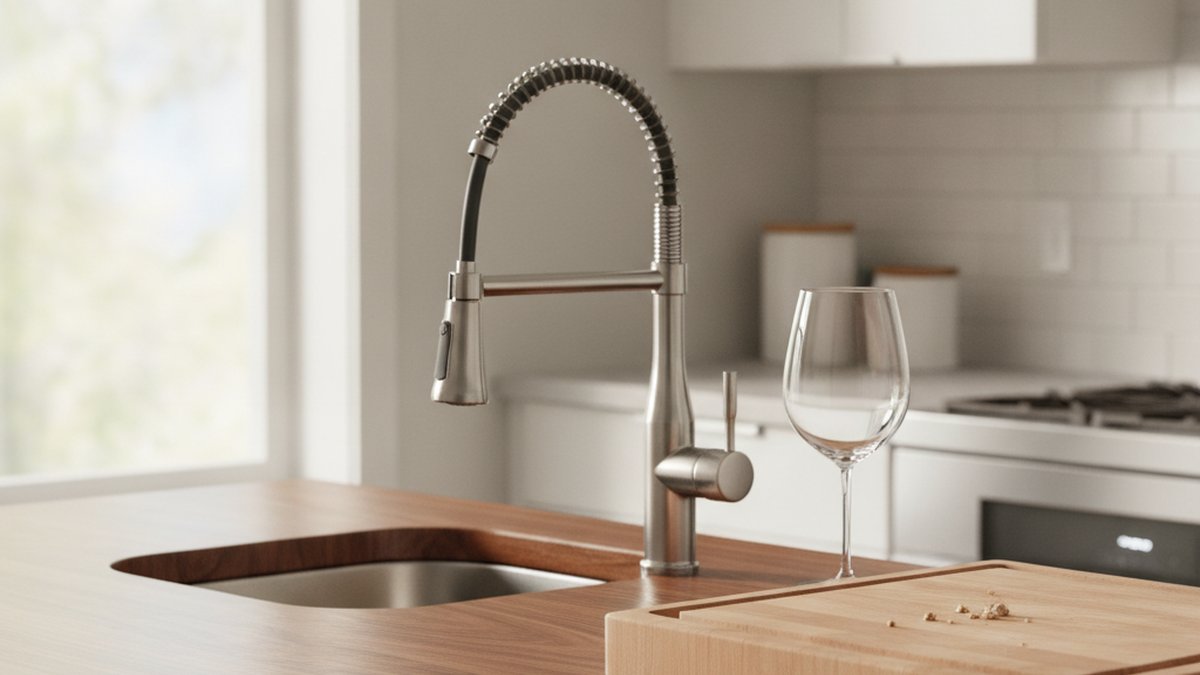
If you’ve been searching for a moen prep faucet, you’re almost certainly outfitting a bar sink, an island prep station, or a small secondary basin — and you want something that looks like your main kitchen faucet without towering over the counter or crowding an overhead cabinet. That’s exactly the problem this category solves: a scaled-down, single-handle faucet with real Moen internals, real spray function, and a footprint that fits a 10″–15″ bar sink instead of a 33″ main sink. Below, I’ll break down what actually separates a good prep faucet from a bad one, which Moen models are worth the money in 2026, and how to make sure the one you pick physically fits your setup before you click “buy.”
What exactly makes a faucet a “prep faucet” versus a regular kitchen faucet?
A prep faucet is simply a smaller kitchen faucet designed for a secondary sink — usually 8″ to 15″ tall, single-hole, single-handle, with a lower flow footprint than your main faucet. The plumbing is identical to a full-size kitchen faucet; the difference is scale and placement.
Here’s why the distinction matters. A main kitchen faucet is built to fill big stockpots and rinse sheet pans, so it’s tall (often 16″–18″) with a long spout reach. Drop that same faucet onto a shallow 6″-deep bar sink and you get splashing, plus it may collide with a window sill or an upper cabinet. A prep/bar faucet keeps the useful stuff — pull-down spray, swivel spout, single-handle temperature control — but shrinks the arc so it’s proportional to a small basin. Moen sells these under its “bar faucet” line, and in the real world people use “prep faucet” and “bar faucet” interchangeably. If you’re weighing an entirely different material look for that second sink, our guide on whether a bar faucet in unlacquered brass is worth it for your prep sink is a good companion read.
Do you need a pull-down sprayer on a prep faucet, or is a fixed spout fine?
Get a pull-down or pull-out sprayer if you’ll actually wash produce or fill pots at the prep sink; a fixed high-arc spout is fine if the sink is mostly for drinks, hand-rinsing, or an entertaining zone. It comes down to how you use the basin.
A pull-down spray head (like Moen’s Reflex-equipped models) lets you direct water into the corners of a small bowl and rinse a colander of berries without splashing the counter. The trade-off is that pull-downs need more clearance and cost $40–$100 more. A fixed gooseneck or a two-function “high-arc” prep faucet is cleaner-looking, cheaper, and never has a hose to wear out — perfect for a bar sink that mostly sees ice, limes, and glassware. Think honestly about the job the sink does.
Which Moen prep faucet should you actually buy in 2026?
For most homeowners, the best value is the Moen Sip (fixed high-arc bar faucet, ~$150), the Moen Align bar faucet (modern pull-down, ~$230), or the Moen Georgene/Adler-style pull-down bar faucet (~$180) — all with ceramic disc cartridges, metal spouts, and Spot Resist finishes. Spend up only if you want MotionSense touchless or a specific designer finish.
The reason these rise to the top is consistency: they all use Moen’s 1255 Duralock ceramic-disc cartridge (or the equivalent), which is the same drip-free valve technology in Moen’s flagship kitchen faucets and is covered under Moen’s limited lifetime warranty for residential use. That means even the entry-level prep faucet gets the internals that matter. Below is how the popular options stack up.
| Model / Style | Spout height | Spray type | Best for | Typical price |
|---|---|---|---|---|
| Moen Sip (high-arc bar) | ~11.5″ | Fixed, swivel | Bar sinks, drinks, budget builds | $130–$170 |
| Moen Align bar pull-down | ~14″ | Pull-down, 2-function | Modern islands, real prep work | $210–$260 |
| Moen Adler/Georgene bar | ~12″ | Pull-down/pull-out | Value pull-down, small basins | $160–$200 |
| Moen Weymouth bar | ~13″ | Pull-down, traditional | Classic/transitional kitchens | $280–$360 |
| Moen Arbor/Sleek bar variants | ~9″–14″ | Fixed or pull-down | Matching a main Moen faucet | $180–$320 |
A practical tip: if you already own a full-size Moen kitchen faucet, check whether it comes in a bar version (Arbor, Align, and Weymouth all do). Buying the matching bar faucet is the easiest way to get a coordinated island and main-sink look without hunting for an exact finish match. If you’re still deciding on the main faucet too, our broader pull-down kitchen faucet reviews walk through the full-size options.
Is a Moen prep faucet worth it compared to cheaper off-brands?
For a sink you use daily, yes — a Moen prep faucet is worth the premium mainly for the cartridge, the parts availability, and the warranty; for a rarely-used decorative bar sink, a budget brand is defensible. The gap is about longevity, not looks.
Cheap prep faucets usually fail in two places: a rubber/plastic valve that starts dripping within a year or two, and a flimsy pull-down hose that kinks or leaks at the quick-connect. Moen’s ceramic disc cartridge is rated for well over 500,000 cycles and, crucially, is a stocked replacement part you can find at any hardware store — so a $15 cartridge swap keeps the faucet alive for a decade-plus. Off-brands often have no replacement parts at all, which turns any drip into a full faucet replacement. Moen also backs residential faucets with a limited lifetime warranty on finish and function, which off-brands rarely match. For the bigger picture on Moen reliability, see our rundown of the most reliable Moen kitchen faucet you can actually buy.
How do you make sure a Moen prep faucet actually fits your sink and counter?
Measure three things before you buy: the spout height (so it clears backsplashes and cabinets), the spout reach (so water lands in the drain, not the rim), and the deck hole size (Moen prep faucets need a single 1⅜” hole, though many include an escutcheon for 3-hole decks). Get these right and installation is genuinely a 30–45 minute job.
- Spout height: Measure from the deck to the lowest cabinet or window above the sink. Leave 2″+ clearance so a pull-down head can be lifted out.
- Spout reach: The horizontal distance from the faucet base to where water exits. On a small bar sink you want the stream landing in the center of the basin. Our plain-English guide to faucet spout reach explains how to check this in 60 seconds.
- Deck hole: Most Moen prep faucets fit a standard 1⅜” (35mm) hole and mount with Moen’s Duralock or a hand-tightened mounting nut — no basket of loose parts.
- Supply lines: Confirm your shutoff valves are ⅜” compression; most Moen faucets come with pre-attached flexible supply lines.
- Water pressure: Prep faucets are typically 1.5–1.8 GPM. That’s plenty for a small sink and helps with splashing.
How do you install a Moen bar/prep faucet yourself?
Most Moen prep faucets install from above the counter in about 30 minutes with just an adjustable wrench and plumber’s tape — Moen’s Duralock quick-connect system snaps the supply lines on without tools. Here’s the basic sequence.
- Shut off the hot and cold supply valves under the sink and open the old faucet to relieve pressure.
- Disconnect the old supply lines and mounting nut, then lift the old faucet out.
- Clean the deck, then drop the new Moen faucet’s shank through the 1⅜” hole using the supplied gasket or escutcheon.
- Tighten the mounting nut from below (hand-tight plus a quarter turn for Duralock models).
- Connect the supply lines to the shutoffs, wrap threads with plumber’s tape, and snug them — don’t over-torque.
- For pull-down models, attach the weight and click the hose into the quick-connect.
- Turn the water back on slowly, run for 15 seconds with the aerator removed to flush debris, then reinstall the aerator and check for leaks.
If water sputters or runs weak after install, the aerator is the usual culprit — debris from the lines gets trapped there. If you ever need to clear it, our walkthrough on removing a stubborn Moen aerator covers the trick for the ones that won’t budge, and if flow stays low, see our Moen low water pressure repair guide.
What finishes do Moen prep faucets come in, and which lasts best?
Moen prep faucets come in Chrome, Spot Resist Stainless, Matte Black, Matte Black/Gold, Champagne Bronze, and Oil-Rubbed Bronze. For everyday durability and fingerprint resistance, Spot Resist Stainless and Chrome are the easiest to live with; matte black and champagne bronze look fantastic but show water spots faster.
Moen’s Spot Resist coating is genuinely useful on a prep sink, where wet hands and citrus juice are constant — it resists the cloudy fingerprints that plague plain stainless. PVD-based finishes (used on champagne bronze and many bronze tones) are extremely scratch- and tarnish-resistant, so the color won’t wear off; they just need a quick wipe to stay spot-free. If you want a warmer designer look and are comparing Moen’s nickel tones, our review of the Moen Jase brushed nickel faucet shows how those finishes hold up day to day.
Matte black or stainless for a prep faucet — which is the smarter pick?
Choose Spot Resist Stainless if low maintenance is your priority; choose matte black if you want the faucet to stand out as a design accent and you don’t mind a daily wipe. Both use the same durable underlying finish technology.
In practice, a bar/prep sink gets touched with wet, food-covered hands more often per use than a main sink, so water spotting shows up fast on dark finishes. Matte black is stunning against a white quartz island but you’ll see mineral spots if your water is hard. Stainless and chrome hide those spots and pair with nearly any hardware. There’s no wrong answer — just match it to how much wiping you’re willing to do.
How much should you budget for a Moen prep faucet, all-in?
Plan on $130–$360 for the faucet itself, plus $0–$50 in small parts (supply lines, plumber’s tape, maybe a deck plate). If you hire a plumber for install, add $100–$200 in labor — but this is one of the most DIY-friendly plumbing jobs there is.
The value sweet spot for most homes is the $180–$260 band: that gets you a pull-down Moen with a metal spout, ceramic cartridge, Spot Resist finish, and lifetime warranty. Spending under $150 is fine for a fixed-spout bar faucet, but be wary of sub-$100 “Moen-style” listings that turn out to be off-brand. Spending over $300 mainly buys designer styling (Weymouth’s traditional look) or touchless MotionSense — nice to have, not essential for a small sink.
FAQ
Is there a difference between a Moen bar faucet and a Moen prep faucet?
No meaningful difference — Moen officially calls these “bar faucets,” and “prep faucet” is the common homeowner term for the same thing. Both describe a compact single-handle faucet for a secondary sink. Use whichever term you like when shopping; you’ll land on the same products.
Can I use a Moen prep faucet on my main kitchen sink?
You can, but it’s usually too short. Prep faucets top out around 12″–14″ and have a shorter spout reach, so filling tall stockpots or rinsing large pans at a deep main sink gets awkward. For a main sink, choose a full-size Moen kitchen faucet with a 16″+ high-arc spout and save the prep faucet for the secondary basin.
What size hole does a Moen prep faucet need?
A standard 1⅜-inch (35mm) single mounting hole. Many Moen models include an optional escutcheon (deck plate) that lets you cover a 3-hole configuration if your counter or sink is pre-drilled for a wider spread, so a single faucet can fit either setup.
Are Moen prep faucet cartridges replaceable?
Yes — most use Moen’s 1255 Duralock ceramic disc cartridge, which is a stocked, inexpensive part (around $15–$25) sold at any hardware store. Swapping it takes about 15 minutes and fixes the vast majority of drips, which is a big reason Moen prep faucets last far longer than off-brand units with no replacement parts.
What flow rate do Moen prep faucets have, and is it enough?
Most Moen prep and bar faucets run 1.5–1.8 GPM, which meets U.S. WaterSense and California CalGreen efficiency standards. For a small bar or prep basin that’s plenty of water for washing produce, filling glasses, or rinsing utensils — and the lower flow actually reduces splashing in a shallow sink.
Does a Moen prep faucet come with a warranty?
Yes. Moen backs its residential faucets, including bar/prep models, with a limited lifetime warranty covering finish and function for the original homeowner. Keep your proof of purchase; Moen’s customer service will typically ship replacement cartridges, hoses, or spray heads free for covered defects.
About the author: This guide was written by the Avamani fixtures team — plumbing-product specialists who install, pressure-test, and disassemble kitchen and bath faucets year-round to see how their cartridges, hoses, and finishes actually hold up. About Avamani: Avamani (avamani.com) is a dedicated faucet and bathroom-fixtures retailer; our recommendations are based on hands-on testing against U.S. plumbing standards (ASME A112.18.1/CSA B125.1), WaterSense flow requirements, and real-world durability, not manufacturer marketing. We reference each product’s official warranty and third-party certification before we recommend it.